

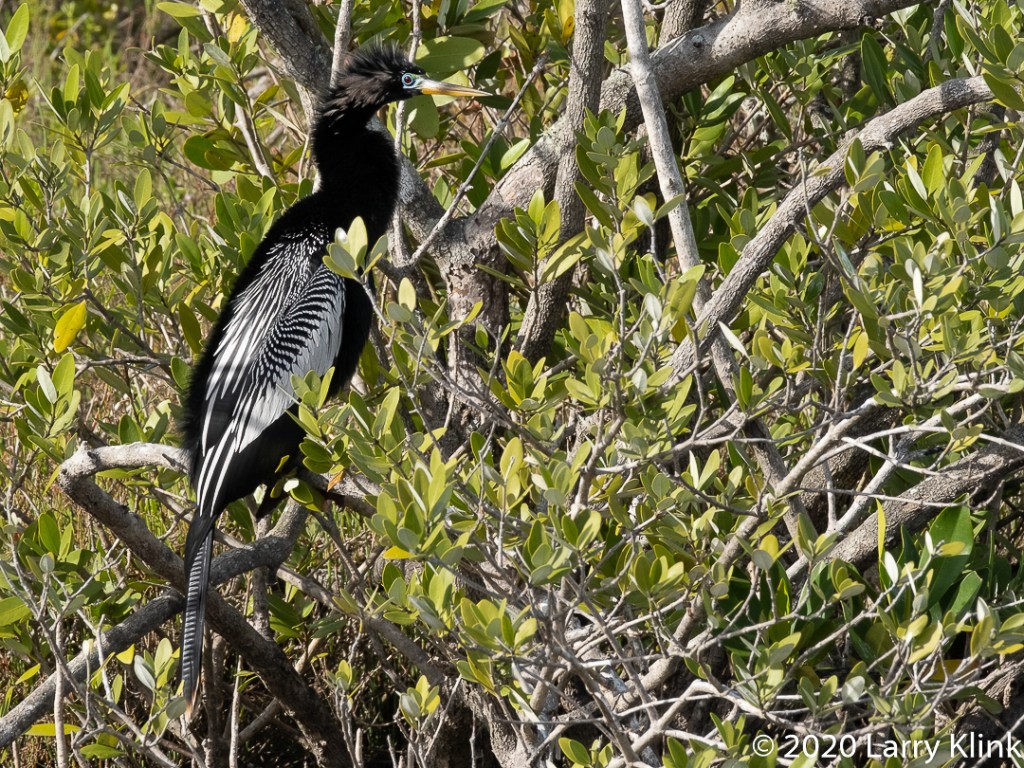
Blue eye ring indicates readiness to breed.
Merritt Island National Wildlife Refuge, Titusville, FL; FEB 2020
The Anhinga is water bird that looks like a Cormorant but are not Cormorants. Anhinga’s have a more dagger-like beak and longer tails. Like a Cormorant, they swim partially submerged when foraging for food. Typically, we see only their head and snake-like neck above the water line. When I see them, it reminds me of one of the iconic “Nessie” pictures. The name Anhinga comes from the Brazilian Tupi language, meaning snake bird or devil bird. They mostly eat fish which they spear with their dagger-like beak.
Anhingas are found along the coasts of Southeastern US, Mexico, Central America and the Caribbean. They nest in colonies with Herons, Egrets and Cormorants.
Night Herons are medium sized herons that forage mostly at night. In this post, I have images of both the Black-crowned Night Heron and the Yellow-crowned Night Heron.
The Black-crowned Night Heron is found in wetlands across most of the North America, though some winter over in Mexico and Central America. They forage in early morning and evening where they feed on a wide variety of fresh water and marine animals. They nest in colonies with other Black-crowned Night Herons.
The Yellow-crowned Night Heron is found mostly along the Atlantic coast of Florida and along North America’s Gulf coast, though some do move much further inland to breed. They are also found along the coasts of Mexico, Central America and the Caribbean.
The Yellow-crowned Night Heron feeds mostly on crustaceans. They nest alone or in colonies with others of their kind.
Info from: All About Birds by Cornell Labs
Note: Please click on caption to see image at higher resolution.
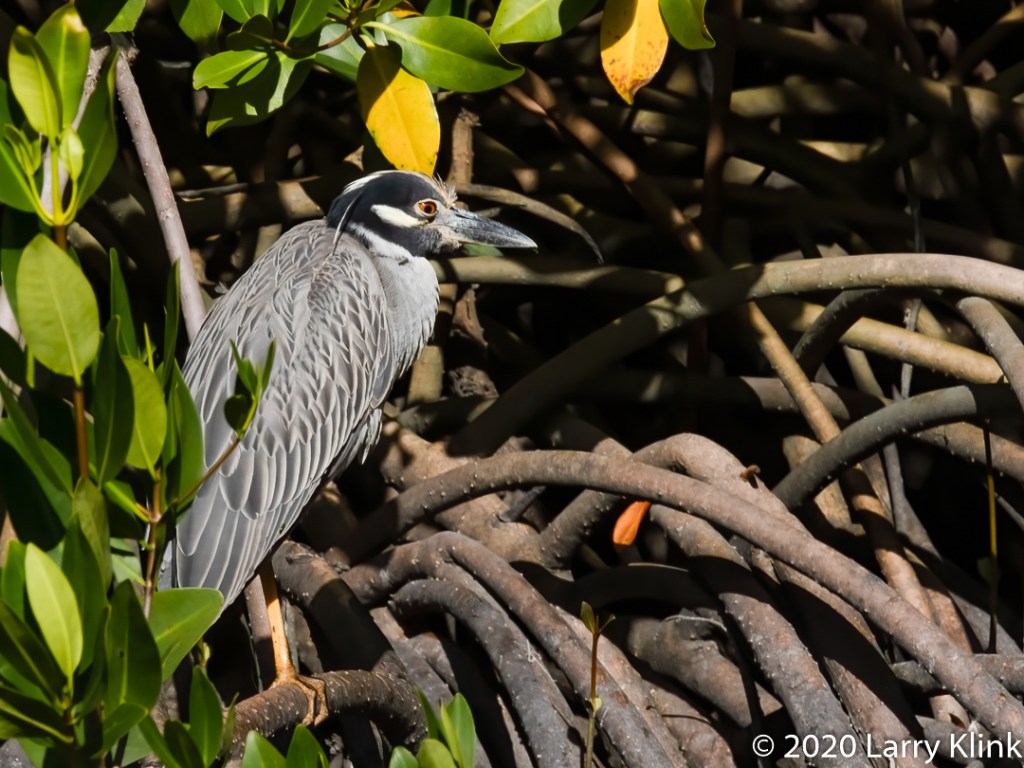
J N “Ding” Darling National Wildlife Refuge; Sanibel Island, FL; FEB 2020

Six Mile Cypress Preserve, Fort Meyers, FL; FEB 2020
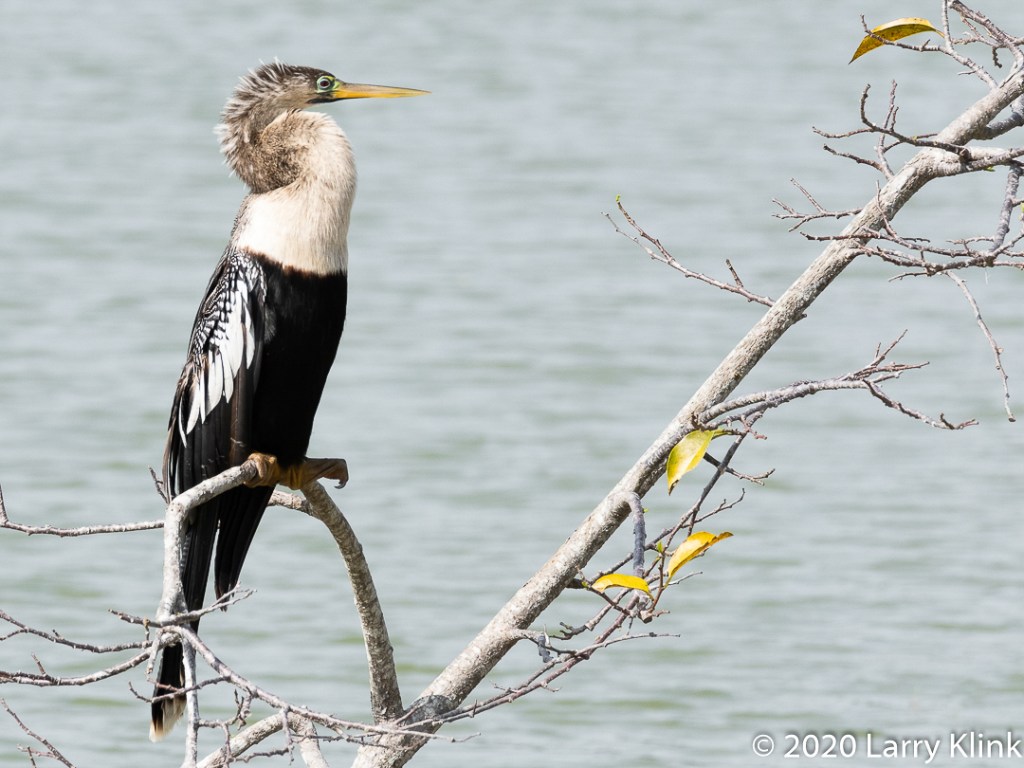
Green-blue eye ring indicates readiness to breed.
Lakes Park, Fort Meyers, FL; FEB 2020
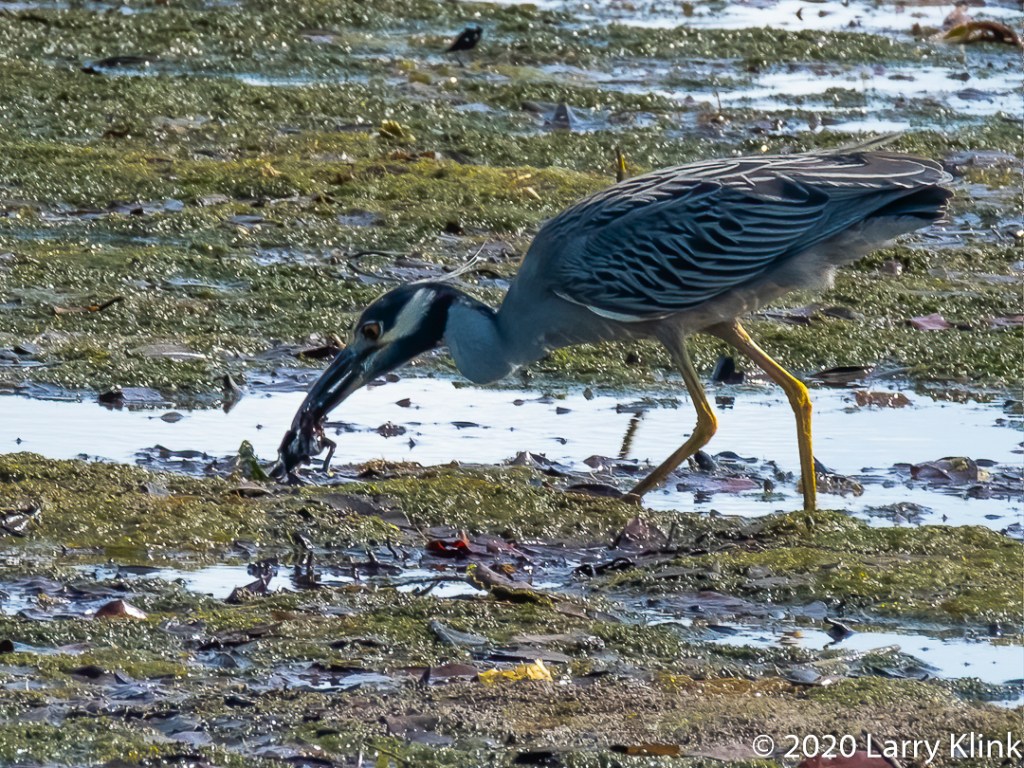
J N “Ding” Darling National Wildlife Refuge; Sanibel Island, FL; FEB 2020

Sanibel Island, FL; FEB 2020

Green-blue eye ring indicates readiness to breed. Lakes Park, Fort Meyers, FL; FEB 2020
Please visit my website, www.earthwatcher.us to see my collection of landscapes and wildlife.
These and other images are available to purchase by contacting larry.klink@earthwatcher.us.
 Earthwatcher