

Death Valley is an amazing place. Especially for those of us who love the desert. In fact, the only thing missing is the sandworms. Donna and I visited Death Valley last week. We arrived the evening after a deluge – 0.5” of rain in a short period of time; slightly more than 20% of its annual rainfall. Water flowing from the box canyons washed debris over many of the roads closing most of the tourist spots.
-
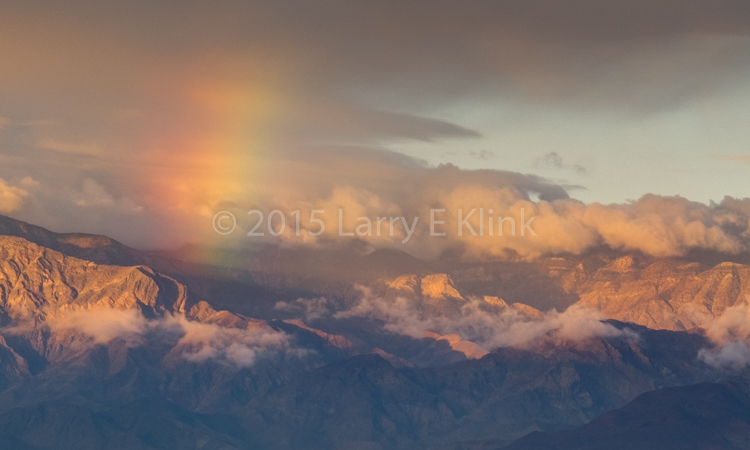
Sunrise over Zabriske Point complete with a marvelous rainbow. Death Valley, Zabriske Point, OCT 2015.
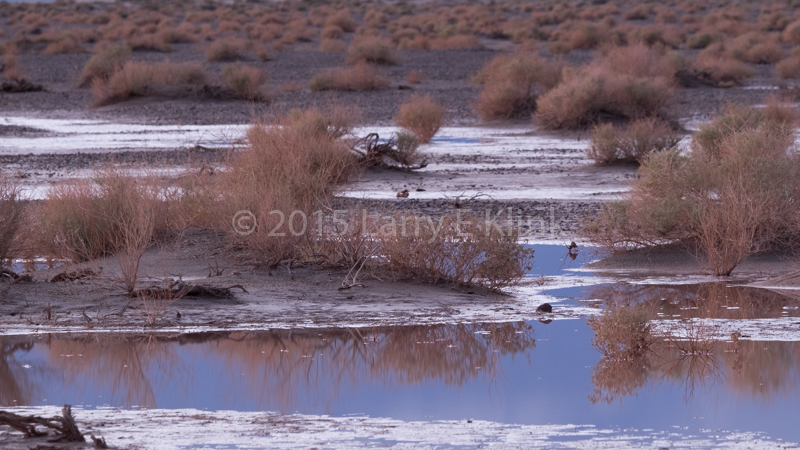
Water was left standing in some of the playas, lake beds where water flows in but not out; an unusual site for most visits. Fortunately, 2 of our favorite spots, Zabriske Point and Mesquite Dunes were accessible.
Zabriske Point is the go to place for a sunrise. The sun rises behind you and over your shoulder, casting an alpenglow onto the mountains on the far side of the valley. If you are lucky, there will be a few clouds over the far mountains and you can watch the sky turn from orange and magenta to gold and then white. It was Donna’s birthday. God was smiling upon her that day. The thick cloud cover from the previous day’s storm was breaking up. We got the beautiful color we had hoped for. But, in addition, we got a marvelous rainbow. It was an unforgettable moment.
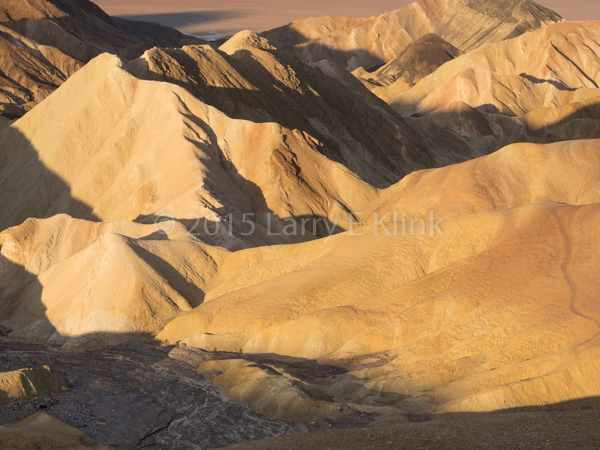
TV and movies give us a picture of the desert as hot, dry, sandy, flat; sometimes with sand dunes. But, much of the desert, in the Great Basin of the western US, is gravely, gray-brown, clay sediment deposited when run off from glaciers made the basins inland lakes and earlier when it was part of an inland sea. It was supplemented by run-off from the surrounding mountains. It is sparsely populated by vegetation, some fragrant and colorful. Zabriske Point is composed of sediments from Furnace Creek Lake, which dried up 5 million years ago. The sediment is painted by minerals and is heavily eroded by water washing down from the Black Mountains over untold millennia. This activity left behind a sculptural landscape, badlands, of muted earth tones. On this morning, after the storm, there was water was standing in both the erosion channels and in the normally dry playas in the valley below.
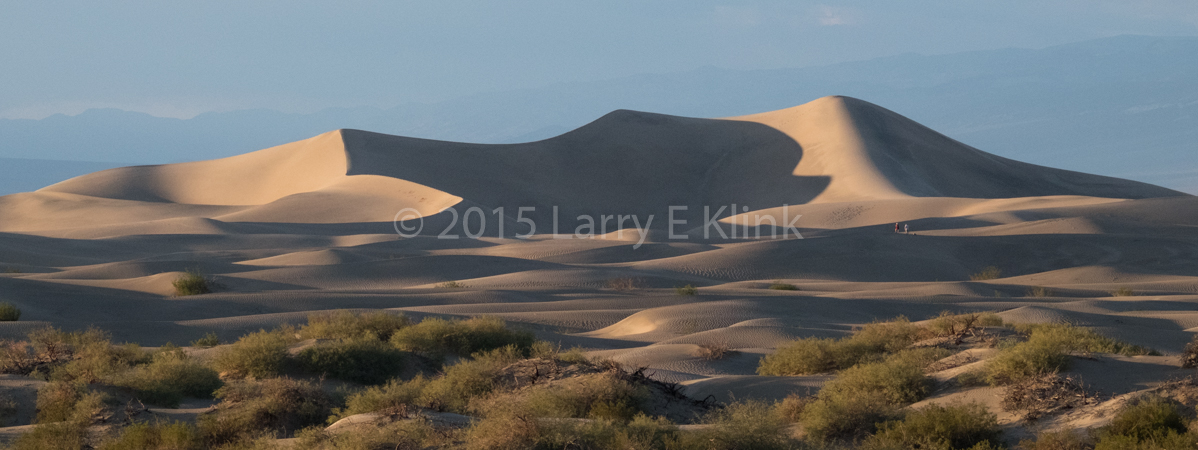
I’ve photographed Mesquite Dunes at sunrise and sunset. Sunset seems to be the better time; especially later in the sunset when the wind carved dunes cast shadows that are deep and long. To me, the shapes created by the light and dark areas provide a texture reminiscent of a cubist painting by Picasso. It’s fun to watch the light play on the dunes as the sun sets. Shapes and textures change; color changes; all in ways that stimulate the imagination.

I hope you enjoy these images from our day in Death Valley. Please share them with your friends.

Regards,
Larry
These and other images are available for sale by contacting me at larry@earthwatcehr.us or on my web site: www.earthwatcher.us.
 Earthwatcher