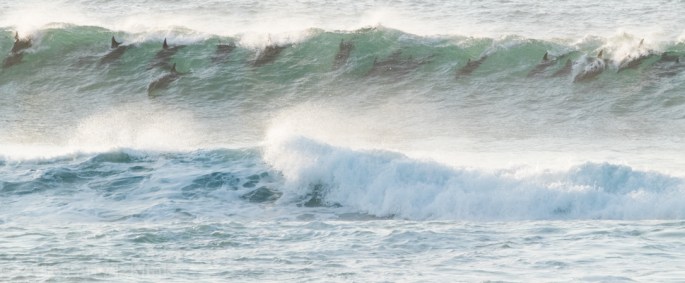
Mboyti River Lodge, Lusikisiki, South Africa, AUG 2016
Sometimes you are lucky and are at the right place and right time. We spent one night at Mboyti River Lodge, Lusikisiki, South Africa; a lovely place along the Indian Ocean coast. I got up early in the morning hoping to get a nice sunrise shot. I did and will share it later. I found a nice spot, on a small embankment overlooking the ocean. As I scanned the ocean, I saw a few dolphins. Over the next few minutes a whole pod showed up – probably 30 of them. I have wanted a shot of the dolphins in the surf line for a long time. This morning, they put on a great show for me. I hope you enjoy this image.
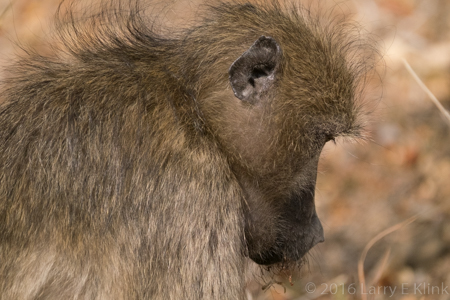
Pensive Baboon, Kruger National Park, South Africa, AUG 2016
My wife says that Baboons are wretched creatures. They look like monkeys but have an unsettling grunt and 3 inch canine teeth. When we stayed at Elephant Plains Game Lodge, we were awoken each morning by their unnerving growls that sounded like they were right outside our door and on our roof. The Leopard’s growl wasn’t as unsettling as the Baboon’s.
Baboons are very smart; especially when it comes to acquiring food. We were warned to keep our doors locked because they can open doors and will trash your room looking for food. At one stop, I watched a baboon open a garbage can and grab some leftovers. We were also warned that they will grab bags you may be carrying or steal food from your table.
Though they can be a fearsome nuisance, they are also fun to watch. They are fellow primates and I could see some of us in them. We watched them jumping and chasing each other through trees and over rocks. We watched them groom each other and care for their young. Wretched, maybe. Scary, sometimes. Interesting and fun to watch, absolutely.
I hope you enjoy these images.
Regards,
Larry
Note: Images can be viewed at a larger size by clicking on image.
Infant Baboon, Kruger National Park, South Africa, AUG 2016Grooming Little Baboon, Kruger National Park, South Africa, AUG 2016Baboon – Perspective 3, Kruger National Park, South Africa, AUG 2016
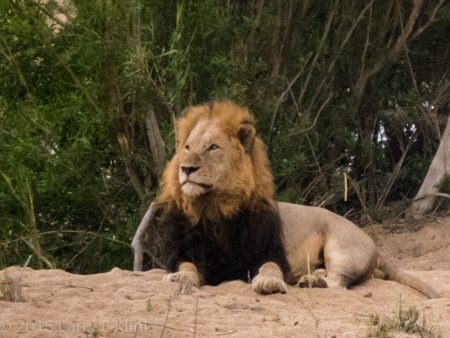
Coalition of Male Lions, Elephant Plains Game Lodge, Sabi Sands, South Africa
We had 4 lion sightings on our trip. Unfortunately, on the best opportunity, a female babysitting the pride’s cubs, I had to shoot through the windshield because we couldn’t get a good position. As is expected, lions draw big crowds and lot of folks beat us to the site. So, with that, I’ll tell you that my lion images aren’t of the quality I typically post. I posted them more because I thought they would be interesting.
Except for the cubs, lions like to lay down and sleep most of the time. Our first encounter was with 3 males. Except for one who took a few minutes to look at us, they all laid down and closed their eyes as if we weren’t there. The best shots came at night, in Kruger, when we encountered a mating pair. When mating, the male and female roam together, away from the pride, for three days. We watched and photographed them for 15-20 minutes before they walked off into the bush.
By the way, I learned something about lions while I was there. A pride of lions is a group of females and cubs. They have a territory but live in a territory that is controlled by a coalition of male lions; usually brothers. One male in the coalition is the alpha.
I hope you find these shots interesting. Again, my apologies on the quality.
Regards
Larry
Note: Click on image to view it in a larger size
Female Lion with Cubs, Kruger National Park, South Africa, AUG 2016Male Lion, Kruger National Park, South Africa, AUG 2016Mating Pair – Perspective 1, Kruger National Park, South Africa, AUG 2016Mating Pair – Perspective 2, Kruger National Park, South Africa, AUG 2016
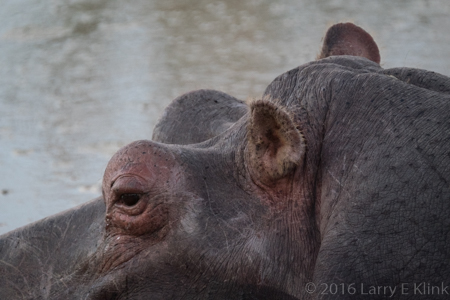
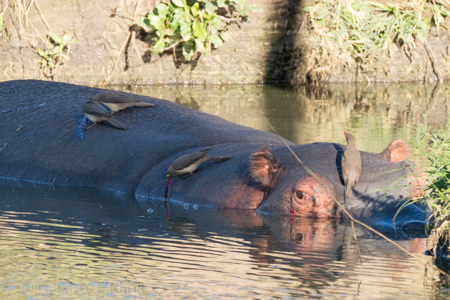
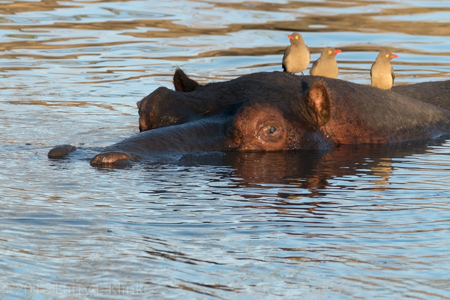
The Pensive Hippo, Elephant Plains Game Lodge, Sabi Sands, South Africa
I was very surprised by the number of hippopotamus we saw on our visit to South Africa. I expected to see some but their numbers really surprised me. As we travelled and spoke with guides/rangers we learned that despite what we saw this year has been devastating for the hippo population. Drought has dried up rivers and significantly impacted the amount of grass available for foraging. Typical hippo behavior is to spend the daytime hours in the water and forage at night. They also spend time on the shore sunbathing in the warm sun. Drought has forced them to travel further distances to find food and, in some cases, they just aren’t finding enough.
With water in short supply, maintaining a place to drink and soak during the day is important. In the game lodges, as well as in Kruger, we saw many man made water holes filled by pumping groundwater. Many were filled with pumps driven by windmills. These water holes are a win-win. They provide water for animals and a place for tourists to visit and watch them. Part of me rails against such an unnatural arrangement, but in the end, I am alright with it. It’s part of the vicious cycle: tourists come to see animals in the wild, animals need habitat and protection, habitat and protection costs money, tourists bring money.
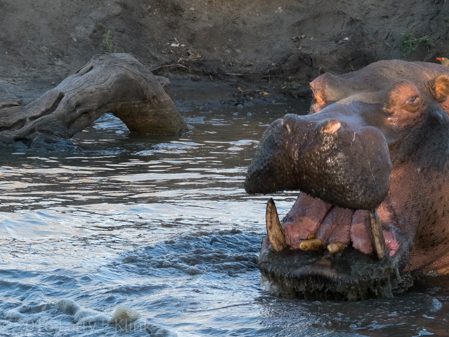
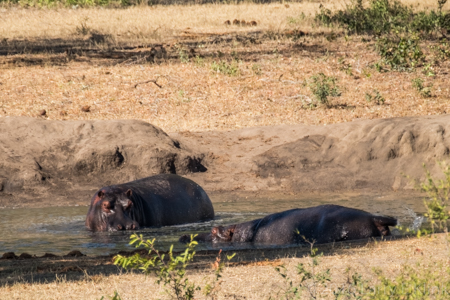
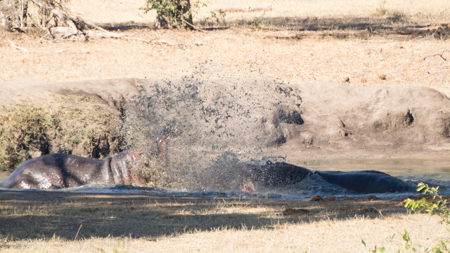
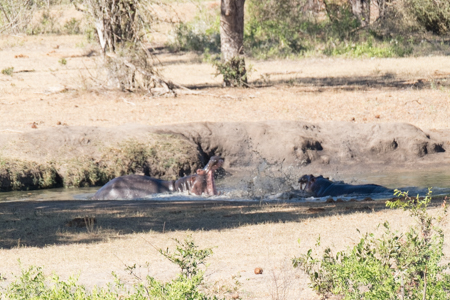
There is an older hippo who claims the water hole at Elephant Plains Game Lodge as his own. While were there, the hippo returned from foraging to find another male had moved in. A fight ensued. Hippo fights are noisy affairs accompanied by wide stretched jaws and attacks with sharp teeth. They fight until one backs down or is killed.
One of the iconic pictures of hippos and rhinos shows them with the oxpecker bird on their backs. The relationship is symbiotic but benefits the bird more than the hippo or rhino. The oxpecker eats ticks on the beast but also eats fly larvae that grow in the wounds incurred by these animals.
I hope you enjoy these hippo images. Please look closely at the battle pictures. These beasts can be very scary and aggressive.
Regards,
Larry
Note: The images can be seen in larger size by clicking on the image or by visiting the Hippos Gallery on my website: https://larryklink.smugmug.com/South-African-Adventure-2016/Hippos/
Don’t Mess With Me, Elephant Plains Game Lodge, Sabi Sands, South AfricaHe returned from foraging and found another male inhabitng his water hole. He gave his warning. Elephant Plains Game Lodge, Sabi Sands, South AfricaThe Face Off, Elephant Plains Game Lodge, Sabi Sands, South AfricaThe Challenge, Elephant Plains Game Lodge, Sabi Sands, South AfricaThe Round is Underway, Elephant Plains Game Lodge, Sabi Sands, South AfricaThe Round Continues, Elephant Plains Game Lodge, Sabi Sands, South AfricaAttack and Defense, Elephant Plains Game Lodge, Sabi Sands, South AfricaThe Battle is Over, After many rounds, the battle is over, the challenger is vanquished. Elephant Plains Game Lodge, Sabi Sands, South AfricaTime to Relax, Hippo and Oxpecker, Elephant Plains Game Lodge, Sabi Sands, South AfricaSunbathing, Kruger National Park, South Africa, AUG 2016Foraging Hippo, Kruger National Park, South Africa, AUG 2016Hippo in Reflection, Kruger National Park, South Africa, AUG 2016
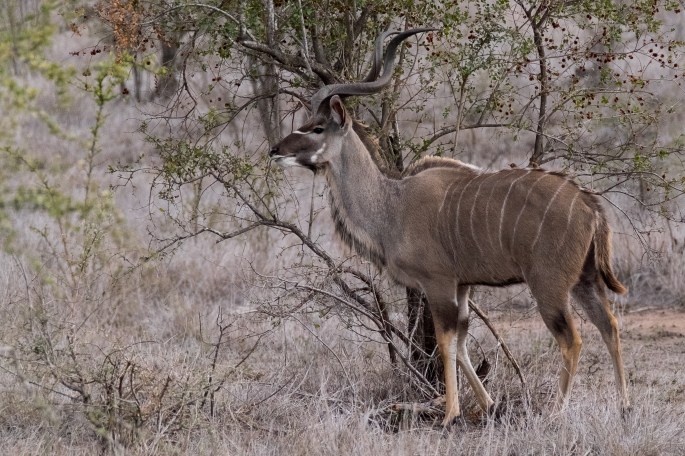
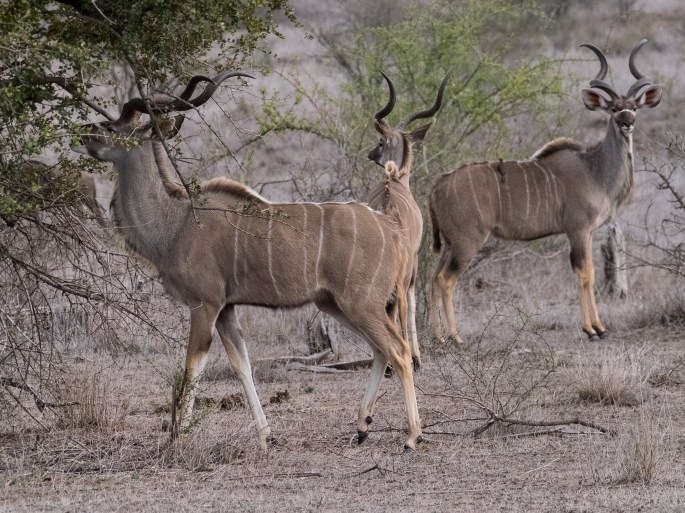
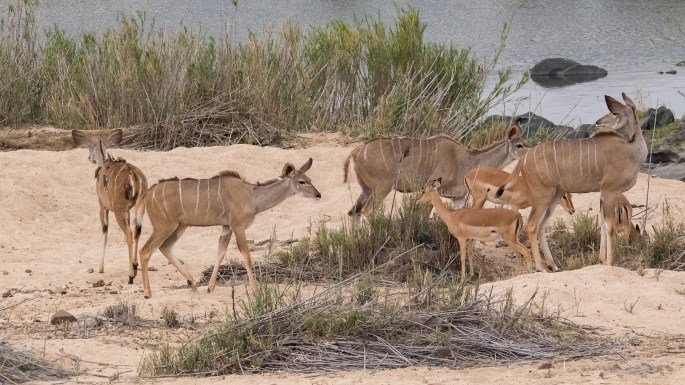
When I left for South Africa, I knew that I would see a lot of magnificent wildlife; it did not disappoint. I knew also that I would see antelope though I really didn’t think much of it, my thoughts were on lions, leopards, rhinos and the like. Then I saw the Kudu. To my surprise, I was really smitten by its beauty. It is an antelope, about the size of an elk, with long, twisted horns. Its face is lama like. It has a small hump and a mane. Like the moose, it seems to be constructed from parts of different animals. I hope you find it as beautiful as I do.
Regards
Larry
Kruger National Park, South Africa, AUG 2016Kruger National Park, South Africa, AUG 2016Kruger National Park, South Africa, AUG 2016Addo Elephant Park, South Africa, AUG 2016
Black Sands Beach, Bonita Cove, Marin Headlands, Marin County, CA, FEB 2015
Almost a year and half ago, my friend Richard Bieniek took a day trip to the Marin Headlands outside of San Francisco. The Headlands are the area north and west of the Golden Gate Bridge that border on the ocean. It was a beautiful day. The sun was almost blindingly bright. The waves were tall and strong. As we walked down the steep that was path cut into the cliff side, you could hear the waves thunder before you could even see them. When we reached the small, sandy beach in the cove, the unfolding scene was remarkable. It was mid—afternoon. The sun was so bright it caused strong silvery reflections on the water. Those reflections contrasted with the deep shadows in the surrounding rock. As the waves approached, they gave the impression of a wall of water coming right at you. The scene was full of energy. Though difficult, I knew I had to share the story of what I saw.
I hope this image gives you that picture because it was wonderful to behold.
How Did I Process This Image
Those of us who shoot with a DSLR will recognize the difficulty in capturing this image. The dynamic range, the difference in exposure needed to display some detail in the shadows while not blowing away the highlights in this image is well outside the capabilities of most cameras. The obvious answer is HDR. However, that requires 3 identical images with exposures about 2 stops apart. The problem is that the ocean won’t stand still and pose long enough to make that happen. I might have chosen to blur the waves but that would have defeated one of my main objectives, to show the energy of the scene.
As you can see from the histogram in this this screenshot below, I exposed the image to minimize both the black and white clipping thus minimizing the loss of detail in both shadows and highlights. However, the digital negative is very dark. Despite many hours of trying, there was no way get a good image just manipulating the sliders and using other features of Lightroom. I had to rely on HDR. I made 3 virtual copies of the digital negative in Adobe Lightroom. I opened the exposure of 1 copy about as far as I dare; about ¾ of a stop. I made one of the others about 2 stops brighter and the other about 2 stops darker than the first. I opened the 3 copies in Photomatrix to merge them into a single HDR image. I chose the option that gave me the best, most realistic image I could find. I made a few minor tweaks and created the final HDR image. But even that created an image where the foam in the foreground churn was dark and dingy. I couldn’t open the exposure, the highlights or the whites. It would cause the ocean to blow out and lose the silvery reflection. So, I finished the image using Lightroom’s paintbrush to open the exposure on just that section of the image. I believe it worked.
My wife, brother, sister-in-law and I took a trip to the Eastern Sierra and the desert of the Great Basin. I remember a trip to Yosemite and down Rte. 395 seeing the snow capped Sierra for the first time. It was an incredible experience. In the intervening years we have experienced drought. The snow left the mountains early causing the rivers to slow early. The beauty is always there but, it’s not as spectacular as when we get lots of snow and rain. This year we got a respite from the drought so the drive down 395 regained much of its splendor. We were treated to scenes from romantic westerns; large mountain valleys, ringed with high snowcapped peaks, cattle grazing on lush green grass. I felt like I should be on a horse with Hoss and Little Joe. The rivers were running hard, churning white water that glistened in the sun. At Yosemite, the waterfalls thundered.
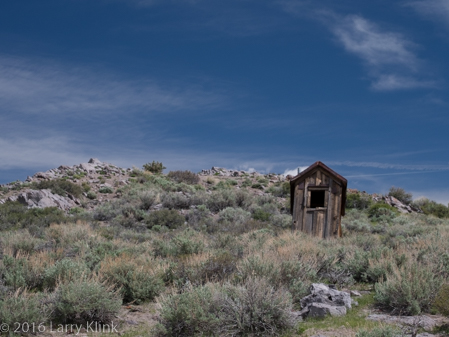
As we travel south on Rte. 395 we reach a point where the terrain transitions from mountain valleys to the valleys of the high desert. The grass goes away and is replaced by gnarled shrub. Even the vegetation along the rivers is stunted. With this year’s rain and snow, the area took on a different look. The wildflower blooms in Bodie were near their end but, stalks retained their spring green, creating a strong contrast against the brown buildings and deep blue sky.
Outhouse on a Hill, Bodie, CA, MAY 2016
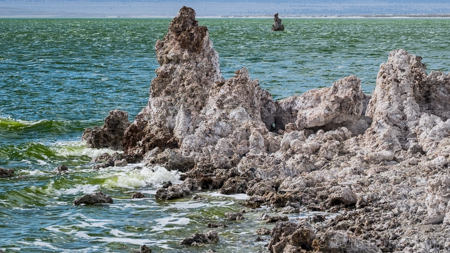
Mono Lake had a hue of emerald green instead of aqua. The lake color, along with the spring greens of its vegetation gave the tufa a softer, cooler gray color and gave a green cast to the air. The winds were very strong that day. They created white caps along with waves that crashed against the tufa and broke along the shore.
Mono Lake, South Tufa Reserve, May 2016
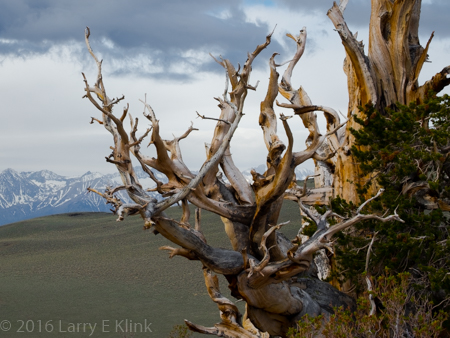
The strong winds followed us to the Ancient Bristlecone Pine Forest where we had planned an early morning hike along the Methuselah Trail. We had to cancel the hike because the wind chill was really bad. We hiked the shorter Discovery Trail instead. The trail was clear but snow patches dotted the adjacent hillsides. The sun peeked through openings in the overcast sky highlighting the sculptural bristlecones and the mountains in the distance.
Schullman Grove, Ancient Bristlecone Pine Forest, MAY 2016
From the bristlecones, we made our way to Death Valley. Spring was in the desert air also. Wildflowers of yellow and white were in bloom along the road. The Joshua Trees were budding but not quite ready to open. Even the cholla cactus was putting on its spring display.
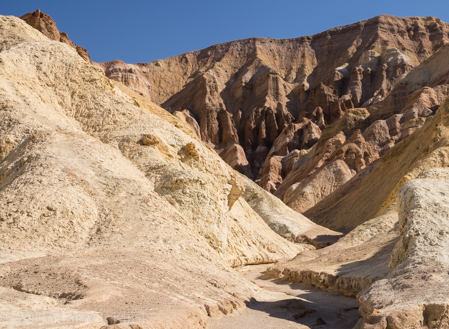
My brother and sister-in-law were taken aback by Death Valley. Like me, they were raised in the eastern US. We saw deserts only in movies. They were areas where sand dunes stretched from horizon to horizon; a place where people rode camels and hung out at an oasis with palm trees. Instead, Death Valley is a typical valley in the basin and range ecosystem. It is long and narrow and ringed with high mountains. It’s hard, gray-brown soil is dotted with gnarled vegetation and rocks that washed down from the mountainsides during storms. But even it was showing signs of spring. Some of the normally dry playas contained water. Tiny wildflowers, mostly yellow, were in bloom. We hiked back Golden Canyon and we watched a sunrise at Zabriske Point. The strongly eroded mountainsides, painted by mineral deposits are always a treat to see especially under the golden sunlight of a sunrise from Zabriske.
Golden Canyon, Death Valley National Park, May 2016
We continued our journey to Lone Pine, CA. Along the way, we chuckled at 2 coyotes working the tourists at a pull-off in Panamint Valley – Will pose of food.
The Alabama Hills are located near Lone Pine. They are oddly eroded, twisted rocks, at the base of Mt Whitney. They were used as the set for many Hollywood productions of western and other adventure movies. Those of us who were fans of Roy Rogers, Gene Autrey, Hopalong Cassidy and the other cowboy protagonists of our childhood would find those hills familiar. Lone Pine also houses the Lone Pine Film History Museum. It holds memorabilia from movies produced in that area. It was fun to see the fancy saddles and guns, stagecoaches and even some monsters and space aliens. It was fun to reminisce also.
The final part of this journey took us to Yosemite. Our plans were to go across Tioga Pass but a snowfall the night before closed it. We had to detour. The detour took us on Rte. 88 from Sorenson’s to Jackson; a stretch we’ve never driven. It was a beautiful drive over granite balds, along steep sided canyons and past mountain lakes. We found a new place to explore for photo opportunities.
Yosemite is at its most beautiful in the spring. Waterfalls thundered, the Merced River churned white water, ephemeral waterfalls were still flowing. We were only able to visit the valley. Even Glacier Point was closed due to “impending storm”. But wondering through the valley is a joy. The immense scale, with waterfalls crashing over sheer granite cliffs towering 3,000 feet and more above your head, drive home the power and awesomeness of nature’s forces and God’s creativity. I am always awe-struck by its beauty. It never gets tiring.
Bridal Veil Falls, Yosemite National Park, May 2016
I hope my images and words give you a sense of spring in Northern California. Stay tuned for Part 2 of our adventure.
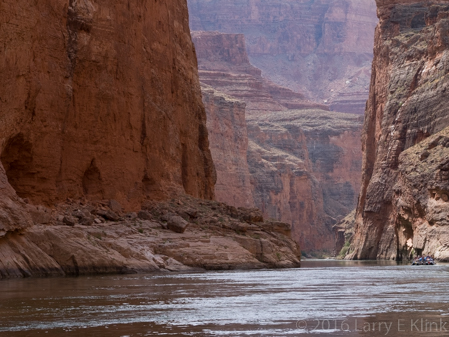
I had an amazing experience; five days rafting through the Grand Canyon on the Colorado River. Many thanks to Gary Hart (http://www.garyhartphotography.com/), who organized the trip, and to Western River Outfitters (http://www.westernriver.com/), who conducted it. Their professionalism, efficiency, and energy made the trip great fun, great adventure, and an unforgettable experience.
The trip began with a flight over the Colorado Plateau to Marble Canyon, AZ where we packed up and entered the river at a spot called Lee’s Ferry. We traveled 180 miles through Marble Canyon and the Grand Canyon. At Whitmore Wash we were helicoptered out to Bar 10 ranch then back to Las Vegas by small plane. After spending time on the river, the return flight gave me an opportunity to connect some dots: I could see the relief of the canyon and view the beds of the feeder rivers as they travelled to the slot canyons and into the Colorado. We travelled on motorized rafts that were 5 heavy duty vinyl pontoons lashed together with ropes. Each of the pontoons was about 25 feet long and 3 feet in diameter. Our food, camping gear, and personal items were piled on, covered, and tied down on 2 platforms lashed to the pontoons. We camped on sandbars along the river; some under the stars, others in tents.
My first impression took me back to adventure stories where a team of intrepid explorers entered an unknown and unexplored area looking for the fabled lost city and its people. The narrow gorge through weathered, high walled canyons, felt imposing. The patterns on the rock reminded me of ancient statuary that weathered away. It left me wondering where the door to the ancient city, the one that is only revealed at sunset on the summer solstice, is located.
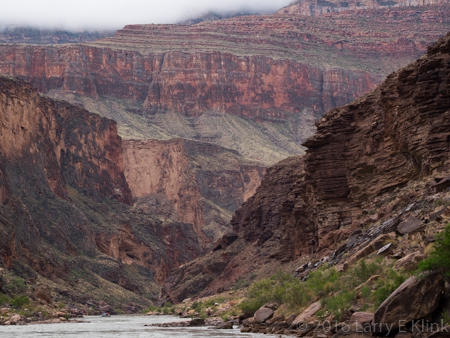
The geology was fascinating. Over the course of our trip, our elevation changed by 1,700 feet. When we entered Marble Canyon, we were between walls of the red-orange limestone layer that forms the roof top of the canyons. As we travelled through the canyon, progressively deeper layers were exposed until we came to the basement layer of granite which underlies the canyon. At places, nearly 2 billion years of earth’s history lay exposed for us to see.
To top off all of this beauty we even got to have fun running the rapids. There were many rapids. Most of them were small ripples. Two of them were really wild rides. Several more were big enough to be exciting. As we approached the rapids, you could see choppy white water ahead. The swells that had already broken smoothed out to a jello-like surface and reflected gold on top of the green river. As the driver turned the raft into the swells the swells would lift the raft and drop it down or the raft would nose dive and dig into the swell. Sometimes a wave would hit from the side. Regardless, water sprayed up, soaking us. As we held on, braving the bucking and twisting, we laughed like little kids. I was anxious about this part of the trip, not really knowing what to expect. Having done it, I wouldn’t trade the experience.
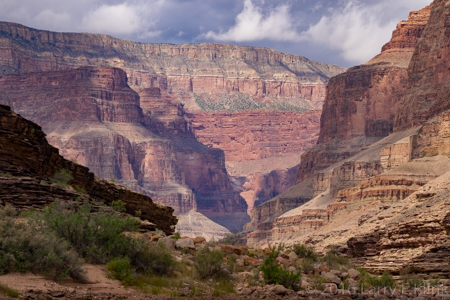
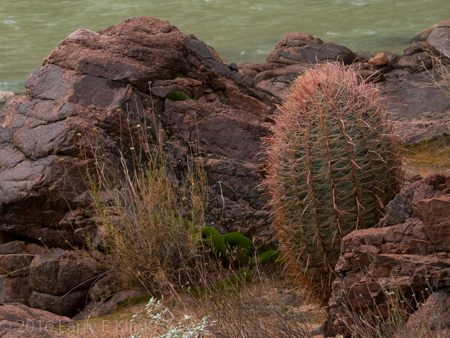
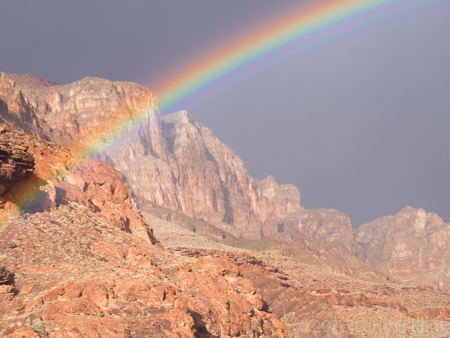
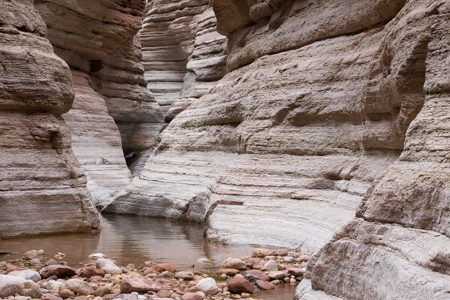
Visiting the rim or flying over the canyon will give you an appreciation of its magnificence. But running the river brings it up close and personal. Look up and see cliff walls rising thousands of feet or see the layers set back, one upon the other, rising into the sky. Look at the walls and see swirls of fossilized sand dunes or rock walls that look like layers of stacked stone; some horizontal, some tilted at an angle. Vegetation invaded the weathered red-orange limestone giving the appearance of terraced gardens. In other places cacti and brush dotted hillsides of black and brown in no particular pattern. Still other areas were painted in earth tones of tan, brown, pink and green. We hiked back slot canyons to see running streams and waterfalls that have carved the sidewalls and brought debris to the canyon floor. We were even lucky enough to see some of the wildlife that inhabits the canyon: condors flying high above, big horn sheep climbing canyon walls, swallows swooping over the rapids to catch bugs and even a heron. I have difficulty finding words to describe how it felt to be among those ancient walls. Walls that were created by the deposition of silt and the remains of creatures at the bottom of a great sea, uplifted when plates of the earth’s crust crashed into each other and finally sculpted by the forces of wind and rain into the natural wonder that was presented to me each day of the trip. Wonder and awe aren’t expressive enough.
I hope the images I’ve included give you sense of what I felt as I traveled through the natural wonder that is the Grand Canyon.
My wife, my mother and I decided to visit Daffodil Hill, a beautiful spring attraction in Amador County, CA. After the visit, we decided to wander some of the lesser traveled roads in rural El Dorado and Placer counties; an area where my wife spent a lot of time during her childhood. As we wandered, we crossed a small bridge spanning the North Fork of the Cosumnes River. The Cosumnes is a 52 mile long river starting as 3 forks in the Sierra Nevada, eventually merging with other rivers and flowing into the San Francisco Bay by way of the Sacramento/San Juaquin delta. We were somewhere along the North Fork near Somerset, CA. The recent rain and snow, brought on by the El Nino, has given us a brief respite from the years of drought. The river was flowing rapidly through this shallow gorge. The morning sun filtered through the forest, highlighting the bright spring green of life reawakening.
I hope you enjoy these 2 perspectives of this beautiful canyon.
With an impending trip to Kruger National Park in South Africa, this year is shaping up to be a year where I concentrate on wildlife. My love has always been more intimate landscapes, so I truly enjoy the opportunities to shoot wildlife in the context of a landscape. Last weekend, I had the opportunity to visit the San Diego Zoo Safari Park, an 1,800 acre wildlife sanctuary that displays animals in large open enclosures where they can roam and exercise. Though the animals are the highlight, it is landscaped beautifully and is well worth a visit. I hope to get back sometime and spend more time photographing both the landscapes and the wildlife.
On this visit, it was overcast and rainy. Even so, the wildlife was out and active. I hope you enjoy these images from my visit.
Larger images of these and other wildlife can be seen at my Birds, Wildlife and Insects gallery on my website: http://www.earthwatcher.us.























 Earthwatcher