Swans

Trumpeter Swan (Cygnus Buccinator)
Swan Lake Flat, Yellowstone National Park; SEP 2018

Today I am sharing images of swans I’ve photographed over the past several years.

Trumpeter Swans (Cygnus Buccinator) are North America’s largest waterfowl. Thy can have a 6 foot wingspan and weigh as much as 26 pounds. According to All About Birds, a Website from Cornell Labs: “They breed on wetlands in remote Alaska, Canada, and the northwestern U.S., and winter on ice-free coastal and inland waters.” The odd thing here is that I found some on the icy Yellowstone River in February.

The Tundra Swan (Cygnus Columbianus) is a winter migrant to the US. We see them winter over on the Pacific Flyway from late October through about the end of February. They nest on arctic tundra. The Tundra Swan is sometimes called a Whistling Swan.

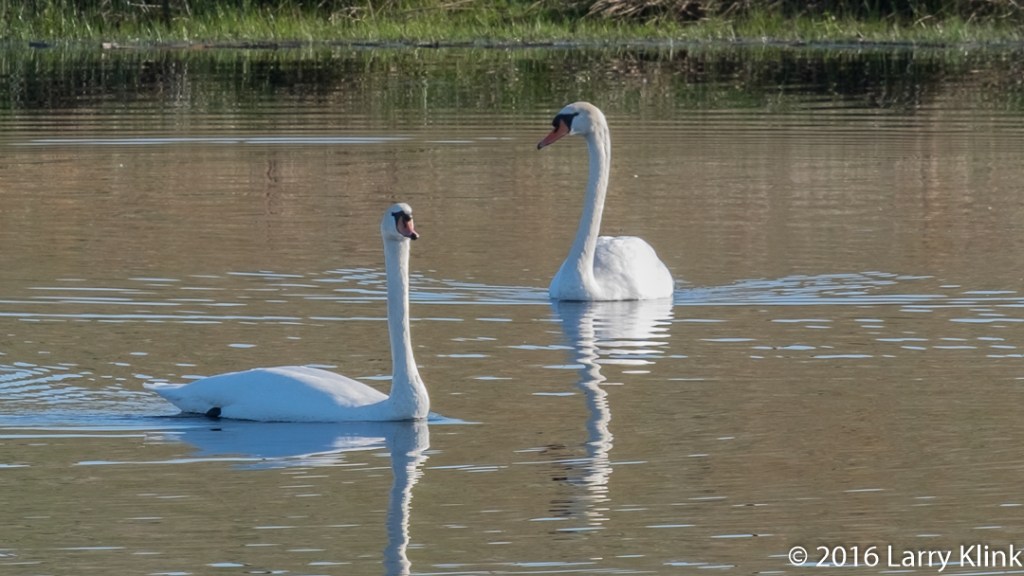
The Mute Swan (Cygnus Olor) is not native to North America; it’s a European immigrant. It is the swan we see in ponds and lakes at parks, farms and estates. According to All About Birds: “ All of the Mute Swans in North America descended from swans imported from Europe from the mid 1800s through early 1900s to adorn large estates, city parks, and zoos. Escapees established breeding populations and are now established in the Northeast, Mid-Atlantic, Great Lakes, and Pacific Northwest of the U.S.” The ones I am presenting may be from a wild colony or may be feral.

I found the Whooper Swans (Cygnus cygnus) in Iceland. According to Wikipedia, Whooper swans can migrate hundreds or even thousands of miles to their wintering sites in southern Europe and eastern Asia. They breed in subarctic Eurasia. Icelandic Whooper Swans breed and winter over in the United Kingdom and Ireland. They can have a wingspan of 9 feet and weigh over 30 pounds. Whooper Swans pair for life.

Please click on caption to see image at higher resolution.
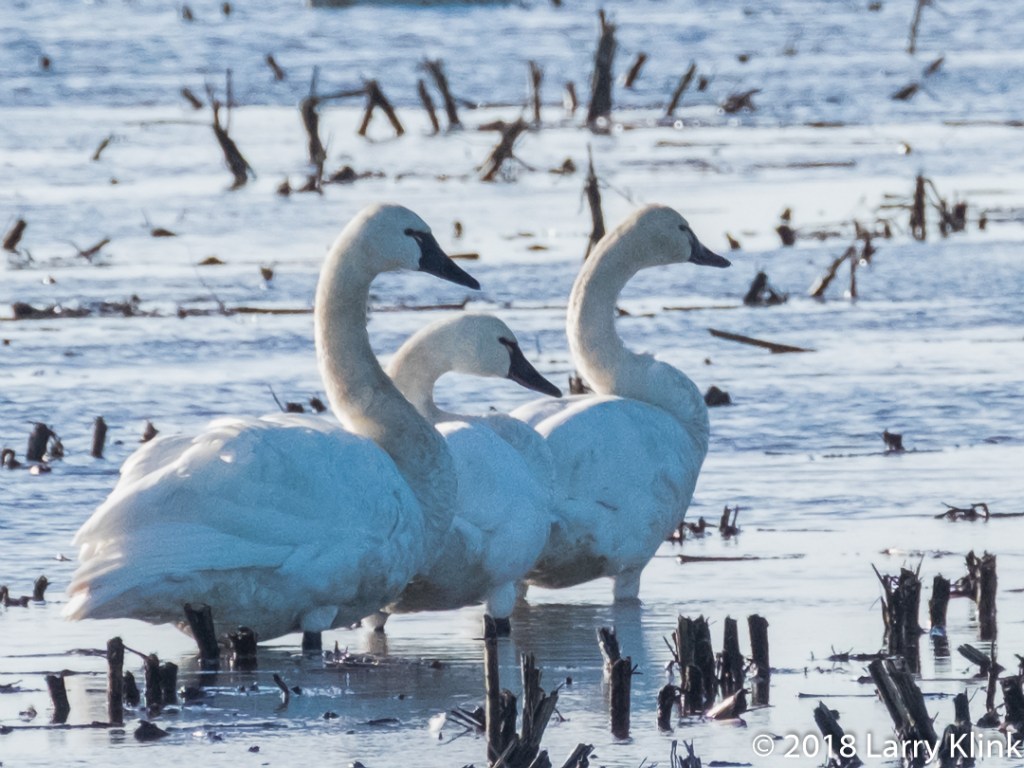
Tundra Swans (Cygnus Columbianus)
Staten Island Road, Galt, CA; JAN 2018
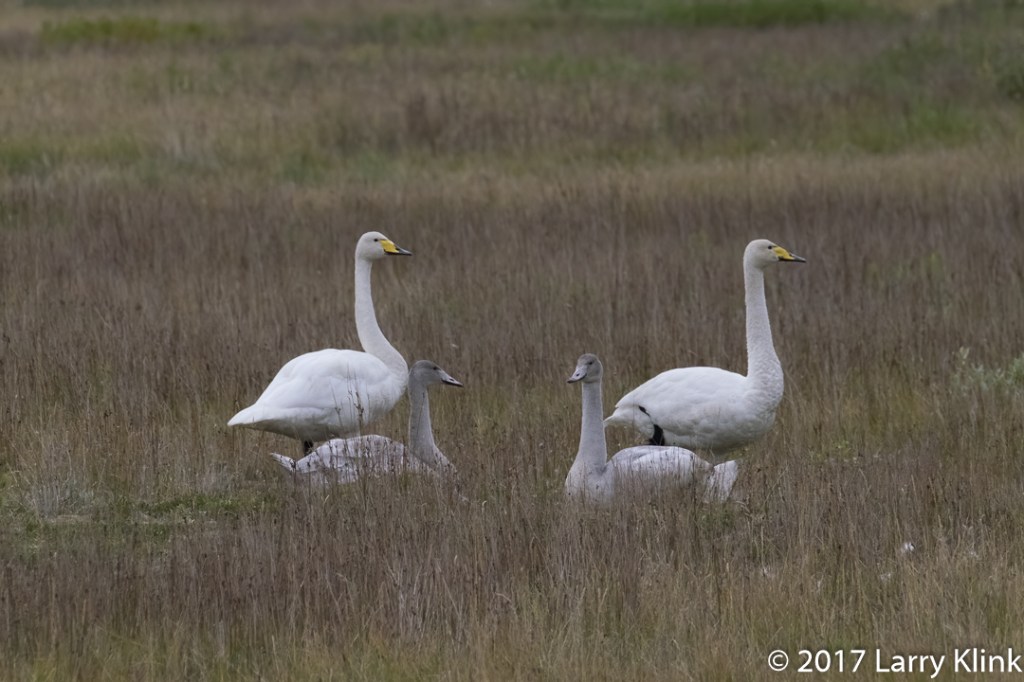
Whooper Swans (Cygnus cygnus)
South Coast of Iceland; SEP 2017
Mute Swan (Cygnus Olor)
Scott Road, Folsom, CA; FEB 2016
Trumpeter Swans (Cygnus Buccinator) – P1
Yellowstone River, Yellowstone National Park, WY, FEB 2013
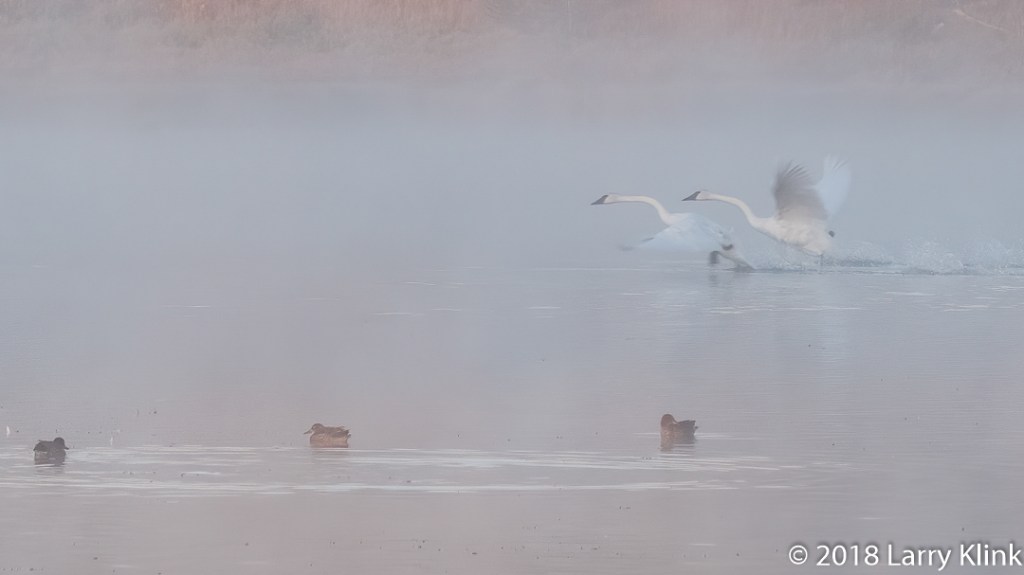
Trumpeter Swans (Cygnus Buccinator)
Swan Lake Flat, Yellowstone National Park; SEP 2018
Mute Swan (Cygnus Olor) – P2
Willow Creek Recreation Area, Folsom, CA; OCT 2019
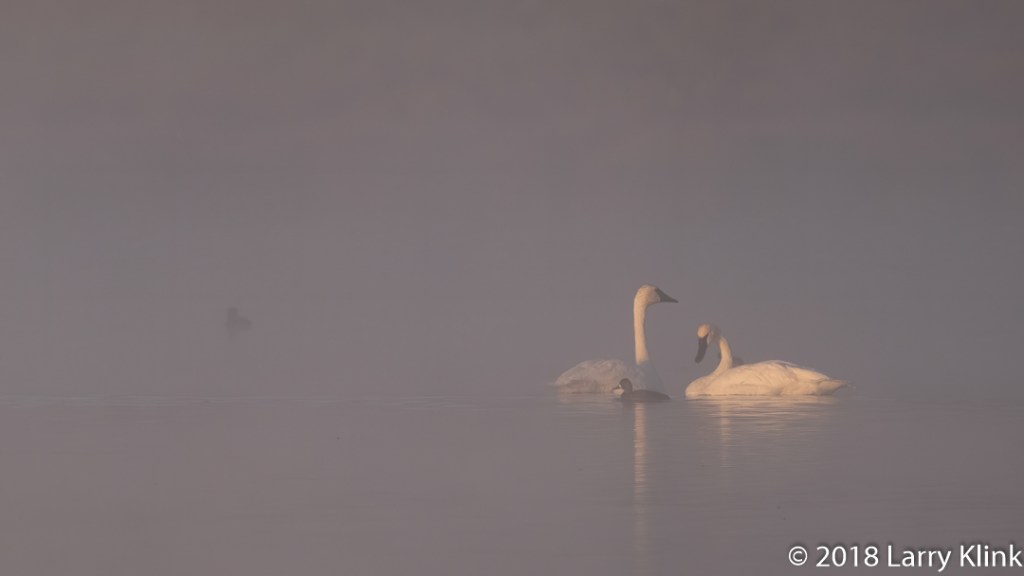
Trumpeter Swans at Sunrise (Cygnus Buccinator) -P1
Swan Lake Flat, Yellowstone National Park; SEP 2018
Trumpeter Swans (Cygnus Buccinator) at Sunrise – P2
Swan Lake Flat, Yellowstone National Park; SEP 201
Trumpeter Swan (Cygnus Buccinator) – P2
Yellowstone River, Yellowstone National Park; FEB 2013

These and other images are available to purchase on my website: www.earthwatcher.us or by contacting larry.klink@earthwatcher.us.
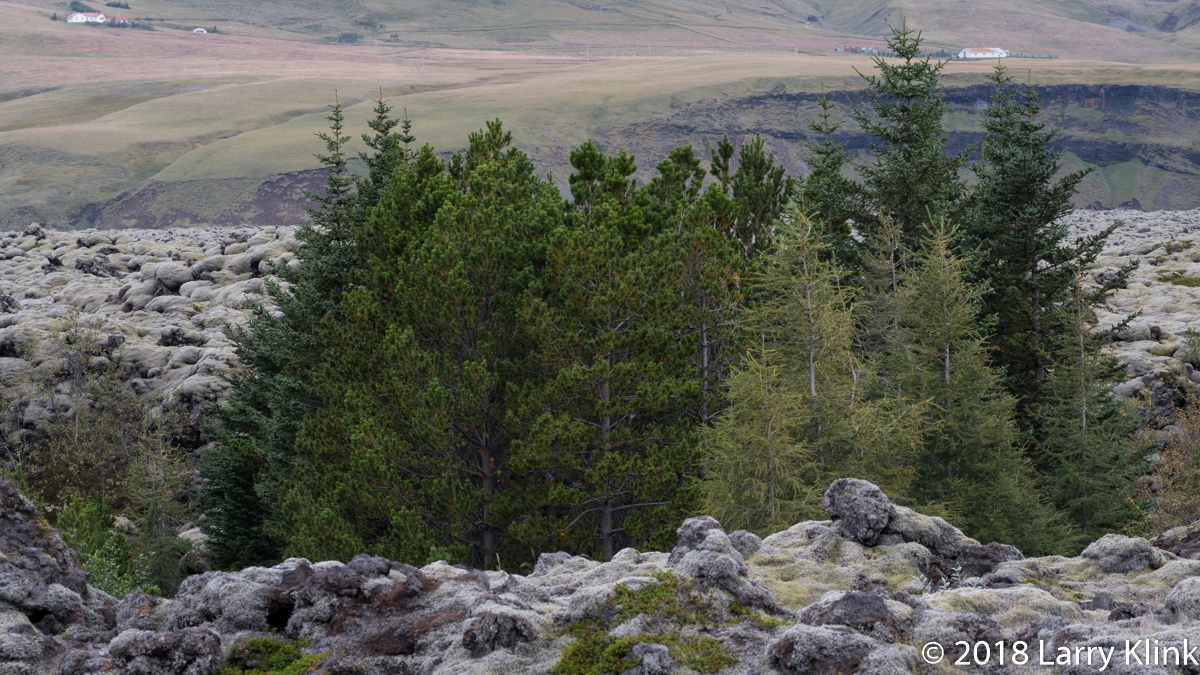
Lava Fields in Iceland

Trees in a Lava Field
Trees in a Lava Field, Iceland, 2017

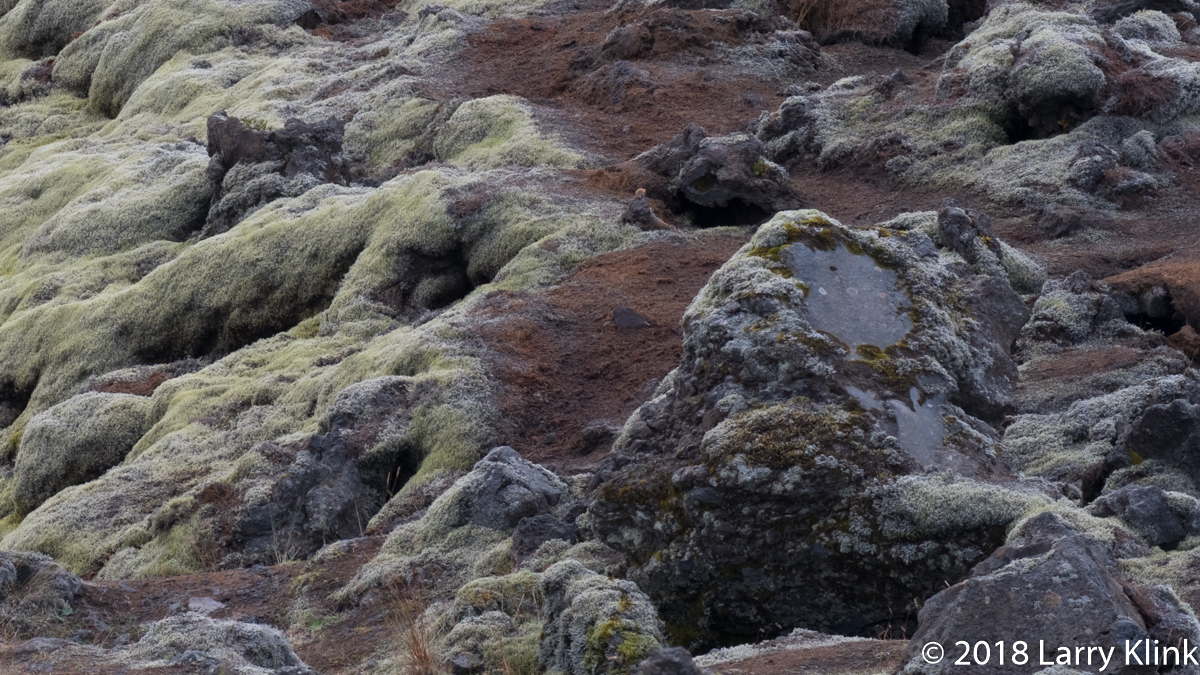
I was intrigued by the Lava Fields that I saw in Iceland last summer. A lava field, or lava bed, is a flat plain over which lava flowed and cooled. The ones that intrigued me the most were those that looked like rocks strewn at random. But what really caught my eye was how nature found a way to turn this area of desolation into a soft blanket of green. Lichens took over and attached themselves to the rock. Low shrubs invaded and even a clump of trees found a way to survive. The images I am sharing attempt to convey the beauty of these features. I hope you enjoy them.

Regards,

Larry

Note: Click on caption to see larger, high resolution copy of image.

Lichen Blanketing a Lava Field
Lichen Blanketing a Lava Field, Iceland 2017

Green Shrub in a Lichen Covered Lava Field
Green Shrub in a Lichen Covered Lava Field, Iceland 2017

Note: These and other images are available for purchase at my website: www.earthwatcher.us or by contacting larry@earthwatcher.us.

Almannagjá Ravine

Almannagjá Ravine - Icelandic Rift Valley
Almannagjá Ravine – Icelandic Rift Valley

Politically, Iceland is considered part of Europe. Geologically, though, it is a very different situation. Iceland sits atop the mid-Atlantic ridge. The ridge is a chain of volcanic mountains, mostly under the Atlantic Ocean that stretches most of the way between the North and South Poles. It is the dividing line between the Eurasian and North American tectonic plates. As the volcanos erupt, the lava causes the Atlantic Ocean to become wider, pushing North and South America westward and Europe and Africa eastward.
The Almannagjá Ravine is a crack or rift between the North American and Eurasian plates that is located in Þingvellir National Park It is a small part of the section of the mid-Atlantic ridge that runs northeast to southwest through Iceland. It geologically, marks the boundary between Europe and North America.
These images were taken in the Almannagjá Ravine. As you look at them, the walls to the left are in Europe and those on the right are in North America. For geology geeks like my wife and I, it is truly amazing to be able to stand on the mid-Atlantic ridge and to be able to walk between Europe and North America.
In 930, Iceland established its parliament in Þingvellir, near this location. Sessions were held there until 1800.

I hope you enjoy these images.

Regards,

Larry

Note: Click on caption to see images in higher resolution and larger size.

Öxarárfoss
Öxarárfoss, Oxara River, Almannagjá Ravine, Iceland

Öxará River
Öxará River, Almannagjá Gorge, Iceland

These and other images are available to purchase at my website www.earthwatcher.us or by contacting larry@earthwatcher.us


Icebergs, Auroras and Birds

Aurora Borealis - Perspective 4
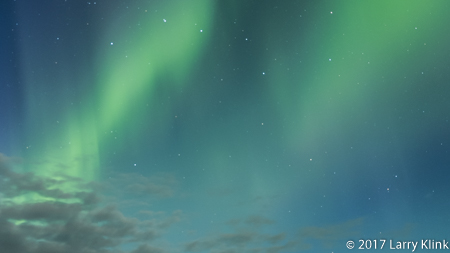
Aurora Borealis and Big Dipper

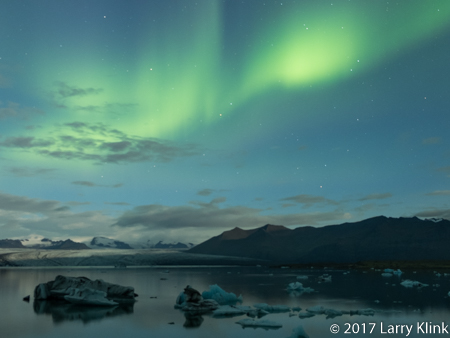
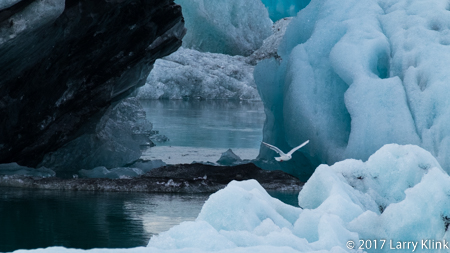
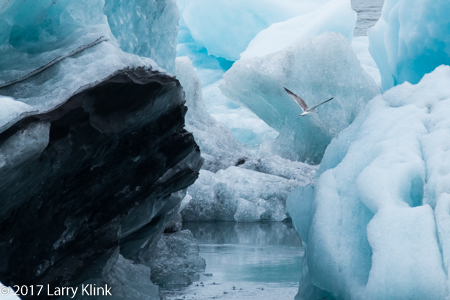
I am mashing together 2 different subjects in this post: Aurora Borealis and the interaction of icebergs with each other and with the avian life that inhabits them. I hope you enjoy these images.

Regards,

Larry

Note to see these images in larger size and higher resolution, please click on caption.

Aurora Borealis - Perspective 1
Aurora Borealis – Perspective 1


Aurora Borealis - Perspective 3
Aurora Borealis – Perspective 2


Aurora Borealis - Perspective 2
Aurora Borealis – Perspective 1


Icy Aviary - Perspective 4
Icy Aviary – Perspective 4


Icy Aviary - Perspective 5
Icy Aviary – Perspective 5


Icy Aviary - Perspective 3
Icy Aviary – Perspective 3


Icy Aviary - Perspective 1
Icy Aviary – Perspective 1


Icy Aviary - Perspective 2
Icy Aviary – Perspective 2

These and other images are available to purchase by visiting www.earthwatcher.us or contacting larry@earthwatcher.us.


Glaciers and Icebergs


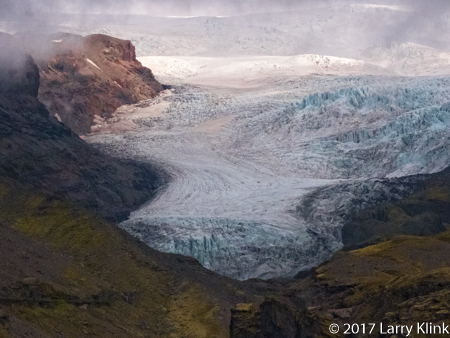
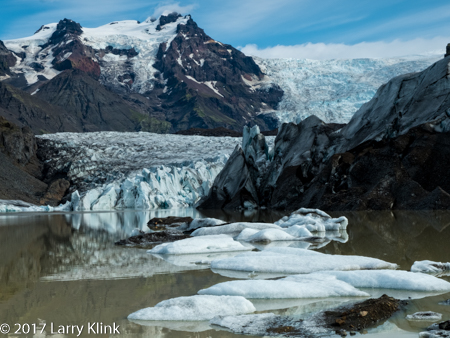
Image of a tongue of Vatnajökull Glacier
Vatnajökull Glacier, Near Hof, Iceland; SEP 2017

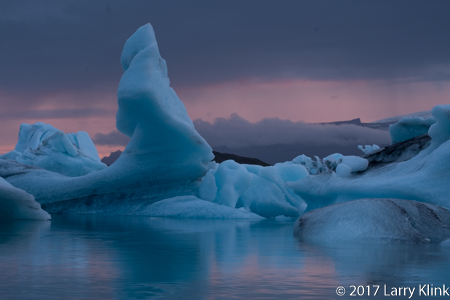
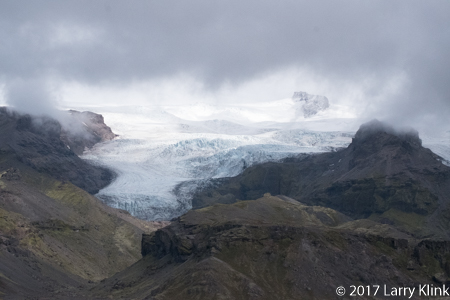
Long ago, I heard the quip that Greenland is icy and Iceland is green. I’ve never been to Greenland but can attest that, at least in the late summer, Iceland is very green. That being said, there is a lot of ice in Iceland. Iceland bills itself as the land of fire and ice because of the many glaciers and volcanos. In the area we travelled, we saw the glacier capped peaks anywhere there was a break in the cliff sides or where the cliff sides were set back far enough that we could see above them. Some were so large, you can see them cover peak after peak for many miles. In places, their tongues would wind their way down mountain valleys, sometimes reaching the floor. I have seen glaciers on TV and have heard about the dangerous crevices but it was not until this visit that I was able to follow a glacier, with my eyes, and see that it not just a smooth icy crust, but rather a cragged set of peaks and crevices. Perhaps, when there is a lot of snow, it fills the crevices making the glacier appear smooth and making it a much more dangerous place to cross.

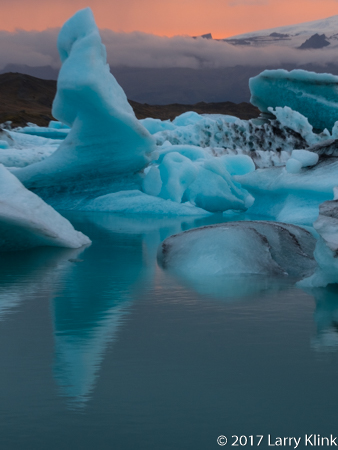
Several things intrigued me about the glaciers I saw: some of the ice is white and some of it is blue, there were big black stripes over the glaciers and several of the glaciers sat atop volcanos, 2 of which erupted recently. The blue ice is caused by how some of the ice crystals react with light. The black stripes are windblown particles of volcanic ash that cover the glacier in the summer. In the winter, they are mostly covered with snow.

Volcanos under ice is the interesting story. Eyjafjallajökull, a volcano under a glacier of the same name, erupted in 2010. Grímsvötn, a volcano under Iceland’s largest glacier, Vatnajökull, erupted in 2011. Katla, which is partly covered by Mýrdalsjökull is currently threatening eruption and may be a much larger than the others in recent history. (By the way, jökull means glacier in Icelandic.) In addition to the explosive action of the eruption, it can melt the snow and ice creating catastrophic water and mudflows called lahars. The eruption of magma, the lava flows and the lahars will reshape a landscape. Because Iceland has so many volcanos that are active, fire and ice are responsible for Iceland’s rugged beauty.

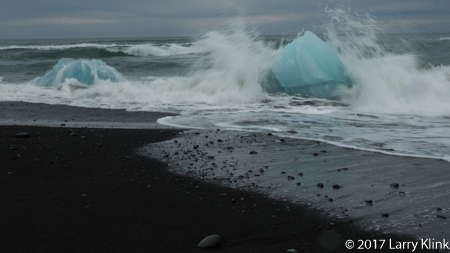
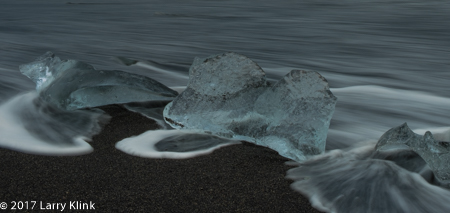
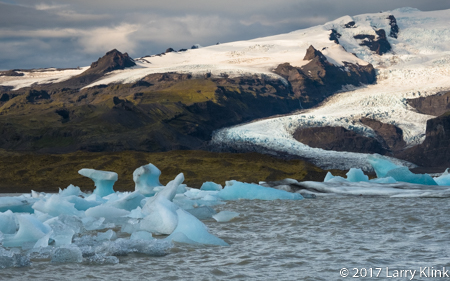
Between the eruptions, the glaciers provide the water for the many waterfalls and the lush, green, vegetation and wildflowers. Where the glacial tongues reach the plains, they calve icebergs into lagoons. At one of the most popular lagoons, Jökulsárlón, a short river provides an outlet for the icebergs to flow to the ocean as the tides recede. When the tides return, many of the icebergs wash back onto the black sand beach. It is a wonder to behold.

I hope you enjoy the images of Glaciers and Icebergs.

Note: Click on caption to see image in larger size and resolution.

Iceberg; Jökulsárlón Lagoon, Iceland

Iceberg; Blue Ice - Last Light
Iceberg; Jökulsárlón Lagoon, Iceland

Surf and Ice
Surf and Ice, Jökulsárlón Ice Beach

Surf and Ice
Surf and Ice, Jökulsárlón Ice Beach

Vatnajökull Glacier
Vatnajökull Glacier, Near Hof, Iceland

Image of Svinafellsjokulsvegur Glacial Tongue and Lagoon
Svinafellsjokulsvegur Glacier

Regards,

Larry

These and other images are available for purchase at http://www.earthwatcher.us or by contacting larry@earthwatcher.us

An Adventure in Iceland, SEP 2017

20170904-Iceland-Snæfellsnes-181-Web
Coastal Plain, Búðir, Snæfellsnes Peninsula, Iceland; SEP 2017

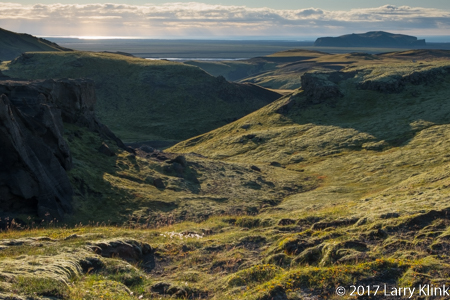
When I close my eyes and picture Iceland, I think of coastal plains lying between the ocean and tall cliff sides. At some places, the plains are grass covered, at other places they are filled with jagged black lava. The cliff sides are impressively tall and massive. They are green with vegetation and filled with outcrops of volcanic basalt. All along the cliff sides, waterfalls appear at frequent intervals. Free range sheep, in small groups, dot the hillsides. Oceanside beaches are black from the volcanic rock and sand.

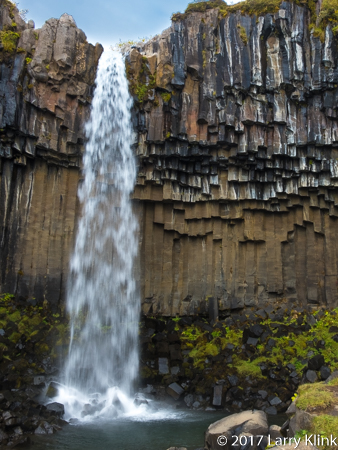
Svartifoss (Black Falls)
Svartifoss (Black Falls), Iceland with its well formed Basaltic Columns. SEP 2017

Glacier melt from the ice covered volcanic mountains creates many, many small streams. These streams drop in long thin ribbons of white from the cliffside. Where they hit the plain, they cut small streams that meander their way to the oceans. In September, the streams flow through gullies in their rocky beds. But, I am told, that in the spring the beds are full of raging water. The streams travel short distances so they don’t have time to merge into large rivers. Despite their size, the fall from glacier to ocean gives them a swift current.

Icelandic Sheep
Icelandic Sheep, Snæfellsnes Peninsula; SEP 2017


The plains are used for ranching. A few ranchers have cattle but most raise sheep and horses. Icelandic wool products are sold throughout the country. Lamb is a staple; Icelandic meat soup is very good.

20170903-Iceland-West-047-Web
Icelandic Horse


There are also many horses which are unique to Iceland. They are short, stalky beasts with long, shaggy mains and tails. There is little farming. In fact, we saw only one garden at a home behind a place where we stayed.

Wildflowers and Moss
Wildflowers and Moss, Near Hoffellsjökull, Iceland, SEP 2017


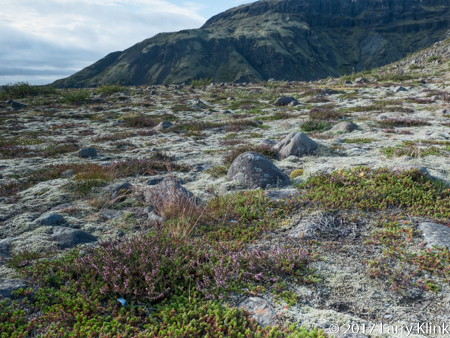
Iceland has a history of recent volcanic activity. So, the rocks are angular and jagged. They haven’t had time to weather into smoother surfaces. But, even in the lava fields, grasses and wildflowers grow between the rocks and gravel. Moss sometimes grows on the volcanic rock giving the lava fields a soft, velvety green color to contrast with its normal black, jagged features.

Mountain Valley
Mountain Valley, Iceland, Þakgil; SEP 2017

Hof Glacial Lagoon and Vatnajokull Glacier
Hof Glacial Lagoon and Vatnajokull Glacier; SEP 2017

As you travel through Iceland, you get glimpses of the massive glaciers that cover many of the mountains. In a few spots, glacial tongues reach the valley floor. Where this occurs, you can see the blue icy edges of the glacier. At the edge, ice breaks loose and falls as icebergs into lagoons. In Jökulsárlón, the icebergs float down a short river and into the ocean where some flow back onto beach.

Highland Valley
Highland Valley Þakgil; SEP 2017


We got to spend precious few hours in the highlands (mountains). One visit took us across a rocky riverbed of gray-green volcanic rock into hills made of broken shards of shale. Shale is sedimentary rock meaning it formed under a calm lake or ocean. It is an anomaly in an otherwise volcanic landscape. A second trip took us to a high valley near one of the glaciers. The valley is reminiscent of those you might see in a medieval fantasy story. The path through the jagged rocks of the tall valley led uphill, next to a stream that cascades from the glacier. The atmosphere was cool and damp. The cliff side was covered with moss and wildflowers.

I’ll be publishing more images focused on different features. Iceland is a remarkably beautiful place. I look forward to visiting again.


Note: Click on caption to see images in a larger size.

These and other images are available for purchase on my website: www.earthwatcher.us or by contacting larry@earthwatcher.us