Rainbow Bridge, American River Parkway, Folsom, CA, JUN 2015 (Click to See Image Enlarged)
I regularly walk along various stretches of the American River Parkway trail system. It is a great place to get exercise and enjoy the beauty of an urban forest and riparian habitat. I rarely have my camera because, if I did, I’d never get exercise. But, I always have my phone.
On several of my blogs, I remind readers that it is the composition and lighting that make the image and not the camera. Especially with today’s smartphone cameras and their incredible software. But, I have a problem using my phone. I can’t hold it steady enough to lock in the composition and get the focus right. So, I invested in a walking stick/monopod/tripod by Manfroto and a bracket to hold my phone. Now, I can overcome my shakiness. I also carry a microfiber cloth to clean the lens – it can get grimy being carried around in purse, pocket or holster. Grimy lenses impact the clarity of the image.
I have the Samsung Galaxy S6 with its 16MP rear camera. It does a great job. You can use it as a point and shoot by using auto mode or you can put it in pro mode which allows you to manually control functions just like on a DSLR. I find manual selection of the focus point to be the most useful but wish it wasn’t tied to the auto exposure so I could control them separately.
The attached image was shot with my phone last week. I am very pleased with it. Enjoy and make the best of your photography.
Landscape photographers are taught that you should always try to shoot during the golden hours; roughly the 3 hours after sunrise and the three hours before sunset. Indeed, the warm saturated colors make very dramatic and beautiful vistas. But does that mean you pack away your camera the rest of the day? Not really. You can get great shots any time of day if you work with the compositional elements and lighting you have to craft a great composition. It is the composition that makes the image.
I took the image in Figure 2 on a clear day, at mid-day, when the sun was high. The composition is decent and interesting. You can see some texture in the canyon and the canyon itself leads your eye
Figure 2: Image Taken Under Uninteresting Light
through the image. So, it is a good image to show friends that have never been to Yosemite, what they would see; a travel photograph. But it’s not a great image. Contrast that with the image in Figure 3, taken from a similar perspective but with strong, dramatic lighting. The difference is obvious. Besides making the picture pop with color, the light leads your eye through the image to interesting features. It provides shadows that add texture. It makes the image much more interesting.
Figure 3: Image With Strong , Dramatic Light
So, its obvious: If you have great light, you can make better image. But, what if you can’t just run off and chase the light? You have to work with what you have when you are there.
Look again at figure 3 to see the enhancements the light is providing. It provides color, texture and controls the movement of the eye through the image. When you have light that is diffuse, you need to find other compositional elements to compensate for the missing light.
Figure 4: Image Taken Under Diffuse Light
Look at Figure 4. It was taken under cloudy skies, in the evening. It is, to me, a very interesting image. I like the composition. While the light is not available to provide the interest, look at how the grass and leaves provide texture that contrasts with the granite and the stream. The colors in the leaves add color that subtly pops the image. Even without strong light, there are shadows and highlights. The stream and the line of rocks lead the eye.
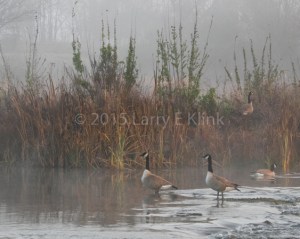
Figure 5 is an image taken under foggy conditions that also diffuse the light. In this case there is some subtle early morning rim light highlighting the edges. The color and texture in the reeds and bushes provide texture to offset the fog shrouded background and the stream.
Figure 5: Image Taken Under Low, Diffuse Light
The key is to look around; to see what is happening; to see what you can use; then craft your image from what you have.
Warm Light Breaking Through Storm Clouds, Trail to Inspiration Point, Yosemite National Park, MAY 2015
This past week, it rained and snowed in the Sierra. Not nearly enough to have any real impact on our drought. But, as evening comes and the storm breaks up, golden sunlight streams through the breaks in the clouds, dappling the mountainsides with gold hued color. I took advantage of the weather conditions this week and visited Yosemite for a quick overnight trip. My goal was to do some exploring and to study how light can add depth to an image. I did some research and learned that sun would be setting in a line that would illuminate half dome, clouds rest and the canyons below. A perfect setting for what I wanted to do. To satisfy the explorer in my blood, I went off the beaten path to get different perspectives with Half Dome as my anchor.
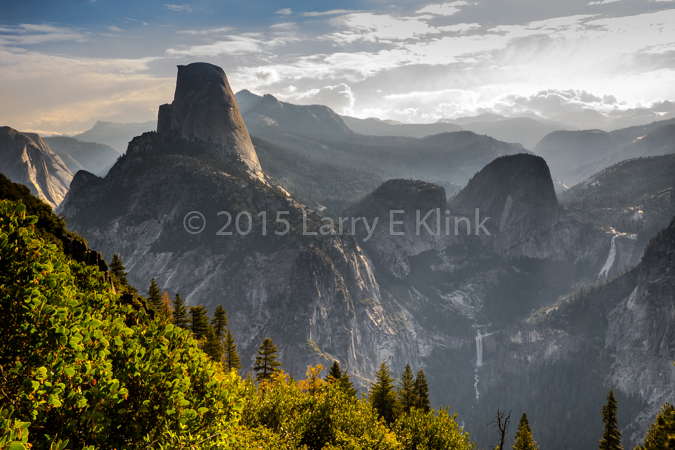
Early Evening Light Breaking Through Rain Clouds Over Yosemite Valley. Glacier Point, Yosemite National Park, MAY 2015
I hiked the trail toward Inspiration Point looking for a different perspective from the traditional view of Yosemite Valley from Tunnel View. The trail is 2.6 miles, round trip, with a 1,000 foot elevation gain. Aside from being steep, it is full of rocks, many of which are loose, and many tree roots. It’s not for the casual walker. But, for those that are willing to endure, the view of the valley, especially Bridalveil Falls, is spectacular.
I also hiked a small section of the Panorama Trail; the portion from Glacier Point to the top of Illilouette Falls and back. This piece is 4 miles round trip with a 1,470 foot elevation change. Fortunately, most of trail is very well groomed.
Morning Light Awakening Half Dome and Little Yosemite Valley, the Valley of the Merced River, Panorama Trail near Glacier Point, Yosemite National Park, CA MAY 2015
This portion of the Panorama trail provides a perspective of Half Dome from the back leading down to Little Yosemite Valley and Vernal and Nevada Falls. Illilouette falls is a 370’ waterfall that is quite beautiful as seen from the Mist Trail. But, you really cannot see the fall itself from the portion of the trail that I hiked; perhaps crossing the bridge may lead you to a spot where the falls are visible. There is one spot where you can see the top of falls through the trees and another spot where it may be more visible if you stand right on the cliff edge. Though you cannot see the fall itself, there is a beautiful cascade where the trail bridge crosses the river. That, in and of itself, is worth the effort to go there.
Nice weather, nice light, spectacular scenery. It was a great time. I hope you enjoy the images.
Mt Shasta, topping off at 14,167 feet, appears as a huge monolith rising out of the countryside as you travel through far North Central California. It is a stratovolcano; a large cone made of layers of different material ejected during its eruptions. Should Mt Shasta erupt, it will create severe natural as well as economic impact. According to Stephen L. Harris, in Fire Mountains of the West, during the last 10,000 years, Mt Shasta has erupted, on average, once every 600-800 years. But, its pace has accelerated to once every 200-300 years in recent centuries. Its last significant eruption was 200 years ago. There are no signs of imminent activity.
Mt Shasta, MAY 2015
Volcanoes can be quite disruptive. When we think of volcanoes, we see images of ash plumes, mudslides, lahars and other natural impacts. If you happen to be there when in erupts, it will change your life. But, their periods of activity represent only a very small fraction of their life. During periods of inactivity, the water from their snow melt brings moisture to the lands below. Additionally, water and wind erode the mountain side, spreading nourishing minerals to the land below. If you travel through Eastern Washington, Oregon and California, you see the benefits in places where the rich land has been put to use for agricultural purposes.
I hope you enjoy these images of Mt Shasta. As you do, pause to think about all we derive from this gentle giant who, only infrequently, explodes and creates havoc.
Peaceful Morning on the American River. Wm Pond Park, American River Parkway, Sacramento, CA, APR 2015 (Click on image to enlarge)Irises on the Bank. Wm Pond Park, American River Parkway, Sacramento, CA, APR 2015 (Click on image to enlarge)
As often as I have walked along the banks of the American River, at William Pond Park, I never realized that much of the vegetation I saw was wild irises. But, imagine if you will, clumps of the brilliant yellow blossoms outlining both sides of the shore for perhaps a half mile or so, complimenting the lupine and other wildflowers. Though there are some wild irises that are native to northern California, I haven’t been able to find if this particular species is or is not and even if it is, whether they are native to the banks of the American River. Regardless, they provide a real treat.
A few weeks ago, Donna and I spent a balmy Saturday exploring the Emerald Bay area of Lake Tahoe. One of the features of Emerald Bay is Eagle Falls. Eagle Falls is a big, beautiful waterfall; well worth the hike to see. But I was more intrigued by a small fingerling stream at its base. The early rays of sun illuminated the miniature canyon through which it flowed. Its miniature boulders created whitewater as the stream flowed over a waterfall into a deeper canyon. All the while, Eagle Falls rumbled in the background adding ambiance to the miniature world it helped create. I love to see ecosystems that replicate the grandiose in miniature. I think about how every stream and river started as a trickle and eroded their way into mountainside, plateau and delta, forming the spectacular scenery we see and appreciate. But, the next time you are at a grand vista, look for the small, hidden, treats also. They are often as worthy of appreciation.
Regards
Larry
Images displayed on this page, and many others can be viewed and purchased on my website:http://www.earthwatcher.us or by contacting me directly.
Here is a brief explanation about why you get noise on some images, particularly on night shots with long exposures.
Noise is an extraneous electrical signal that is picked up by your camera’s sensor which translates into a pattern of color and graininess on your image. Look at the image above, you’ll see specs and small streaks of magenta against the dark sky; this is the most common symptom of noise. Heat is the primary culprit that generates the extraneous electrical signal.
Heat is generated in one of 2 ways: high ISO settings and long exposures. The pixels on your camera sensor are very tiny. The longer you hold the shutter open, the more electricity gets fed to your sensor which causes heat to build up in your sensor. Increasing ISO is like turning up the volume on your radio. When you turn up the volume on your radio, you are amplifying or increasing the strength of the signal to your speakers by pumping in more electricity. Likewise, when you increase ISO, you are increasing the strength of the signal to your camera’s sensor. The more electricity you feed it, the more the heat builds up and the more extraneous electric signals are picked up.
Each camera model has different noise characteristics. Camera manufacturers are always trying to improve their noise reduction. But, noise is a reality of digital cameras. If you are planning to photograph night shots, experiment with your camera ahead of time to find your best noise performance so you can judge how to set up your camera when you are shooting for real.
Software such as Photo Ninja, Photoshop and Adobe Lightroom have ways to reduce noise. They work well but need to be used in moderation. As you apply more noise reduction the more you loose sharpness in your finished image.
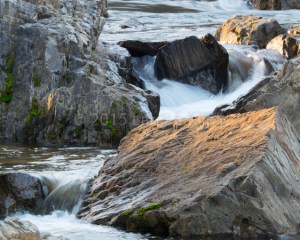
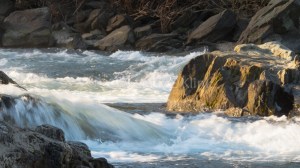
A Playful Moment in the Life of Water – Perspective 1A Playful Moment in the Life of Water – Perspective 2
A river; water molecules traveling in unison; herded by rock and dirt; their progress blocked but not deterred. They flow until captured and stored; until they drift apart, their individual courses changed to serve the purposes of nature, or of human civilization. But here, in unrestricted freedom, they frolic, they crash, they splash and foam. Basking in early morning light, they appear to enjoy the moment unperturbed; as if they know they can play now, before they must get to work. They will do their part then some day will be reunited in the vast ocean, carried into the sky, and begin the journey anew. Such is the life of water.Regards,
Larry
Images displayed on this page, and many others can be viewed and purchased on my website: http://www.earthwatcher.us or by contacting me directly.







 Earthwatcher