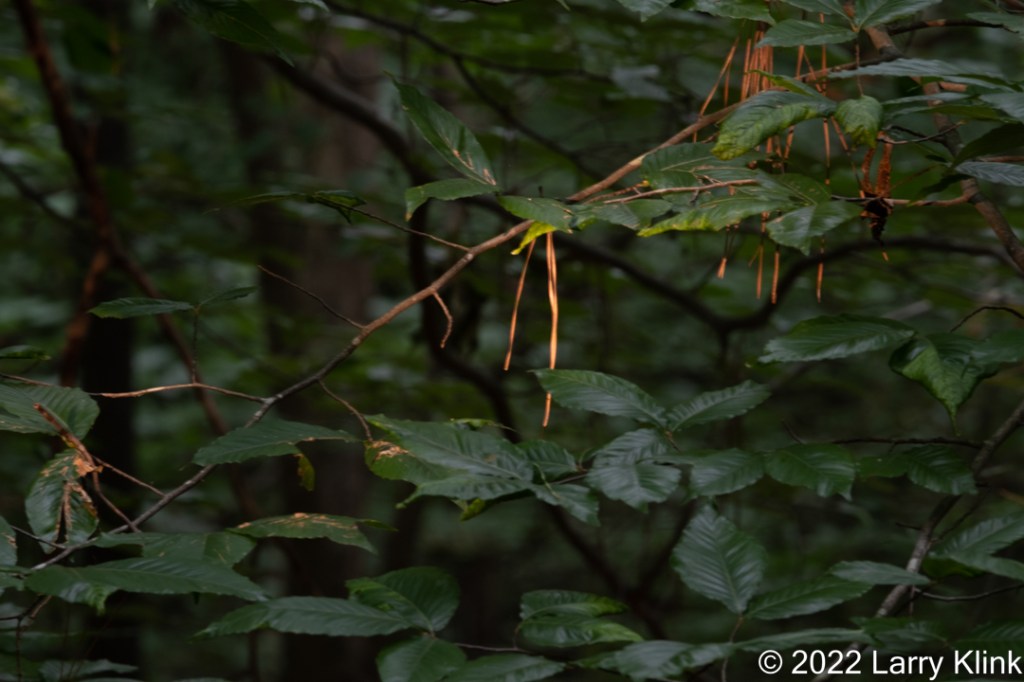
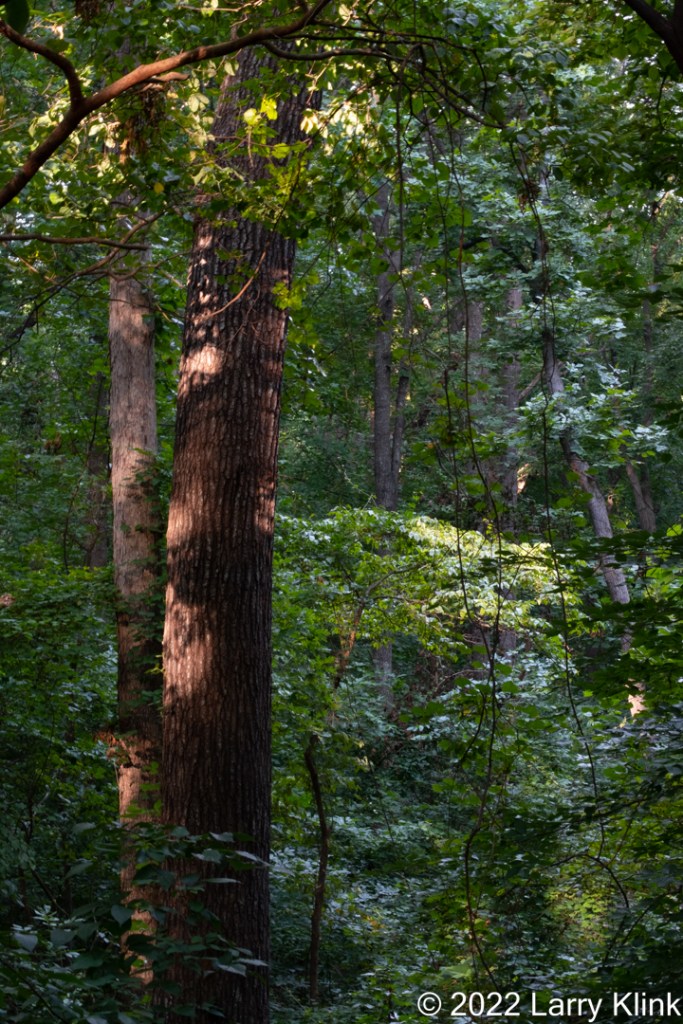
Last week, I visited Big Trees Forest Preserve in Sandy Springs, Georgia. It’s a suburb of Atlanta. It has several short trails that are easy to walk. I went specifically to photograph the light penetrating through the deciduous forest in the early morning. It was a fun hike.
By the way, compared to Calaveras Big Trees State Park in California, the big trees here look like match sticks. But they are quite beautiful none the less.
Please click on caption to see image at higher resolution.
If anyone would like a copy of almost any picture in my library, for educational or research use, please contact me and I will happily share a digital copy with you.
Please click on caption to see picture at higher resolution.
Today I am sharing a picture of a beautiful waterfall that is very near where I live. Its in a tiny, picturesque park and sets under a covered bridge. My understanding is that the waterfall is man-made, and the bridge is recent. It is very well done. It is on Big Creek, once known as Vickery Creek.
Please visit my website, www.earthwatcher.us to see my collection of landscapes and wildlife.
If anyone would like a copy of almost any picture in my library, for educational or research use, please contact me and I will happily share a digital copy with you.
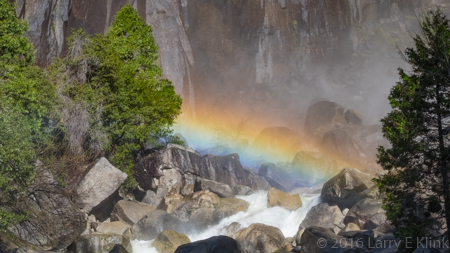
Last week, we took a trip to Yosemite National Park. We were a bit late in the season. We were looking for snow, but almost all of the snow was gone from the valley floor. There was some clinging to the nooks on the cliff side. It was sunny when we arrived but, as the golden hour approached, the skies became cloud covered and we got rain. Just being in Yosemite when there are few people is a real treat, so walking around in the rain was enjoyable even though photography opportunities were few. Little did we know the treat that would await us in the morning.
We dutifully got up and out ½ hour before sunrise – about an
hour before the sun would start to light up the valley walls. While planning
the trip, I learned we would have clear skies in the morning and that the sun
would be in a good position to light Yosemite Falls. Yosemite falls is often
shaded during the golden hours for photography. We found the position from
which I wanted to shoot and set up. It was then we got our first surprise –
snow had fallen on the cliffsides on either side of the waterfall. There was
even a dead tree that was partially snow covered that I could get into the
frame.
I set up my composition and waited in the cold. After a
period of time that seemed interminable, golden sunlight began to penetrate the
valley. Watching the sun light the mountain tops and valley walls is one of my
favorite experiences; I never grow tired of it. We watched and enjoyed. I would
shoot from time to time. But, I really wanted more light on the water fall.
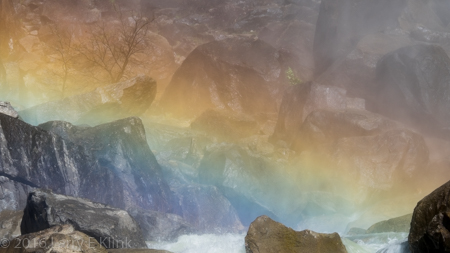
When the light broke, I got a treat I hadn’t expected. The sun began giving the
water and the mist a golden glow. I watched and I shot as the different
sections would glow. We stayed through the entire show.
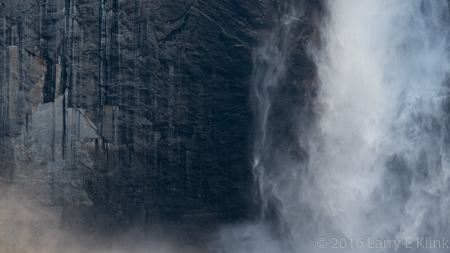
I’ve included 2 of the images I got that morning. I hope you enjoy them.
Please click on caption to see these images at higher resolution.
Politically, Iceland is considered part of Europe. Geologically, though, it is a very different situation. Iceland sits atop the mid-Atlantic ridge. The ridge is a chain of volcanic mountains, mostly under the Atlantic Ocean that stretches most of the way between the North and South Poles. It is the dividing line between the Eurasian and North American tectonic plates. As the volcanos erupt, the lava causes the Atlantic Ocean to become wider, pushing North and South America westward and Europe and Africa eastward.
The Almannagjá Ravine is a crack or rift between the North American and Eurasian plates that is located in Þingvellir National Park It is a small part of the section of the mid-Atlantic ridge that runs northeast to southwest through Iceland. It geologically, marks the boundary between Europe and North America.
These images were taken in the Almannagjá Ravine. As you look at them, the walls to the left are in Europe and those on the right are in North America. For geology geeks like my wife and I, it is truly amazing to be able to stand on the mid-Atlantic ridge and to be able to walk between Europe and North America.
In 930, Iceland established its parliament in Þingvellir, near this location. Sessions were held there until 1800.
I hope you enjoy these images.
Regards,
Larry
Note: Click on caption to see images in higher resolution and larger size.
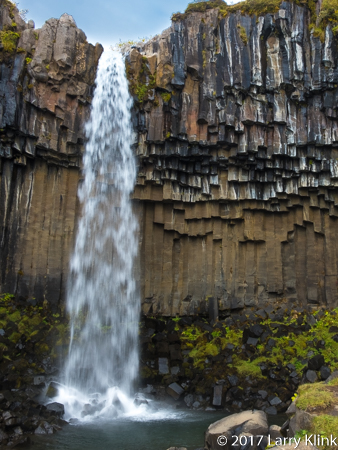
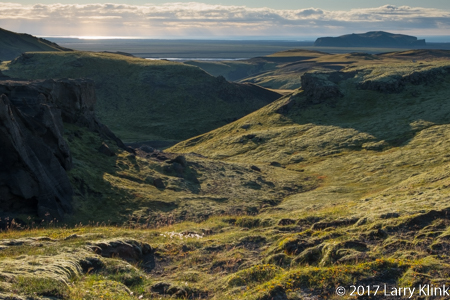
When I close my eyes and picture Iceland, I think of coastal plains lying between the ocean and tall cliff sides. At some places, the plains are grass covered, at other places they are filled with jagged black lava. The cliff sides are impressively tall and massive. They are green with vegetation and filled with outcrops of volcanic basalt. All along the cliff sides, waterfalls appear at frequent intervals. Free range sheep, in small groups, dot the hillsides. Oceanside beaches are black from the volcanic rock and sand.
Glacier melt from the ice covered volcanic mountains creates many, many small streams. These streams drop in long thin ribbons of white from the cliffside. Where they hit the plain, they cut small streams that meander their way to the oceans. In September, the streams flow through gullies in their rocky beds. But, I am told, that in the spring the beds are full of raging water. The streams travel short distances so they don’t have time to merge into large rivers. Despite their size, the fall from glacier to ocean gives them a swift current.
The plains are used for ranching. A few ranchers have cattle but most raise sheep and horses. Icelandic wool products are sold throughout the country. Lamb is a staple; Icelandic meat soup is very good.
There are also many horses which are unique to Iceland. They are short, stalky beasts with long, shaggy mains and tails. There is little farming. In fact, we saw only one garden at a home behind a place where we stayed.
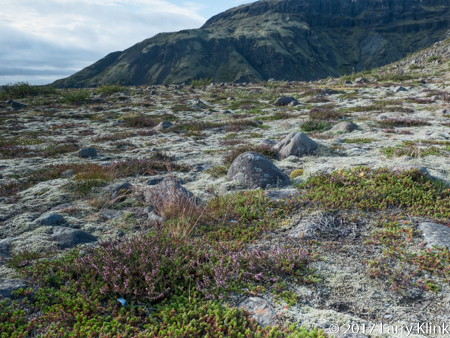
Iceland has a history of recent volcanic activity. So, the rocks are angular and jagged. They haven’t had time to weather into smoother surfaces. But, even in the lava fields, grasses and wildflowers grow between the rocks and gravel. Moss sometimes grows on the volcanic rock giving the lava fields a soft, velvety green color to contrast with its normal black, jagged features.
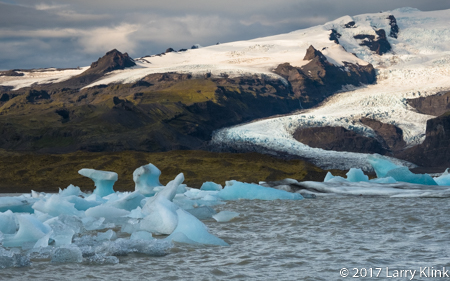
As you travel through Iceland, you get glimpses of the massive glaciers that cover many of the mountains. In a few spots, glacial tongues reach the valley floor. Where this occurs, you can see the blue icy edges of the glacier. At the edge, ice breaks loose and falls as icebergs into lagoons. In Jökulsárlón, the icebergs float down a short river and into the ocean where some flow back onto beach.
We got to spend precious few hours in the highlands (mountains). One visit took us across a rocky riverbed of gray-green volcanic rock into hills made of broken shards of shale. Shale is sedimentary rock meaning it formed under a calm lake or ocean. It is an anomaly in an otherwise volcanic landscape. A second trip took us to a high valley near one of the glaciers. The valley is reminiscent of those you might see in a medieval fantasy story. The path through the jagged rocks of the tall valley led uphill, next to a stream that cascades from the glacier. The atmosphere was cool and damp. The cliff side was covered with moss and wildflowers.
I’ll be publishing more images focused on different features. Iceland is a remarkably beautiful place. I look forward to visiting again.
Note: Click on caption to see images in a larger size.
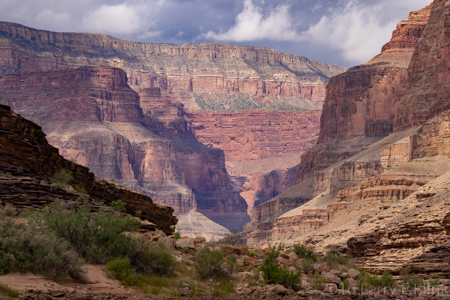
I had an amazing experience; five days rafting through the Grand Canyon on the Colorado River. Many thanks to Gary Hart (http://www.garyhartphotography.com/), who organized the trip, and to Western River Outfitters (http://www.westernriver.com/), who conducted it. Their professionalism, efficiency, and energy made the trip great fun, great adventure, and an unforgettable experience.
The trip began with a flight over the Colorado Plateau to Marble Canyon, AZ where we packed up and entered the river at a spot called Lee’s Ferry. We traveled 180 miles through Marble Canyon and the Grand Canyon. At Whitmore Wash we were helicoptered out to Bar 10 ranch then back to Las Vegas by small plane. After spending time on the river, the return flight gave me an opportunity to connect some dots: I could see the relief of the canyon and view the beds of the feeder rivers as they travelled to the slot canyons and into the Colorado. We travelled on motorized rafts that were 5 heavy duty vinyl pontoons lashed together with ropes. Each of the pontoons was about 25 feet long and 3 feet in diameter. Our food, camping gear, and personal items were piled on, covered, and tied down on 2 platforms lashed to the pontoons. We camped on sandbars along the river; some under the stars, others in tents.
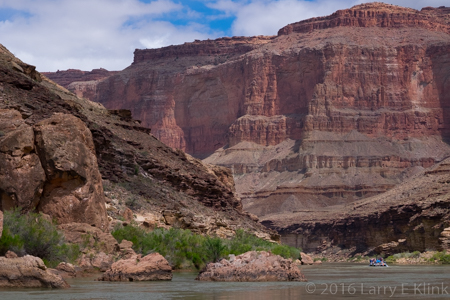
My first impression took me back to adventure stories where a team of intrepid explorers entered an unknown and unexplored area looking for the fabled lost city and its people. The narrow gorge through weathered, high walled canyons, felt imposing. The patterns on the rock reminded me of ancient statuary that weathered away. It left me wondering where the door to the ancient city, the one that is only revealed at sunset on the summer solstice, is located.
The geology was fascinating. Over the course of our trip, our elevation changed by 1,700 feet. When we entered Marble Canyon, we were between walls of the red-orange limestone layer that forms the roof top of the canyons. As we travelled through the canyon, progressively deeper layers were exposed until we came to the basement layer of granite which underlies the canyon. At places, nearly 2 billion years of earth’s history lay exposed for us to see.
To top off all of this beauty we even got to have fun running the rapids. There were many rapids. Most of them were small ripples. Two of them were really wild rides. Several more were big enough to be exciting. As we approached the rapids, you could see choppy white water ahead. The swells that had already broken smoothed out to a jello-like surface and reflected gold on top of the green river. As the driver turned the raft into the swells the swells would lift the raft and drop it down or the raft would nose dive and dig into the swell. Sometimes a wave would hit from the side. Regardless, water sprayed up, soaking us. As we held on, braving the bucking and twisting, we laughed like little kids. I was anxious about this part of the trip, not really knowing what to expect. Having done it, I wouldn’t trade the experience.
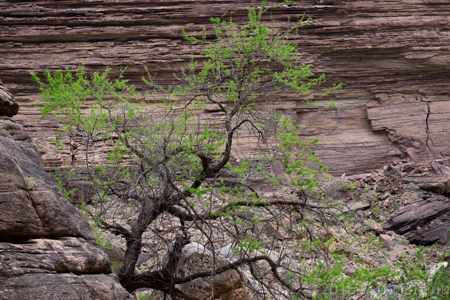
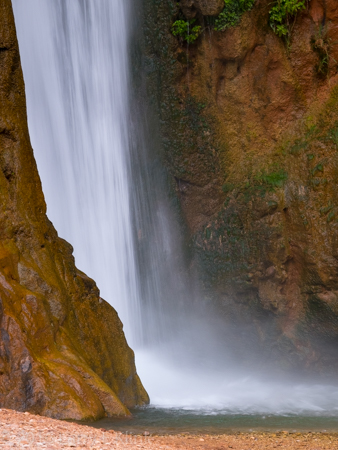
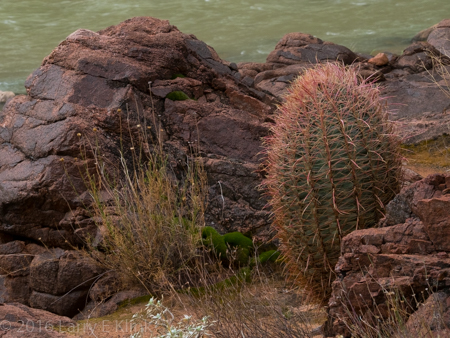
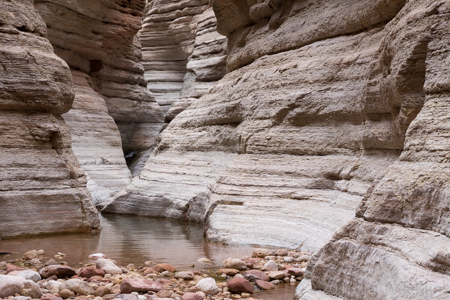
Visiting the rim or flying over the canyon will give you an appreciation of its magnificence. But running the river brings it up close and personal. Look up and see cliff walls rising thousands of feet or see the layers set back, one upon the other, rising into the sky. Look at the walls and see swirls of fossilized sand dunes or rock walls that look like layers of stacked stone; some horizontal, some tilted at an angle. Vegetation invaded the weathered red-orange limestone giving the appearance of terraced gardens. In other places cacti and brush dotted hillsides of black and brown in no particular pattern. Still other areas were painted in earth tones of tan, brown, pink and green. We hiked back slot canyons to see running streams and waterfalls that have carved the sidewalls and brought debris to the canyon floor. We were even lucky enough to see some of the wildlife that inhabits the canyon: condors flying high above, big horn sheep climbing canyon walls, swallows swooping over the rapids to catch bugs and even a heron. I have difficulty finding words to describe how it felt to be among those ancient walls. Walls that were created by the deposition of silt and the remains of creatures at the bottom of a great sea, uplifted when plates of the earth’s crust crashed into each other and finally sculpted by the forces of wind and rain into the natural wonder that was presented to me each day of the trip. Wonder and awe aren’t expressive enough.
I hope the images I’ve included give you sense of what I felt as I traveled through the natural wonder that is the Grand Canyon.
We are fortunate this year that El Niño gave us a respite from the drought; a good snow pack in the Sierra! I moved to northern California 4 ½ years ago. My wife told me many times that the ephemeral waterfalls, those that dry up and go away quickly, make Yosemite especially beautiful in early spring. But years of drought gave us little snow, leaving those falls dormant or very short lived. I never had a chance to experience them.
Last weekend, we took an overnight visit to Yosemite. My wife was right, everywhere I looked there was a waterfall that I had never seen before. Even Horsetail falls, the one that lights up like fire at sunset in February, was still running. The Merced River was running strongly. We hiked along the Merced River on the trail to the bridge at Vernal Falls.
At the juncture of Illouette Creek and the Merced River, the waters roiled over the cascades making whitewater that looked like a giant head of cauliflower and sounded like thunder. It was amazing.
Yet, as I traveled through Yosemite, another thought struck me. As humans, ephemeral describes things that come and go quickly; in the span of short periods within our lifetime. But, solid rock in places like Yosemite last for time frames impossible for humans to comprehend but do eventually wash away. To the earth is really ephemeral?
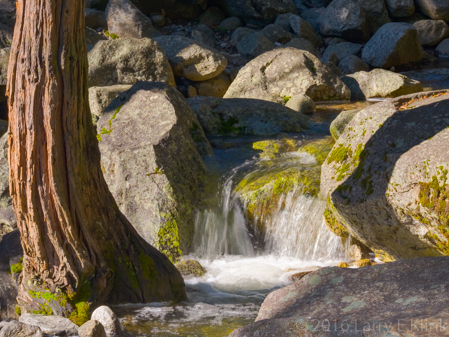
A few weeks ago, Donna and I spent a balmy Saturday exploring the Emerald Bay area of Lake Tahoe. One of the features of Emerald Bay is Eagle Falls. Eagle Falls is a big, beautiful waterfall; well worth the hike to see. But I was more intrigued by a small fingerling stream at its base. The early rays of sun illuminated the miniature canyon through which it flowed. Its miniature boulders created whitewater as the stream flowed over a waterfall into a deeper canyon. All the while, Eagle Falls rumbled in the background adding ambiance to the miniature world it helped create. I love to see ecosystems that replicate the grandiose in miniature. I think about how every stream and river started as a trickle and eroded their way into mountainside, plateau and delta, forming the spectacular scenery we see and appreciate. But, the next time you are at a grand vista, look for the small, hidden, treats also. They are often as worthy of appreciation.
Regards
Larry
Images displayed on this page, and many others can be viewed and purchased on my website:http://www.earthwatcher.us or by contacting me directly.
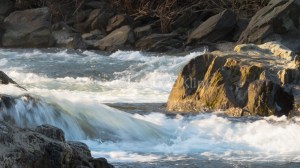
A Playful Moment in the Life of Water – Perspective 1
A Playful Moment in the Life of Water – Perspective 2
A river; water molecules traveling in unison; herded by rock and dirt; their progress blocked but not deterred. They flow until captured and stored; until they drift apart, their individual courses changed to serve the purposes of nature, or of human civilization. But here, in unrestricted freedom, they frolic, they crash, they splash and foam. Basking in early morning light, they appear to enjoy the moment unperturbed; as if they know they can play now, before they must get to work. They will do their part then some day will be reunited in the vast ocean, carried into the sky, and begin the journey anew. Such is the life of water.Regards,
Larry
Images displayed on this page, and many others can be viewed and purchased on my website: http://www.earthwatcher.us or by contacting me directly.
















 Earthwatcher