Red-eyed Vireo

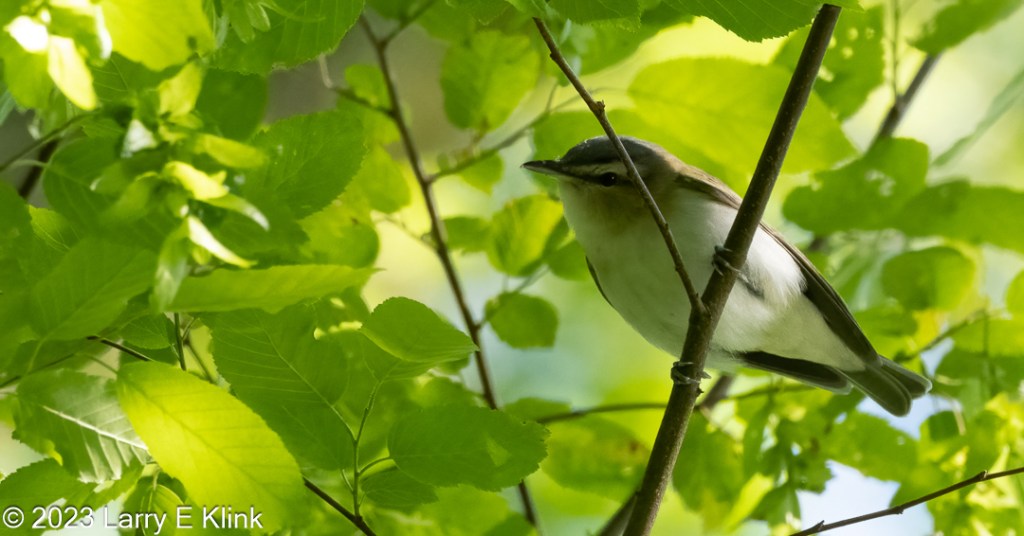
Photograph of a bird, a Red-eyed Vireo, perched on a tree branch. The background is mostly yellow-green leaves with small patches of blue sky. The bird is perched on a dark colored branch that extends from top to bottom at the right side of the picture. The bird is viewed from below, so its underparts and side are visible. Its underparts are white. Beneath its eye and flowing back are its neck, wings and tail feathers, all olive green. The tail feathers are tipped in black. Its eye is red but appears dark in the picture. It has a dark eye stripe. Above its eye is a white stripe topped by a black crown. The bottom of its beak is white, the top is black.
Red-eyed Vireo;
Island Ford, Chattahoochee NRA, Roswell, Georgia, USA; MAY 2023;

Please click on caption to see images at higher resolution!

Photograph of a bird, a Red-eyed Vireo, perched on a tree branch, with one end of a dark colored worm in its beak; the other end of the worm is wrapped around the tree branch. The background is a mix of yellow-green leaves and blue sky. The bird is perched on a dark colored branch that extends from left to right near the bottom of the picture. The bird is viewed from below, so its underparts and side are visible. Its underparts are white. Beneath its eye and flowing back are its neck, wings and tail feathers, all olive green. The tail feathers are tipped in black. The wings have black and green stripes. Its eye is red but appears dark. It has a dark eye stripe. Above its eye is a white stripe topped by a black crown; only the edge of the crown is visible. The bottom of its beak is white, the top is black.
Red-eyed Vireo; Island Ford,
Chattahoochee NRA, Roswell, Georgia, USA; MAY 2023
Photograph of a bird, a Red-eyed Vireo, perched on a tree branch, with a fly in the tip of its beak. The background is mostly yellow-green leaves with a small patch of blue sky. The bird is perched on a dark colored branch that extends from top to bottom at the right side of the picture. The bird is viewed from below, so its underparts and side are visible. Its underparts are white. Beneath its eye and flowing back are its neck, wings and tail feathers, all olive green. The tail feathers are tipped in black. Its eye is red. Above its eye is a white stripe topped by a black crown; only the edge of the crown is visible. The bottom of its beak is white, the top is black. The object at the tip of its beak is an insect it captured.
Red-eyed Vireo;
Island Ford, Chattahoochee NRA, Roswell, Georgia, USA; MAY 2023

Please visit my website, www.earthwatcher.us to see my collection of landscapes and wildlife.

These and other images are available to purchase by contacting larry.klink@earthwatcher.us.

If anyone would like a copy of almost any picture in my library, for educational or research use, please contact me and I will happily share a digital copy with you.

Barred Owl

Photograph of a Barred Owl, perched on a tree limb against a background of blurred, green tree leaves. The tree branch lies horizontally at the bottom of the photo. It is gray, mottled with green moss and gray-green lichen. The branch starts just right of the picture’s left edge. It bows upward to just past mid-frame then bows sharply upward, then curling down to the bottom of the frame. At the bottom right of the frame is another, thicker horizontal branch that also bows upward. It is darker and is mottled with moss. The owl stands just to the left of the middle of the picture and dominates the picture. Its face is round and gray with a heart shaped notch at the top. It has dark eyes with a glint of light in each. Each of the eyes are encircled by fine, gray feathers with pale brown stripes. Between the eyes is a small, ovoid, dark patch. The beak is yellow and sets just below the ovoid patch. It sets in a triangular patch of feathers that are dark at the top that transitions to gray as they reach the rounded bottom of the triangle. It is holding a brown insect in its beak. The owl’s face is encircled by a cowl of brown and gray striped feathers. Its bulky body is white with horizontal stripes of brown feathers. Its 2 bulky legs are light brown with yellow and black claws that are grasping the tree branch.  Its gray tail feathers protrude from under the body and below the tree branch.
Barred Owl with Prey;
Island Ford, Chattahoochee NRA, Roswell, Georgia, USA; MAY 2023

Barred Owls are very common in the Atlanta, Georgia area. I am sharing 2 perspectives on this one, very cooperative, owl that I took a few weeks ago. I think it was just showing off the bug it caught.

Please click on caption to see this image at higher resolution!

Photograph of the face of a Barred owl against a background of blurred, green  tree leaves. Its face is round and gray with a heart shaped notch at the top. It has dark eyes with a glint of light in each. Each of the eyes are encircled by fine, gray feathers with pale brown stripes. Between the eyes is a small, ovoid, dark patch. The beak is yellow and sets just below the ovoid patch. It sets in a triangular patch of feathers that are dark at the top that transitions to gray as they reach the rounded bottom of the triangle. It is holding a brown insect in its beak. The owl’s face is encircled by a cowl of brown and gray striped feathers. Its bulky shoulders and body is white with horizontal stripes of brown feathers. There are a few twigs and leaves randomly located in the picture.
Barred Owl with Prey – Close-up;
Island Ford, Chattahoochee NRA, Roswell, Georgia, USA; MAY 2023

Please visit my website, www.earthwatcher.us to see my collection of landscapes and wildlife.

These and other images are available to purchase by contacting larry.klink@earthwatcher.us.

If anyone would like a copy of almost any picture in my library, for educational or research use, please contact me and I will happily share a digital copy with you.

New Kids in the Neighborhood

Subscribe to continue reading

Subscribe to get access to the rest of this post and other subscriber-only content.

A Few Birds from Our Recent Trip

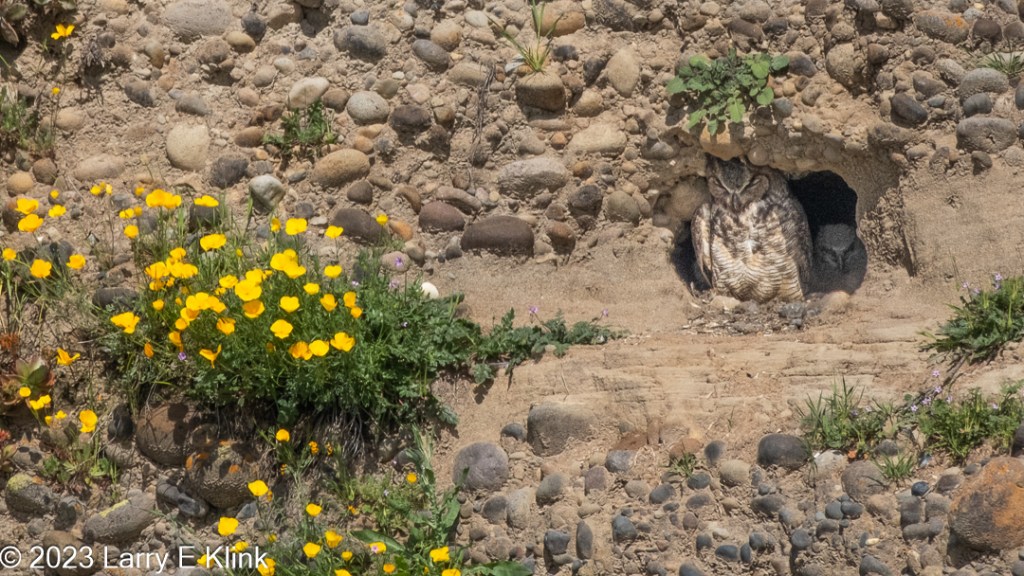
Photo of an adult and a juvenile Great Horned Owl at the opening of its hillside nesting cave. The hillside is a sedimentary mix of mud and ovoid river rocks. The background color isa sandy beige. The rocks are a mix of grays and browns. In the lower right corner is green foliage with yellow flowers – California Golden Poppies. There is some other green foliage dotting the hillside. The 2 owls are standing side by side at the entrance to their cave. The adult is the larger bird standing on the left, the juvenile is the small gray bird with gay beak standing on the right. Both birds are facing front with their head bent down, partially obscuring their eyes. The adult’s breast is mostly white, but orange in some areas, all with gray horizontal stripes. The top of the adult’s head is triangular patch with the point at the top of the beak. The patch is gray, outlined by a white stripe and further by a gray stripe. Its face is gray, outlined by a black stripe that makes it almost heart shaped. Its beak is gray.
Nimbus Fish Hatchery,
American River Parkway, Rancho Cordova, California, USA; APR 2023

Please click on caption to see image at higher resolution!

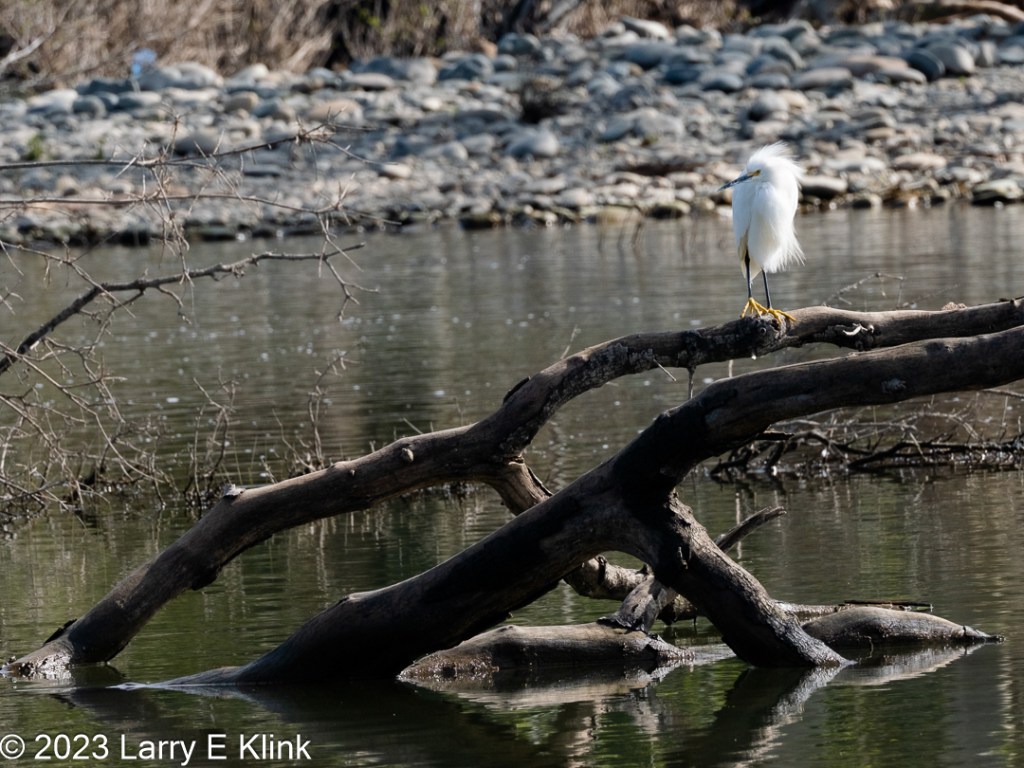
Photo of a Snowy Egret perched on a fallen tree in a pond. The fallen tree is two large main branches projecting from the water in the lower left of the picture. They project upward, across the picture toward the right at about a 30-degree angle.  There are supporting branches on each of the main branches that project back into the water in the lower right quarter of the picture. The branches are dark gray, streaked with light gray on the top by the sunlight.  The water is green in the lower third of the picture then changing to a greenish gray as it progresses to the opposite side of the pond. The bird is in the upper right quadrant of the picture. It is bright white with a black beak, black legs and yellow feet. Its eye is a small black dot where the beak meets the head. There is a small yellow patch on the end of the beak at the eye. There are many smaller branches in the water around the fallen tree. The river bank on the opposite site is out of focus river rocks capped with out of focus brush.
Snowy Egret;
Effie Yeaw Nature Center, Sacramento, California, USA; MAR 2023
Photo of a Snowy Egret perched on a fallen tree in a pond. The fallen tree appears as several medium gray to light gray, twisted, large branches. They appear to project from the lower right corner of the picture, curving upward; one into the middle, the other to left side. The bird is perched on one leg, on one of the branches, in the middle, vertically and one third of the way from the right side of the picture. The bird is white. It has a black beak and leg with a yellow foot. Its feathers are fluffed from the wind. Its eye is a tiny black dot at the base of the beak. There is a yellow patch on the base of the beak and around the eye. The background is the pond. The water is green in the lower third of the picture. It is mostly blue with greenish brown streaks in the rest of the picture.
Snowy Egret;
Effie Yeaw Nature Center, Sacramento, California, USA; MAR 2023
Photo of a Black Oystercatcher standing on a rock along the water’s edge.  On the left side of the image is a triangular shaped, granular looking rock, sandy brown on type grading to dark gray.  Across the bottom of the image, is a flat-topped rock which is light beige on the left and golden brown on the right. The water in the background is blue with some brown, shimmering rocks just below the water’s surface. The bird is standing upright atop the flat top rock, facing left. The bird has a black body, pink legs and a red beak. The bird is holding its prey, a black circular object, likely a shellfish, in its beak. Its eye is yellow with a red ring around it.
Black Oystercatcher;
Point Lobos State Natural Reserve, California, USA; APR 2023
Photo of a Black Oystercatcher on a rock along the water’s edge. Across the bottom of the image, is a flat-topped rock which is light beige on the left and golden brown on the right. The water in the background is blue with some brown, shimmering rocks just below the water’s surface. The bird is standing hunched over, atop the flat top rock, facing left. The bird has a black body, pink legs and a red beak. The bird is holding its prey, a cream-colored circular object, likely a shellfish, in its beak. The shell from its prey sets just below the beak on the rock. Its eye is yellow with a red ring around it.
Black Oystercatcher;
Point Lobos State Natural Reserve, California, USA; APR 2023
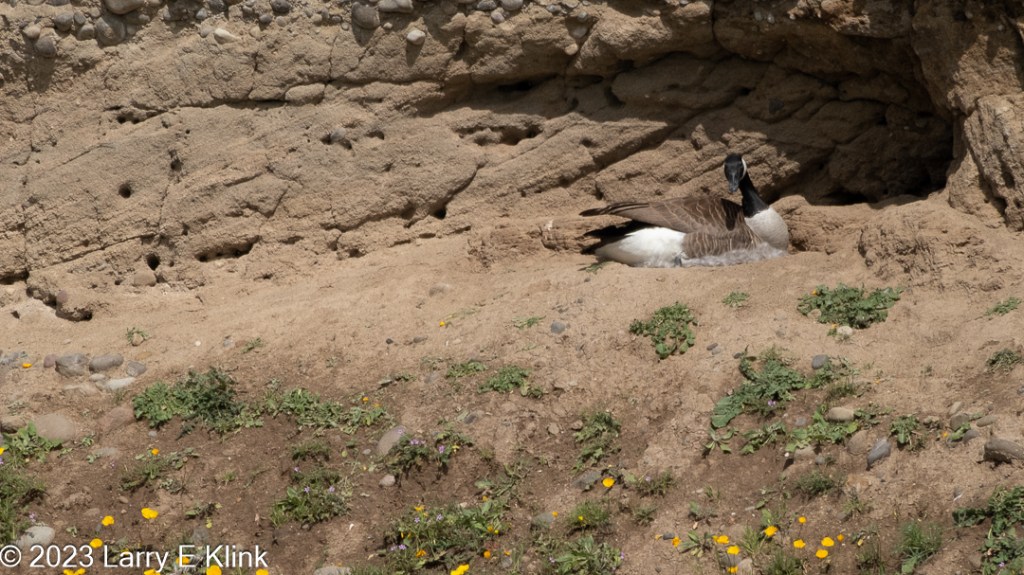
Photo of a Canada Goose on its nest which is on a hillside. The hill side is a dark, sandy beige color. The upper third is rock, the lower two thirds is dried mud. The dried mud is dotted with green foliage and yellow flowers. The bird has a black head, neck and bill. There is a small white patch on the right side of its head. Its breast and under parts are white. Its wing feathers are brown. The wing feathers are folded and extend to the length of its body making a “V” between the wings and underbody.
Canada Goose on Nest;
Nimbus Fish Hatchery, American River Parkway, Rancho Cordova, California, USA; APR 2023

Please visit my website, www.earthwatcher.us to see my collection of landscapes and wildlife.

These and other images are available to purchase by contacting larry.klink@earthwatcher.us.

If anyone would like a copy of almost any picture in my library, for educational or research use, please contact me and I will happily share a digital copy with you.
Birds and Surf – Monterey California Coast

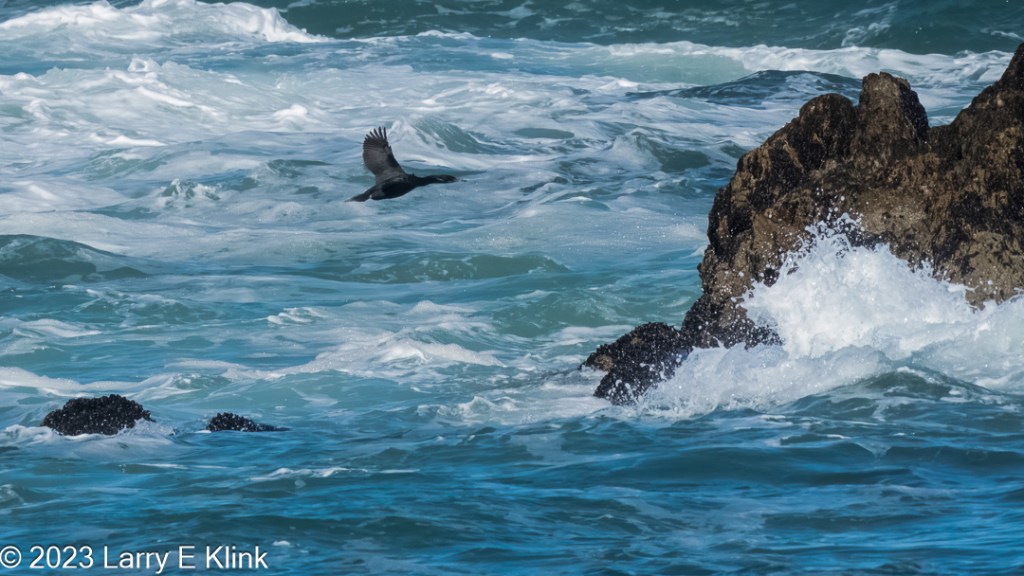
This image portrays a rough surf crashing over a large, triangular rock. Two Brandt’s Cormorants are flying low over the surf. The ocean water is pale gray-green. The rock is black with a brown peak. The surf is a mix of pale gray-green and white. The birds are black and are flying left to right, low above the surf.
Brandt’s Cormorants Traversing Crashing Surf
17 Mile Drive, Carmel By The Sea, California, USA; APR 2023

We returned to northern California for 2 weeks and visited many familiar spots. So, for the next few weeks, I will be featuring photos from that trip. I was intrigued by the birds thriving in the rough rocks and surf of the Pacific Ocean around Monterey and Carmel-By-The-Sea, California, USA.

Please click on caption to see image at higher resolution!

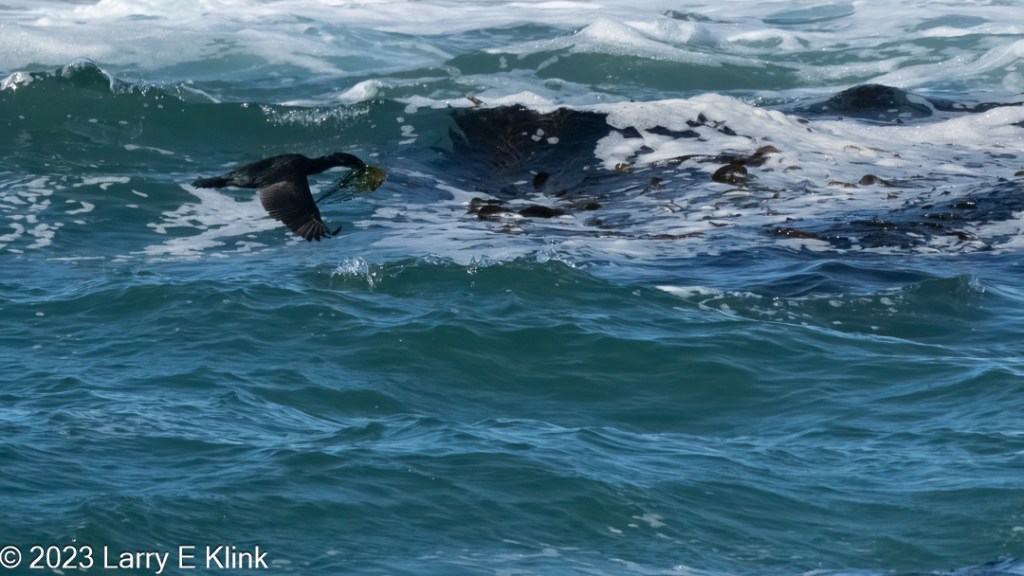
This image is a Brandt’s Cormorant flying left to right while carrying some type of sea grass for nesting material. The background is the blue-green water of the Pacific Ocean, capped with some white foam. The bird is black; the nesting material is in its beak and is a green color. The strip of water at the top of the image is pale gray-green. There is a large black object just below the surface of the water just to the right of the bird. It appears to be some type of marine plant.
Brandt’s Cormorant in Flight Carrying Nesting Material;
17 Mile Drive, Carmel By The Sea, California, USA; APR 2023
This image is a Western Gull flying towards the viewer, banking to the viewers right, over rocks.  The waters of the Pacific Ocean are a green-blue with a strip of darker blue-green at the top of the image. Some of the waves are capped with white foam. The rocks are brown. White surf is flowing over some parts of the rocks. The bird is white and gray with a yellow beak.
Western Gull In Flight;
17 Mile Drive, Carmel By The Sea, California, USA; APR 2023


This image portrays a rough surf crashing over a large, triangular rock. The ocean water is pale gray-green. The rock is gray and is mostly covered with surf and water spray. The surf is a mix of pale gray-green and white becoming deeper blue in the upper right corner.
Crashing Surf;
17 Mile Drive, Carmel By The Sea, California, USA; APR 2023
Brandt’s Cormorant in Flight;
17 Mile Drive, Carmel By The Sea, California, USA; APR 2023
This image is a Western Gull flying towards the viewer, banking to the viewers right, over rocks.  The waters of the Pacific Ocean are a green-blue with a strip of darker blue-green at the top of the image. Some of the waves are capped with white foam. The rocks are brown. White surf is flowing over some parts of the rocks. The bird is white and gray with a yellow beak.
Western Gull In Flight;
17 Mile Drive, Carmel By The Sea, California, USA; APR 2023

Please visit my website, www.earthwatcher.us to see my collection of landscapes and wildlife.

These and other images are available to purchase by contacting larry.klink@earthwatcher.us.

If anyone would like a copy of almost any picture in my library, for educational or research use, please contact me and I will happily share a digital copy with you.

Tale of Two Finches

Image of a male House Finch perched on a gray tree branch, facing left. The bird is surrounded by small twigs, The background is a blurred gray tree on the left fading abruptly to black on the right. The bird’s head and neck is a coppery orange fading to light gray over the breast. Its beak and legs are gray. Its eye is black. It has a gray-brown patch starting at its beak, across and below the middle, of its eye and finishing as ½ ellipse extending to the back of its head and down to the shoulder.
Male House Finch;
Roswell, Georgia, USA; FEB 2023

Most House Finches are red. However, its color comes from the food it eats during molt. Orange and yellow house finches can occasionally be seen.

I am sharing images of 2 male House Finches. These are very common birds whose range includes all the continental United States. One of the 2 images shows a bird with a red head and neck: the predominant color for these birds. The other showed up in our backyard a few weeks ago with this beautiful coppery-orange colored head and neck. It wasn’t the effect of the lighting; it was true color. I researched this condition and learned that House Finches can also come in Yellow. It all depends on what they ate or maybe they didn’t eat. The color derives from organic pigments known as carotenoids.

Please click on caption to see images at higher resolution.

Image of a male house finch perched on a gray tree branch, facing right. The background is blue sky crossed by gray tree branches of varying sizes. The bird’s head and neck is red, fading to light gray over the breast. Its beak and legs are gray. Its eye is black. It has a gray-brown patch starting at its beak, across and below the middle, of its eye and finishing as ½ ellipse extending to the back of its head and down to the shoulder. Its tail feathers are black with white tips at bottom corners.
Male House Finch;
Island Ford, Chattahoochee NRA, Roswell, Georgia, USA; MAR 2023

Please visit my website, www.earthwatcher.us to see my collection of landscapes and wildlife.

These and other images are available to purchase by contacting larry.klink@earthwatcher.us.

If anyone would like a copy of almost any picture in my library, for educational or research use, please contact me and I will happily share a digital copy with you.


Some Birds from Merritt Island – Part 2

Image of a Green Heron perched on a light gray branch facing right. The background is primarily green leaves from a mangrove tree. The cap on the bird’s head is blue-gray. Its back is a darker blue-gray. Its neck, breast and belly is brown with several thick, white stripes. The top of its beak is gray. The bottom of its beak, its legs and its eye are yellow.
Green Heron in the Mangroves;
Merritt Island National Wildlife Refuge, Titusville, Florida, USA; FEB 2023

A few of the other birds we saw at Merritt Island National Wildlife Refuge in Florida, USA.

Please click on caption to see images at higher resolution.

Image of a Little Blue Heron perched above the water on a mangrove tree branch, facing right. The branch is adorned with the green leaves of the mangrove tree. The water is alternately striped blue and gold. The bird’s body is a dark blue-gray Its beak and legs are a light blue-gray. Its beak has a black tip. Its eye is yellow.
Little Blue Heron;
Merritt Island National Wildlife Refuge, Titusville, Florida, USA; FEB 2023
Image of a Tri-colored heron wading in water, facing left. The background is rippled blue water. In the right upper quadrant of the image, the rippled water is reflecting brown from trees along the shore. The bird’s head, back of its neck and its wings are gray. The tips of its tail feathers are black. Its under feathers are white. Its neck is a reddish gray from the curve to the point where it joins the body. The front of its neck is spotted reddish brown and white. Its beak is long and yellow with a gray stripe on top. Its legs and eye are yellow.
Tri-colored Heron;
Merritt Island National Wildlife Refuge, Titusville, Florida, USA; FEB 2023
White Ibis;
Merritt Island National Wildlife Refuge, Titusville, Florida, USA; FEB 2023

Please visit my website, www.earthwatcher.us to see my collection of landscapes and wildlife.

These and other images are available to purchase by contacting larry.klink@earthwatcher.us.

If anyone would like a copy of almost any picture in my library, for educational or research use, please contact me and I will happily share a digital copy with you.
 

Birds of Merritt Island – Part 1

An image of a Blue Jay perched on a brown fence that is adorned by white bird droppings. The bird has a white face, breast, and belly with a black stripe above the beak, through the eye that continues diagonally down along the neck.  Its cap, back of neck and wings are light blue. The wing has a white wing bar. The beak and legs are dark gray. The eye is black.
Blue Jay;
Hobe Sound, Florida, USA; FEB 2023

A few weeks ago, we visited Merritt Island National Wildlife Refuge near Titusville, Florida, USA. We saw fewer species than we have seen during other visits. But we did see some of our favorites.

Please click on caption to see image at higher resolution.

Image of a pair of Common Gallinules on a pond. The background is water colored mostly brownish green. At the top of the frame, the water has jagged stripes of white, gray and brown. The birds have a gray cap, neck, and breast. Its tail feathers form a triangle at the back of the bird. It is predominantly white with a black stripe at its top and bottom. Its wings are brown with a white stripe at its base. It has a black eye patch.  The beak is red orange with a yellow tip.
Common Gallinule, aka Common Moorhen;
Merritt Island National Wildlife Refuge, Titusville, Florida, USA; FEB 2023

An image of a female belted kingfisher on a tree branch. The background is blue sky. At the bottom of the frame is the somewhat blurry green tree to. The tree branch is gray and is adorned with a gray, spaghetti like bindle of sticks. The bird has a dark gray head and black eye. At the base of the head, is a white neck ring. The beak is long and pointed; its color is dark gray. Its neck and belly are white and is bisected with a rusty orange stripe. Its wings are dark blue gray.
Female Belted Kingfisher;
Merritt Island National Wildlife Refuge, Titusville, Florida, USA; FEB 2023
A pair of Pied-billed Grebes floating on the water. The golden-brown pond water is the background. The head, neck and area below the feathers is light brown. The cap on its head and its back is gray. Is tail is the white tuft on the back of the bird. There is a white patch behind the beak, The beak is brown on type, white on the bottom with a black stripe circling it. Its eye is brown.
Pied-billed Grebe;
Merritt Island National Wildlife Refuge, Titusville, Florida, USA; FEB 2023
An image of a Red-winged blackbird sitting atop a shrub with leaves. The background is green with a light gray stripe, caused by the water, at the bottom. The shrub’s leaves are green, highlighted with yellow. The bird is all black. It has a patch of red feathers at the top of its wings. The patch has a yellow border at the bottom. The beak is gray, and the eye is black.
Red-winged Blackbird;
Merritt Island National Wildlife Refuge, Titusville, Florida, USA; FEB 2023

Please visit my website, www.earthwatcher.us to see my collection of landscapes and wildlife.

These and other images are available to purchase by contacting larry.klink@earthwatcher.us.

If anyone would like a copy of almost any picture in my library, for educational or research use, please contact me and I will happily share a digital copy with you.


A Backyard Skirmish

Red-shouldered hawk in the nest they attempted to build. The background is gray tree trunks, the front one broken off as well as a bit of light blue sky at the top. The hawk is on top of the nest which is made of gray sticks. The hawk has dark gray wings with light brown spots. Its neck, breast and belly are light orange with white spots. Its head is brown, eye is black, and beak is dark gray.
Red-shouldered Hawk at Prospective Nest Site;
Roswell, Georgia, USA; FEB 2023

We had a skirmish in our backyard. We had a pair of Red-shouldered Hawks attempt to make a nest in the backyard. We were excited. It would have been interesting to watch some baby hawks grow up. But our crows were strongly opposed to that move. It was a loud skirmish with crow caws and hawk shrieks but the crows won. In one of the battles, the crows chased a hawk away and formed a perimeter in 3 trees between the hawks and the nest. We’ve seen the hawks since that battle, but they’ve not attempted to complete the nest.

Please click on caption to see images at higher resolution.

An American Crow perched on a tree branch with its head facing front. The background light gray with small branches. There is a medium gray-brown tree trunk on the left side of the pictures. There is a light gray tree trunk behind the crow. The crow is black with black eye and beak.
American Crow;
Roswell, Georgia, USA; FEB 2023

Please visit my website, www.earthwatcher.us to see my collection of landscapes and wildlife.

These and other images are available to purchase by contacting larry.klink@earthwatcher.us.

If anyone would like a copy of almost any picture in my library, for educational or research use, please contact me and I will happily share a digital copy with you.
 

Lovely Avian Ladies

Female Northern Cardinal perched on a small, gray, tree branch protruding from another branch. The background is a medium gray. The bird has predominantly golden-brown body with a red crest. The wings are a medium-dark gray with red stripes. There is a black patch above the beak, around the eye and on its neck. The eye is black. The beak is red. Its legs are gray with a faint reddish cast.
Female Northern Cardinal;
Roswell, Georgia, USA; DEC 2022

I was taught that male birds were bright and beautiful while female birds were dull and drab. They were made that way so that the males could distract predators from the nest. I wasn’t taught so well. In some birds, the male and female look alike. In others, even though the female is drabber, she is absolutely beautiful in her own right. Here are a few examples.

Please click on caption to see image at higher resolution!

A female Eastern Towhee perched on a tree branch against a background of green leaves and brown twigs. The bird has a gray head, back and tail, a white belly and orange between the wings and belly The eye and beak are black.
Female Eastern Towhee;
Beaver Lake Bird Sanctuary. Asheville. North Carolina, USA
Female Eastern Bluebird perched on a medium gray tree branch. The background is dark with a few medium gray twigs interspersed. The bird has a gray head and neck. The primary feathers on its wings and tail feathers are blue. Its other feathers are black with white wing bars. Its neck and breast are orange, and its underparts are white. Its eye, beak and legs are black.
Female Eastern Bluebird;
Roswell, Georgia, USA; DEC 2021
Female Common Merganser, a species of duck, perched on what appears to be a section of a fallen tree that appears black. The background is blue and gray water with somewhat out of focus branches protruding above the surface and behind the bird’s head.  The bird has a yellowish-white breast, white neck and white underparts. It has a gray upper body and tail feathers. The wings are gray with a black and white patch. Its head is a dark reddish-brown with a white patch behind the lower side of the bill. It has a black eye and a red bill. Its legs and feet are orange.
Female Common Merganser;
Arboretum Waterfront Park, Seattle, Washington, USA; JAN 2023

Female Hooded Merganser, a species of duck floating on the water. The background and foreground is water in stripes of white, gray, blue and gold. The bird has a gray body and head. It has a brown crest, or hod, atop its head. The wings are dark gray with a small white patch. Its eye is a dull golden color. Its beak is black and is surrounded by a small white patch.
Female Hooded Merganser;
Arboretum Waterfront Park, Seattle, Washington, USA; JAN 2023

Please visit my website, www.earthwatcher.us to see my collection of landscapes and wildlife.

These and other images are available to purchase by contacting larry.klink@earthwatcher.us.

If anyone would like a copy of almost any picture in my library, for educational or research use, please contact me and I will happily share a digital copy with you.