Aerial Abstracts

Fans and Flows, Aerial Abstracts - P10
Aerial Abstracts – P10

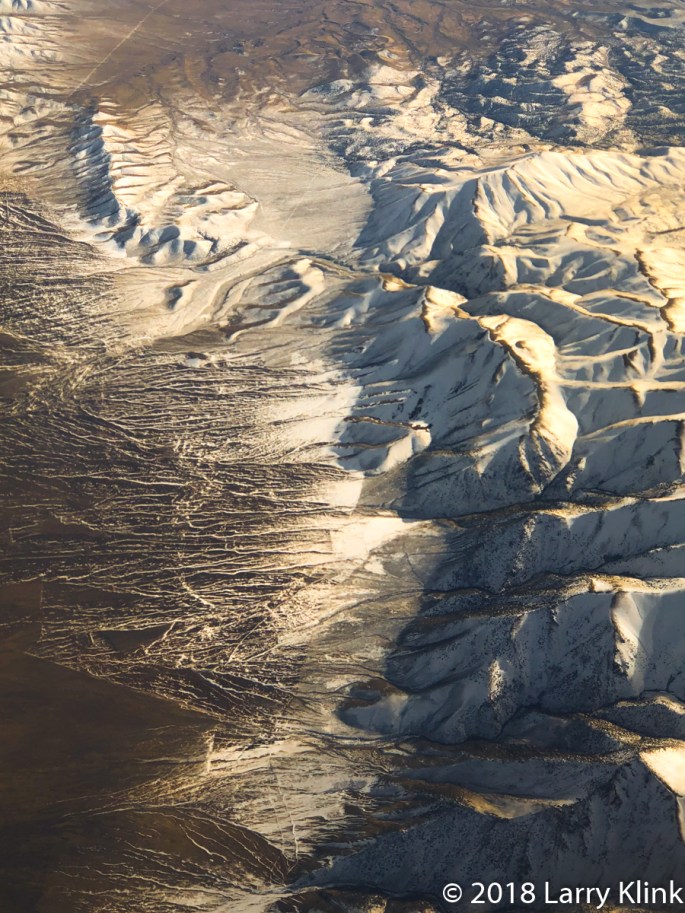
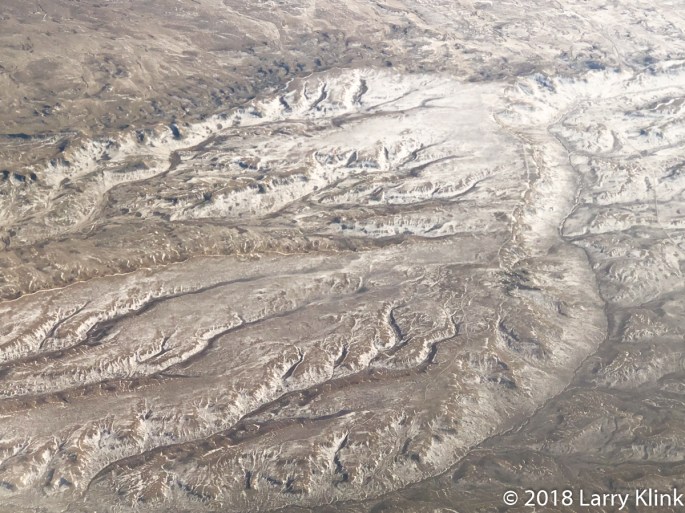
Abstract art uses color, shape and line to create a pleasing image. That image may or may not represent something real. In photography, you arrive at the result through a different route. You find a candidate and create a composition that emphasizes the pattern created by the color, shape and/or line over the subject itself.

I am a primarily a landscape photographer. As I progressed and learned more about that art, I became fascinated with the questions about how a scene evolved; what processes shaped it in the past and what processes are shaping it today. As I observed, I began to see the patterns and to understand how to recognize the effects of the wind, water and tectonic events that influenced it.  I also began to see how the patterns repeated themselves in different ways in different objects. It is those patterns that often make a wonderful abstract image.

On a recent cross-country trip, we flew over the high plains of Kansas and the foothills and peaks of the Rocky Mountains. In many places the snowpack was broken; ice and snow lay in the crevices where snowmelt flows, while the remaining surfaces were clear. I was struck by the patterns that I saw. Erosion created patterns like those of a bush branching or leaves branching on a stem. In one spot, I saw a fish backbone with its tiny ribs extended. Using my trusty phone camera, through an airplane window, I created some abstracts from the landscapes I love.

I hope you enjoy these images. Reflect on the patterns – what do you see?

Regards

Larry

Note: Click on Caption to see larger, higher resolution image

These and other images are available for purchase at http://www.earthwatcher.us or by contacting me at larry@earthwatcher.us.

Aerial Abstracts - P4
Aerial Abstracts – P4
Aerial Abstracts - P11
Aerial Abstracts – P11
Aerial Abstracts - P9
Aerial Abstracts – P9
Aerial Abstracts - P5
Aerial Abstracts – P5

These and other images are available for purchase at www.earthwatcher.us or by contacting me at larry@earthwatcher.us.

Great Basin Images

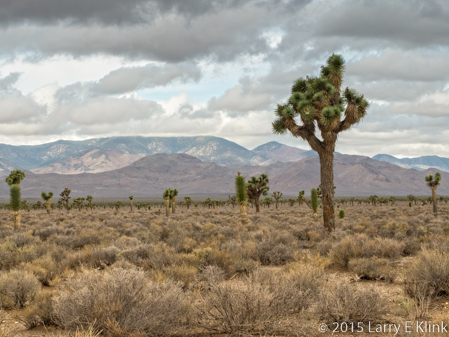
Image of Joshua Tree Forest in Nevada
Joshua Tree Forest

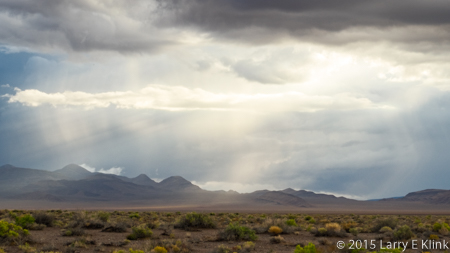
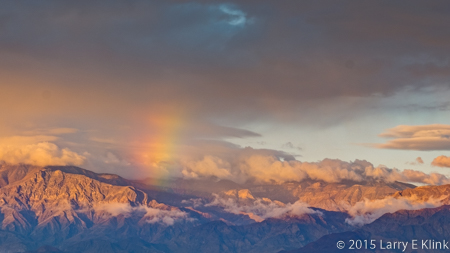
In October, 2015, Donna and I made a tour of the Great Basin area in Nevada.  I recently revisited the images I took during that trip and decided to get them ready to publish.  The first image is of a special Joshua Tree forest.  It is special because, over the mountains,behind the forest, lies Groom Lake, the fabled Area 51.  I wonder what you’d see if you were a bug on one of the trees.  The second image is of a rainstorm over the desert.  It is raining in the distance as crepuscular rays cast their beams over the desert landscape.  The third image is a rainbow over Death Valley.  I’ve published a version of this image before but wasn’t happy with it.  Now it’s back and will be one of the images featured in my show at ACAI Gallery and Studios beginning December 17.  The fourth image is one of Mesquite Dunes in Death Valley.  It too will be displayed in my show.

Image of rain and crepuscular rays over Nevada desert
Clouds, Sun and Rain
Image of a rainbow at sunrise over Death Valley
Wondrous Morning
Image of Sun Set Over Mesquite Dunes - Death Valley
Sun Setting Over Mesquite Dunes – Perspective 1

An Early Spring Day in Yosemite

We are fortunate this year that El Niño gave us a respite from the drought; a good snow pack in the Sierra!  I moved to northern California 4 ½ years ago.  My wife told me many times that the ephemeral waterfalls, those that dry up and go away quickly, make Yosemite especially beautiful in early spring. But years of drought gave us little snow, leaving those falls dormant or very short lived. I never had a chance to experience them.

Last weekend, we took an overnight visit to Yosemite.  My wife was right, everywhere I looked there was a waterfall that I had never seen before.  Even Horsetail falls, the one that lights up like fire at sunset in February, was still running.  The Merced River was running strongly.  We hiked along the Merced River on the trail to the bridge at Vernal Falls.

Roiling & Thundering

At the juncture of Illouette Creek and the Merced River, the waters roiled over the cascades making whitewater that looked like a giant head of cauliflower and sounded like thunder.  It was amazing.


For me, the real treat was Yosemite Falls.

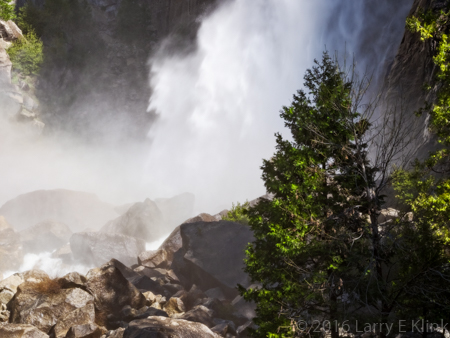
Base of Lower Yosemite Falls

Base of Lower Yosemite Falls, Yosemite National Park, APR 2016

It, too, thundered from the water crashing over the cliff.  Yosemite Creek was rushing harder and was fuller than I have ever seen it.

Rivulet on Yosemite Creek

This little cascade is normally dry. But the snow melt left Yellowstone Creek running high, fast and loud creating a channel bringing this cascade alive. Yosemite National Park, APR 2016


But the real treat was a brilliant rainbow in the mist at the base of the lower falls.

20160416-Yosemite-028-WEB

The sun cast a brilliant rainbow in the mist at the base of the Lower Yellowstone Falls. Though other colors could be seen, the sun highlighted the red-orange spectrum casting a golden glow over the rugged landscape. Yosemite National Park, APR 2016

Though other colors could be seen, the sun highlighted the red-orange spectrum casting a golden glow over parts of the landscape.

20160416-Yosemite-033-WEB

Yosemite Falls thundered strongly from the early spring runoff creating a cool breezy mist. The sun played upon the mist, painting a brilliant rainbow that cast the landscape in a golden glow. Yosemite National Park, APR 2016


Yet, as I traveled through Yosemite, another thought struck me.  As humans, ephemeral describes things that come and go quickly; in the span of short periods within our lifetime.  But, solid rock in places like Yosemite last for time frames impossible for humans to comprehend but do eventually wash away.  To the earth is really ephemeral?

A Deceiving Role
A contrast, the juxtaposition of the ephemeral with the lasting. But, which is really ephemeral? That which appears lasting is eroded, one grain at a time, by that which appears ephemeral, until it is eventually washed away. Meanwhile, that which appears epemeral rushes to sea, evaporates and returns to erode again. Yosemite National Park, APR 2016


Regards,

Larry

These and other images are available for purchase at my website, http://www.earthwatcher.us or by contacting me at larry@earthwatcher.us.

A Spring Morning on the Cosumnes River

Cosumnes RIver, North Fork
A Spring Morning on the Cosumnes River – Perspective 1 Bucks Bar Road, Somerset, CA

My wife, my mother and I decided to visit Daffodil Hill, a beautiful spring attraction in Amador County, CA.  After the visit, we decided to wander some of the lesser traveled roads in rural El Dorado and Placer counties; an area where my wife spent a lot of time during her childhood.  As we wandered, we crossed a small bridge spanning the North Fork of the Cosumnes River.  The Cosumnes is a 52 mile long river starting as 3 forks in the Sierra Nevada, eventually merging with other rivers and flowing into the San Francisco Bay by way of the Sacramento/San Juaquin delta.  We were somewhere along the North Fork near Somerset, CA.  The recent rain and snow, brought on by the El Nino, has given us a brief respite from the years of drought.   The river was flowing rapidly through this shallow gorge.  The morning sun filtered through the forest, highlighting the bright spring green of life reawakening.

I hope you enjoy these 2 perspectives of this beautiful canyon.

Cosumnes RIver, North Fork
A Spring Morning on the Cosumnes River – Perspective 2

These and other imageas are available to purchase on my website: http://www.earthwatcher.us or by contacting larry.klink@earthwatcher.us.

Regards,

Larry


Birds

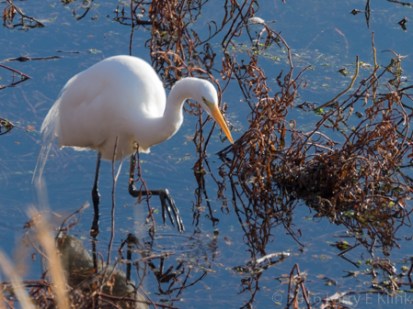
I am not typically a bird photographer.  When I do shoot birds, I try to take them in the context of their environment, trying to answer the questions: this is who I am and this is how I survive.  Living in the Sacramento, CA area affords me the opportunity to shoot migrating winter birds but, I find I really like to go back to the usual suspects – herons, egrets, Canada geese and mallards, hawks.  Learning about them, observing their behavior gives me a lot of pleasure.

The last week or so, I’ve had the added pleasure of trying out my new Fujinon 100-400mm F4.5-5.6 lens and 1.4X Tele-converter.  Its a great lens but its been more than a year since I shot with a long lens so, I made a few depth of field mistakes.  Oh well, I guess I just need to go out and shoot more.

Anyway, here are a few images I shot.  I hope you enjoy them.

20160209-Wm-Pond-Park-047-WEB
Great Egret
20160209-Wm-Pond-Park-027-WEB
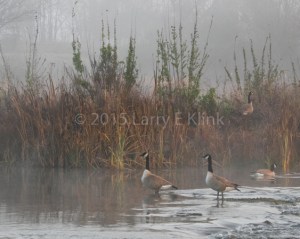
Canada Goose
20160209-Wm-Pond-Park-030-Edit-WEB
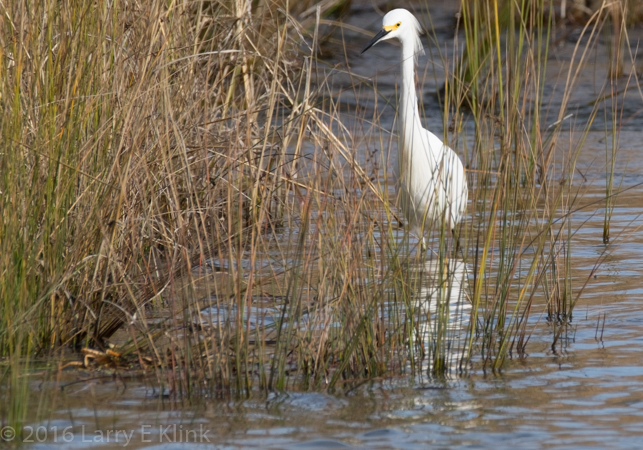
Snowy Egret
Mountain Plover - Winter Plummage
Mountain Plover
20160209-Wm-Pond-Park-043-WEB
Red Shouldered Hawk
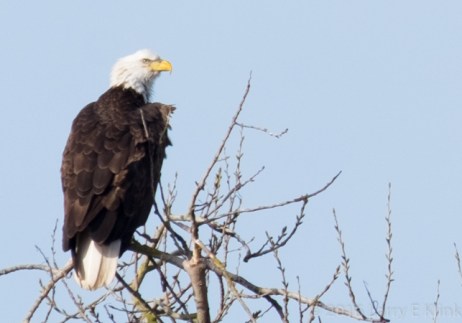
Bald Eagle
Bald Eagle
Snowy Egret
Snowy Egret


Frightened, Ravaged, Dying

Frightened, Ravaged, Dying – APR 2015 (Click for Larger Image)

Tree,
frightened, ravaged,
stripped of bark,
hemorrhaging, dying.
Living its last days,
beautifully bejeweled,
glistening in the sun.

Shooting With My Phone

Rainbow Bridge, American River Parkway, Folsom, CA, JUN 2015 (Click to See Image Enlarged)

I regularly walk along various stretches of the American River Parkway trail system. It is a great place to get exercise and enjoy the beauty of an urban forest and riparian habitat. I rarely have my camera because, if I did, I’d never get exercise. But, I always have my phone.

On several of my blogs, I remind readers that it is the composition and lighting that make the image and not the camera. Especially with today’s smartphone cameras and their incredible software. But, I have a problem using my phone. I can’t hold it steady enough to lock in the composition and get the focus right. So, I invested in a walking stick/monopod/tripod by Manfroto and a bracket to hold my phone. Now, I can overcome my shakiness. I also carry a microfiber cloth to clean the lens – it can get grimy being carried around in purse, pocket or holster. Grimy lenses impact the clarity of the image.

I have the Samsung Galaxy S6 with its 16MP rear camera. It does a great job. You can use it as a point and shoot by using auto mode or you can put it in pro mode which allows you to manually control functions just like on a DSLR. I find manual selection of the focus point to be the most useful but wish it wasn’t tied to the auto exposure so I could control them separately.

The attached image was shot with my phone last week. I am very pleased with it. Enjoy and make the best of your photography.

Please share.

Regards,

Larry

Using the Light You are Given

Figure 1: Image with Warm Saturated Colors

Landscape photographers are taught that you should always try to shoot during the golden hours; roughly the 3 hours after sunrise and the three hours before sunset.  Indeed, the warm saturated colors make very dramatic and beautiful vistas.  But does that mean you pack away your camera the rest of the day?  Not really.   You can get great shots any time of day if you work with the compositional elements and lighting you have to craft a great composition.  It is the composition that makes the image.

I took the image in Figure 2 on a clear day, at mid-day, when the sun was high.  The composition is decent and interesting.  You can see some texture in the canyon and the canyon itself leads your eye

Figure 2: Image Taken Under Uninteresting Light

through the image.  So, it is a good image to show friends that have never been to Yosemite, what they would see; a travel photograph.  But it’s not a great image.   Contrast that with the image in Figure 3, taken from a similar perspective but with strong, dramatic lighting.  The difference is obvious.  Besides making the picture pop with color, the light leads your eye through the image to interesting features.  It provides shadows that add texture.  It makes the image much more interesting.

Figure 3: Image With Strong , Dramatic Light

So, its obvious:  If you have great light, you can make better image.  But, what if you can’t just run off and chase the light? You have to work with what you have when you are there.

Look again at figure 3 to see the enhancements the light is providing.  It provides  color, texture and controls the movement of the eye through the image.   When you have light that is diffuse, you need to find other compositional elements to compensate for the missing light.

Figure 4: Image Taken Under Diffuse Light

Look at Figure 4.  It was taken under cloudy skies, in the evening.    It is, to me, a very interesting image.  I like the composition.  While the light is not available to provide the interest, look at how the grass and leaves provide texture that contrasts with the granite and the stream.    The colors in the leaves add color that subtly pops the image.   Even without strong light, there are shadows and highlights.  The stream and the line of rocks lead the eye.

Figure 5 is an image taken under foggy conditions that also diffuse the light.  In this case there is some subtle early morning rim light highlighting the edges.  The color and texture in the reeds and bushes provide texture to offset the fog shrouded background and the stream.

Figure 5: Image Taken Under Low, Diffuse Light

The key is to look around; to see what is happening; to see what you can use; then craft your image from what you have.

Regards,

Larry

These and other images are available on my website: http://www.earthwatcher.us, or by contacting me at: larry@earthwatcher.us.

Golden Hued Yosemite

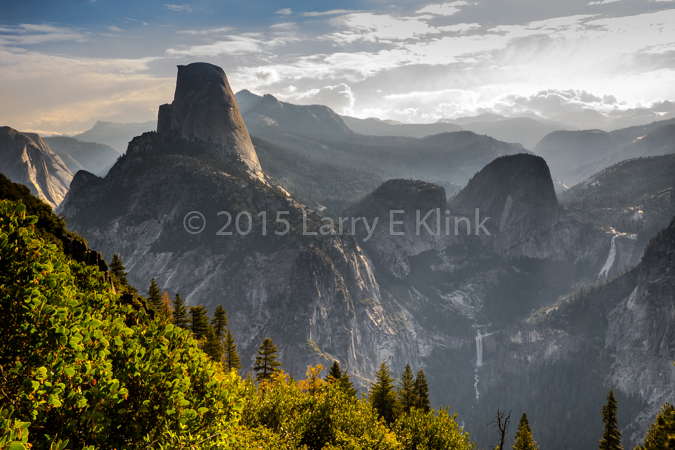
Warm Light Breaking Through Storm Clouds, Trail to Inspiration Point, Yosemite National Park, MAY 2015

This past week, it rained and snowed in the Sierra.  Not nearly enough to have any real impact on our drought.  But, as evening comes and the storm breaks up, golden sunlight streams through the breaks in the clouds, dappling the mountainsides with gold hued color.  I took advantage of the weather conditions this week and visited Yosemite for a quick overnight trip.  My goal was to do some exploring and to study how light can add depth to an image.  I did some research and learned that sun would be setting in a line that would illuminate half dome, clouds rest and the canyons below.  A perfect setting for what I wanted to do.  To satisfy the explorer in my blood, I went off the beaten path to get different perspectives with Half Dome as my anchor.

Early Evening Light Breaking Through Rain Clouds Over Yosemite Valley. Glacier Point, Yosemite National Park, MAY 2015

I hiked the trail toward Inspiration Point looking for a different perspective from the traditional view of Yosemite Valley from Tunnel View. The trail is 2.6 miles, round trip, with a 1,000 foot elevation gain.  Aside from being steep, it is full of rocks, many of which are loose, and many tree roots.  It’s not for the casual walker.  But, for those that are willing to endure, the view of the valley, especially Bridalveil Falls, is spectacular.

I also hiked a small section of the Panorama Trail; the portion from Glacier Point to the top of Illilouette Falls and back.  This piece is 4 miles round trip with a 1,470 foot elevation change.  Fortunately, most of trail is very well groomed.

Morning Light Awakening Half Dome and Little Yosemite Valley, the Valley of the Merced River, Panorama Trail near Glacier Point, Yosemite National Park, CA MAY 2015

This portion of the Panorama trail provides a perspective of Half Dome from the back leading down to Little Yosemite Valley and Vernal and Nevada Falls.  Illilouette falls is a 370’ waterfall that is quite beautiful as seen from the Mist Trail.  But, you really cannot see the fall itself from the portion of the trail that I hiked; perhaps crossing the bridge may lead you to a spot where the falls are visible.  There is one spot where you can see the top of falls through the trees and another spot where it may be more visible if you stand right on the cliff edge.  Though you cannot see the fall itself, there is a beautiful cascade where the trail bridge crosses the river.  That, in and of itself, is worth the effort to go there.

Nice weather, nice light, spectacular scenery.  It was a great time.  I hope you enjoy the images.

Regards,

Larry

Sharing Natures Beauty

These and other images are available for purchase from my website, http://www.earthwatcher.us, or by contacting larry@earthwatcher.us.

Life in the Shadow of a Volcano

Mt Shasta - Perspective 1, MAY 2015
Mt Shasta, MAY 2015

Mt Shasta, topping off at 14,167 feet, appears as a huge monolith rising out of the countryside as you travel through far North Central California.  It is a stratovolcano; a large cone made of layers of different material ejected during its eruptions.  Should Mt Shasta erupt, it will create severe natural as well as economic impact.  According to Stephen L. Harris, in Fire Mountains of the West, during the last 10,000 years, Mt Shasta has erupted, on average, once every 600-800 years.  But, its pace has accelerated to once every 200-300 years in recent centuries.   Its last significant eruption was 200 years ago.  There are no signs of imminent activity.

Mt Shasta - Perspective 2,  MAY 2015
Mt Shasta, MAY 2015

Volcanoes can be quite disruptive.  When we think of volcanoes, we see images of ash plumes, mudslides, lahars and other natural impacts.  If you happen to be there when in erupts, it will change your life.   But, their periods of activity represent only a very small fraction of their life.  During periods of inactivity, the water from their snow melt brings moisture to the lands below.  Additionally, water and wind erode the mountain side, spreading nourishing minerals to the land below.  If you travel through Eastern Washington, Oregon and California, you see the benefits in places where the rich land has been put to use for agricultural purposes.

I hope you enjoy these images of Mt Shasta.  As you do, pause to think about all we derive from this gentle giant who, only infrequently, explodes and creates havoc.

Regards,

Larry

You can see and purchase these and other images from Larry Klink at http://www.earthwatcher.us or by contacting larry@earthwatcher.us.