A Year in the Life of Deer

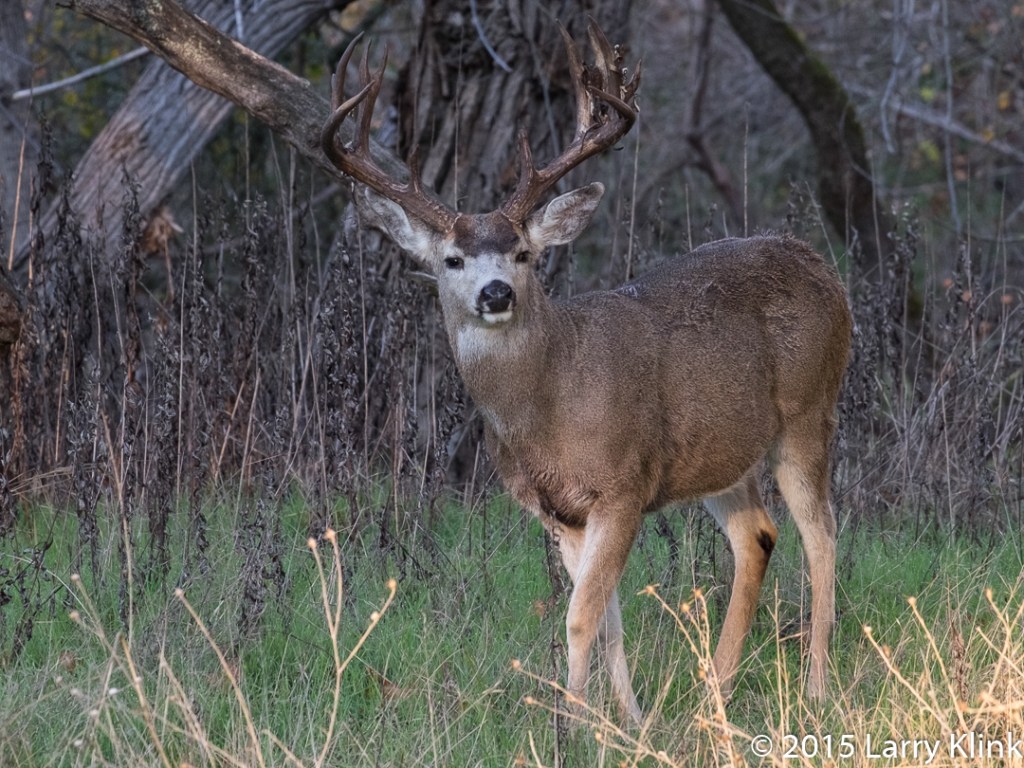
Black-Tailed Mule Deer (Odocoileus hemionus) Buck;
Effie Yeaw Nature Center, Sacramento, CA; DEC 2015

The Black-tailed Mule Deer (Odocoileus hemionus) are found on the western Great Plains, the Rocky Mountains, Southwestern United States and the West Coast of North America.

Deer are ungulates, meaning they are hooved. They are also ruminants which means they eat and send their food to the rumen; one of its stomachs. Later, it regurgitates the cud (food) from its rumen, chews it and sends it to its other stomach to digest. Male deer, like moose and elk, have antlers. Antlers are made of bone which are shed and regrown each year. (Animals like sheep, goats, cattle, and antelope have horns. Horns are made of bone covered with keratin which are permanent; not shed and regrown.) The prongs on an antler are referred to as points; a 6 point buck has 3 prongs on each antler.

Male deer are called bucks, female deer are called doe and the babies are called fawns. During most of the year, deer segregate themselves by sex; bucks in groups and doe, along with their young, in separate groups.

Each year, deer go through a reproductive cycle that begins with the “rut”[i]. The rut is the time when male deer fight for the right to breed with a harem of females and concludes with impregnated doe. As the rut commences and bucks have regrown their antlers, the bucks attempt to form a harem. One buck may challenge another for the right to breed with a harem. Bucks will lock antlers and push and fight until one is pushed backwards and loses the challenge. It is a dangerous time for bucks; they can become permanently injured. The ultimate winner breeds with the females as they enter estrus. Gestation is about 200 days.

In mid-to-late winter, the bucks drop their antlers. When the antlers regrow, they are covered with a furry skin commonly called velvet. When the antlers have completed their growth, the velvet dries and causes irritation for the bucks. The bucks rub their antlers against a tree to remove the velvet.

About the time autumn begins, when the fawns have grown and the bucks’ antlers have regrown, the rut begins again.

Note: Please click on caption to see images at higher resolution.

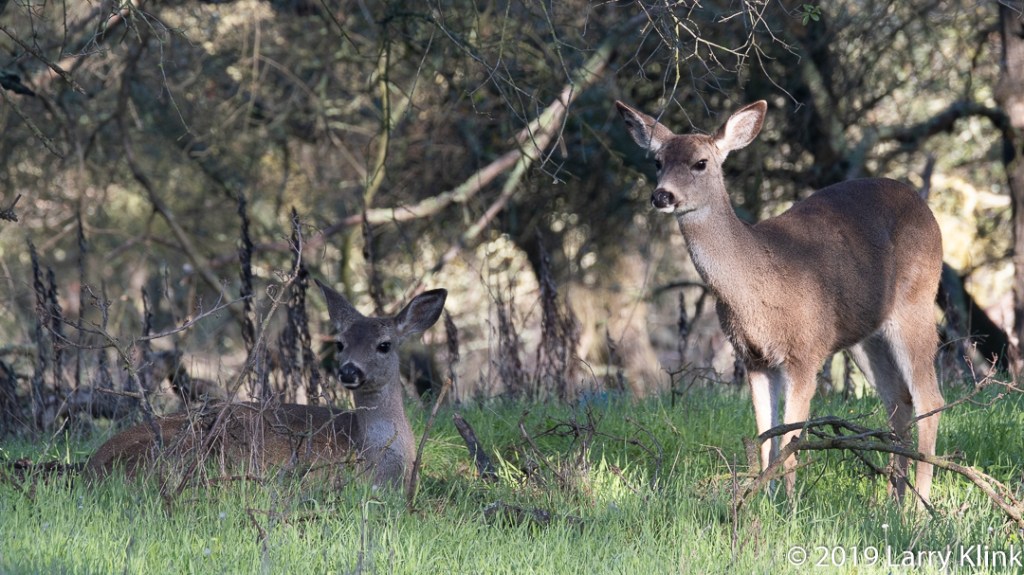
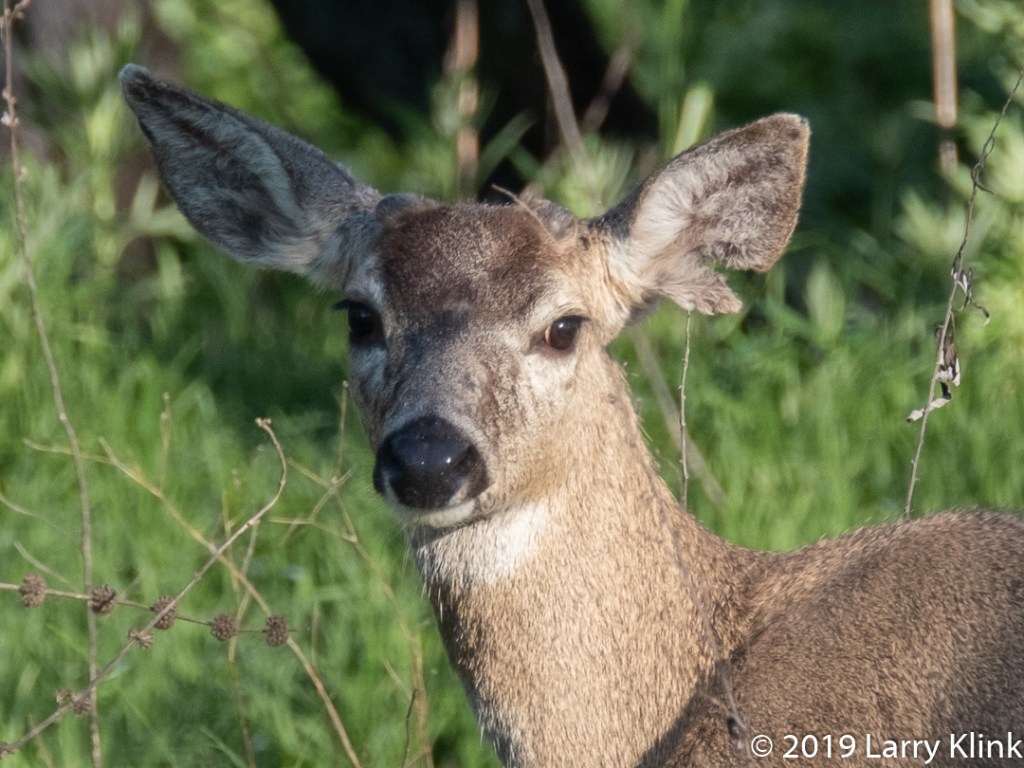
Black-Tailed Mule Deer Doe;
Effie Yeaw Nature Center, Sacramento, CA; FEB 2019
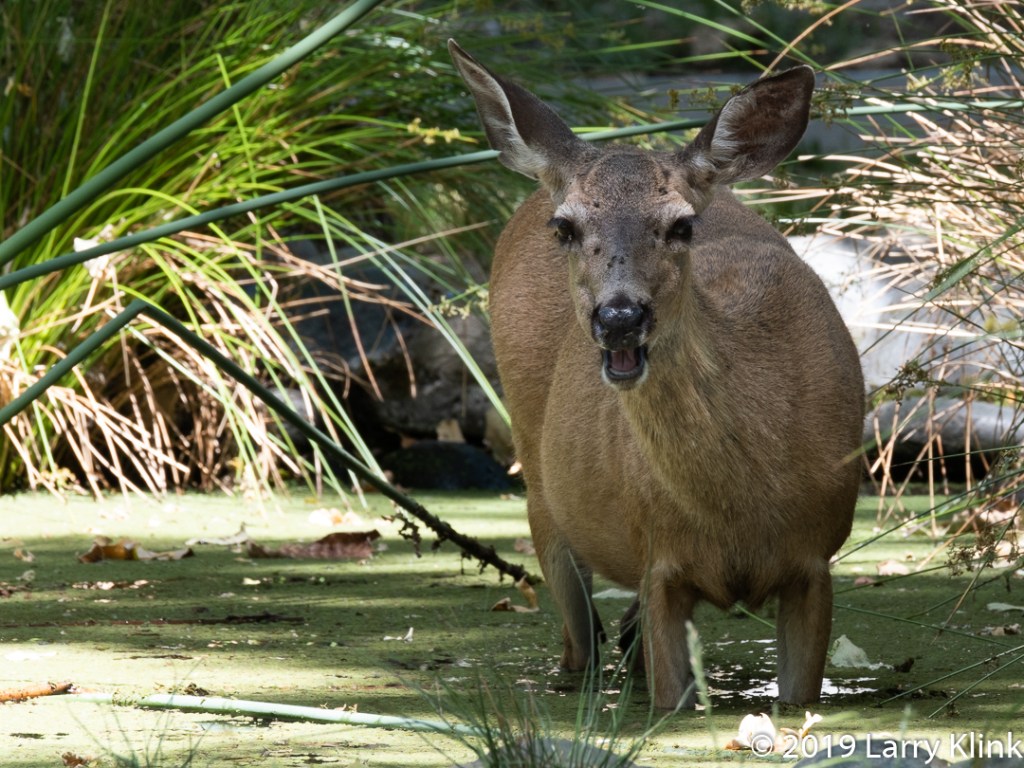
Pregnant Black-tailed Mule Deer;
Effie Yeaw Nature Center, Sacramento, CA; JUN 2019
Black-tailed Mule Deer Fawn;
Effie Yeaw Nature Center, Sacramento, CA; JUL 2019
Black-tailed Mule Deer Nursing Her Fawn;
Effie Yeaw Nature Center, Sacramento, CA; JUN 2019
Black-tailed Mule Deer Buck After Losing Antlers;
Buck was limping. Other bucks still had antlers. It is possible antlers were lost in combat.
Effie Yeaw Nature Center, Sacramento, CA; MAR 2019


Black-tailed Mule Deer Buck with Antlers in Velvet;
Effie Yeaw Nature Center, Sacramento, CA; JUN 2019
Black-tailed Mule Deer Buck; Antlers with Velvet Partially Rubbed-off;
Effie Yeaw Nature Center, Sacramento, CA; SEP 2019
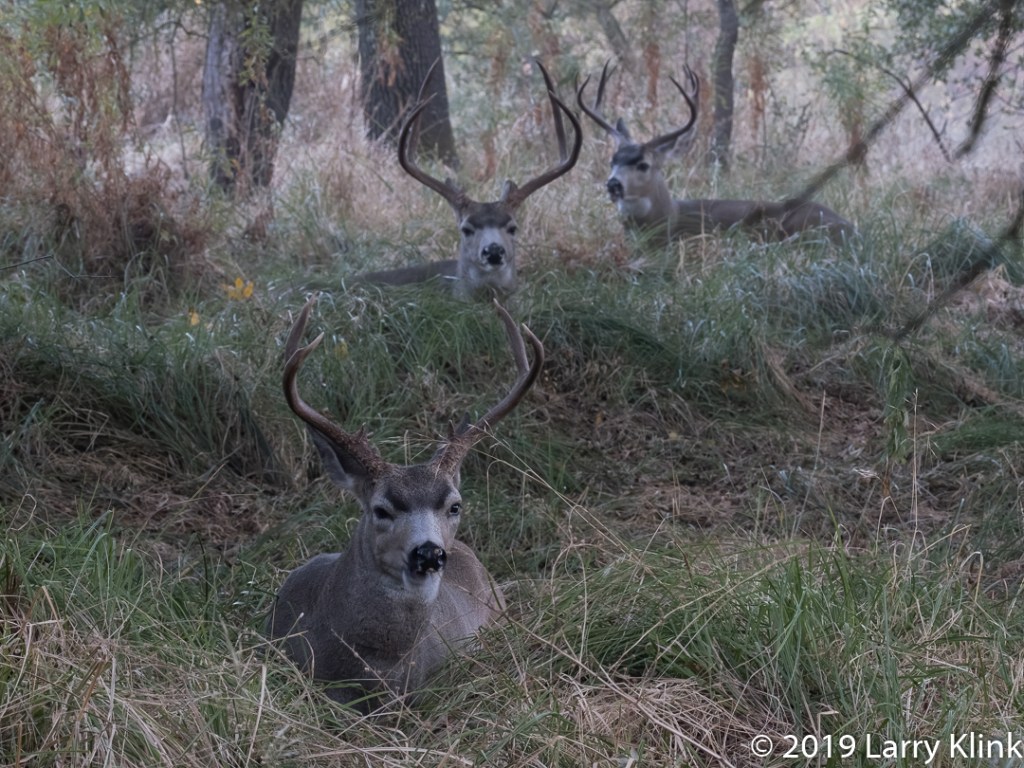
Bucks With Antlers Grown and Polished; the Year Begins Anew ;
Effie Yeaw Nature Center, Sacramento, CA; OCT 2019

These and other images are available to purchase on my website: www.earthwatcher.us or by contacting larry.klink@earthwatcher.us.

[1] Information obtained from: https://www.wildlife.ca.gov/Regions/6/Deer/Natural-History

South African Landscapes and Seascapes

Cape Cormorants on the Western Cape
Cape of Good Hope, South Africa; SEP 2018

Three years ago, we visited South Africa. Afterward, I shared many images, mostly of the abundant and beautiful wildlife. Though I published some landscapes and seascapes, I have many that I didn’t publish. I thought I’d go back and share some of them now. There will be more in the future.

Note: Please click on caption to see image at higher resolution.
Tree Overlooking Sugarcane Field;
Near Eshowe, South Africa; AUG 2016
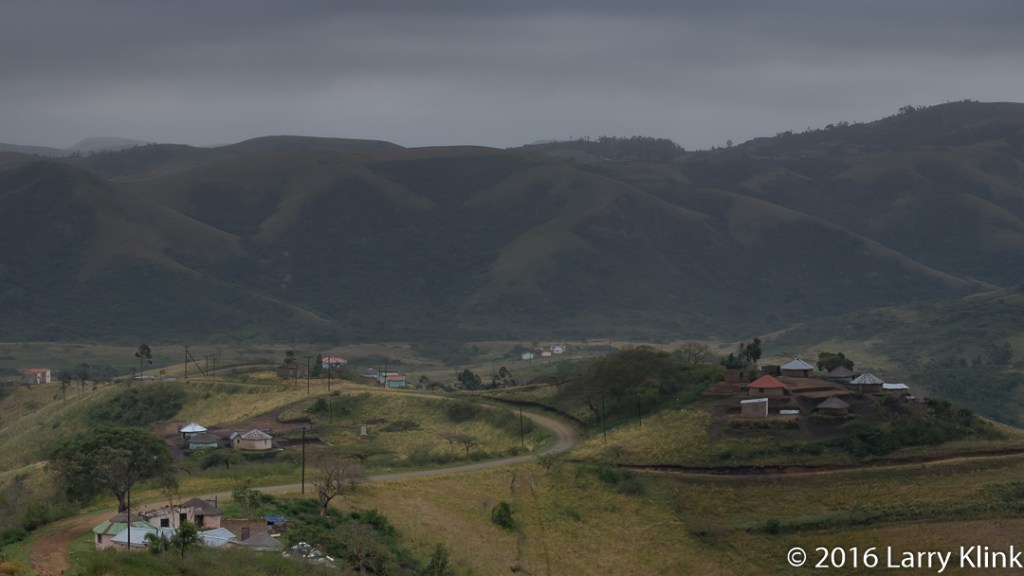
Zulu Homesteads;
Near Eshowe, South Africa; AUG 2016
Waves Breaking at Tsitsikamma Beach;
Tsitsikamma National Park, South Africa AUG 2016

View of the Bush;
Elephant Plains, Sabi Sands, South Africa
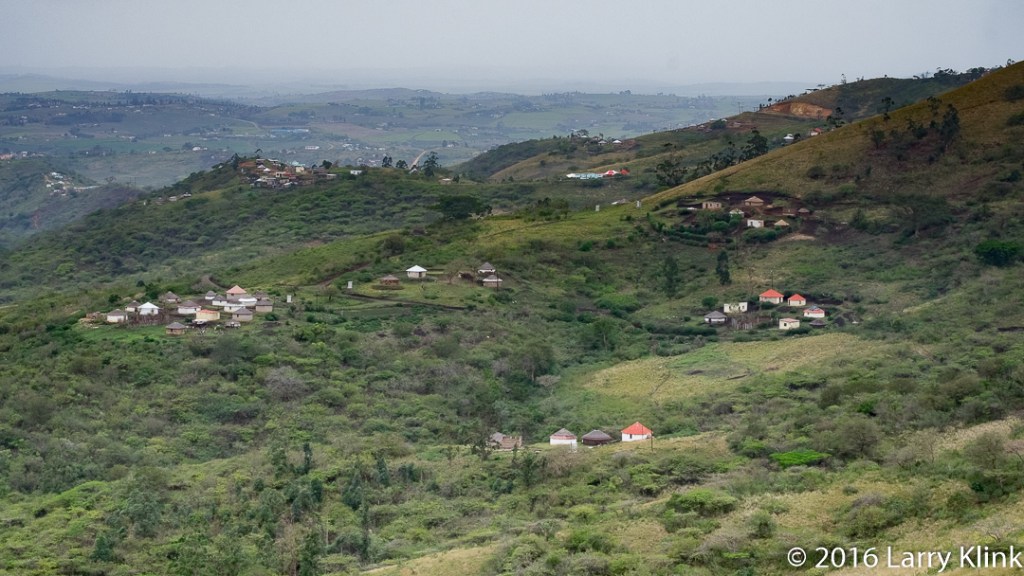
Homestead Dotted Hillside;
Near Eshowe, South Africa, AUG 2016

These and other images are available to purchase on my website: www.earthwatcher.us or by contacting larry.klink@earthwatcher.us

Seal Rock, Oregon

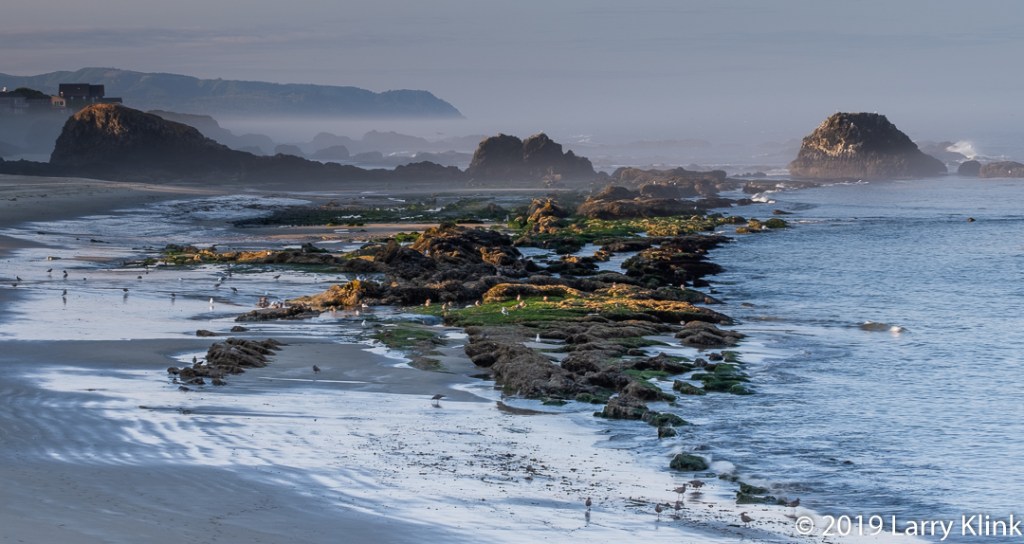
Seal Rock Beach at Sunrise
Seal Rock, Waldport, OR; AUG 2019

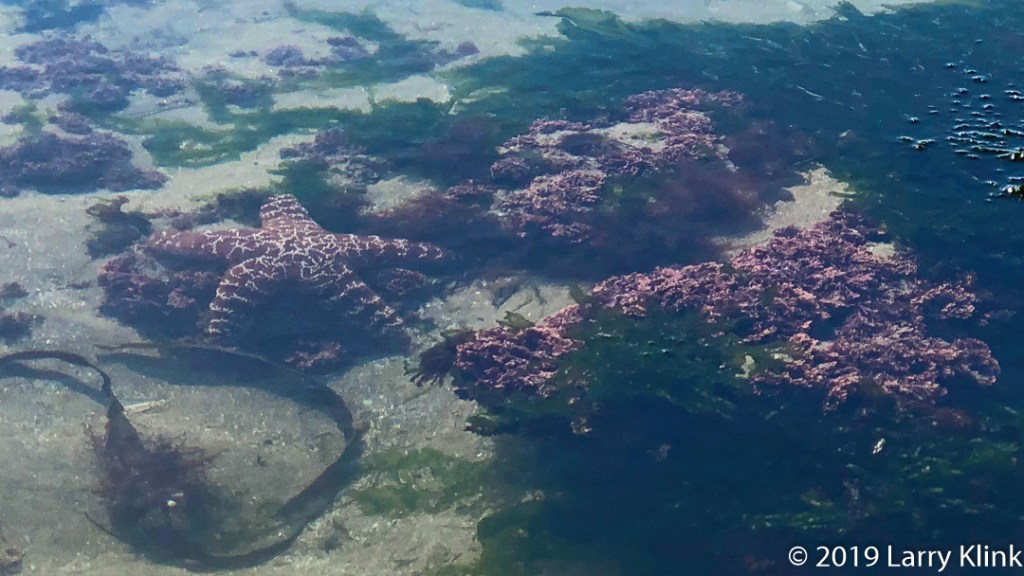
We recently spent a few days on the beach at Waldport, OR. It is located in Oregon Dunes area of the coast. Just outside of town sets a beach amongst a craggy, old volcanic lava flow. It is a beautiful beach with many tidal pools left teeming with wildlife as the tide recedes.

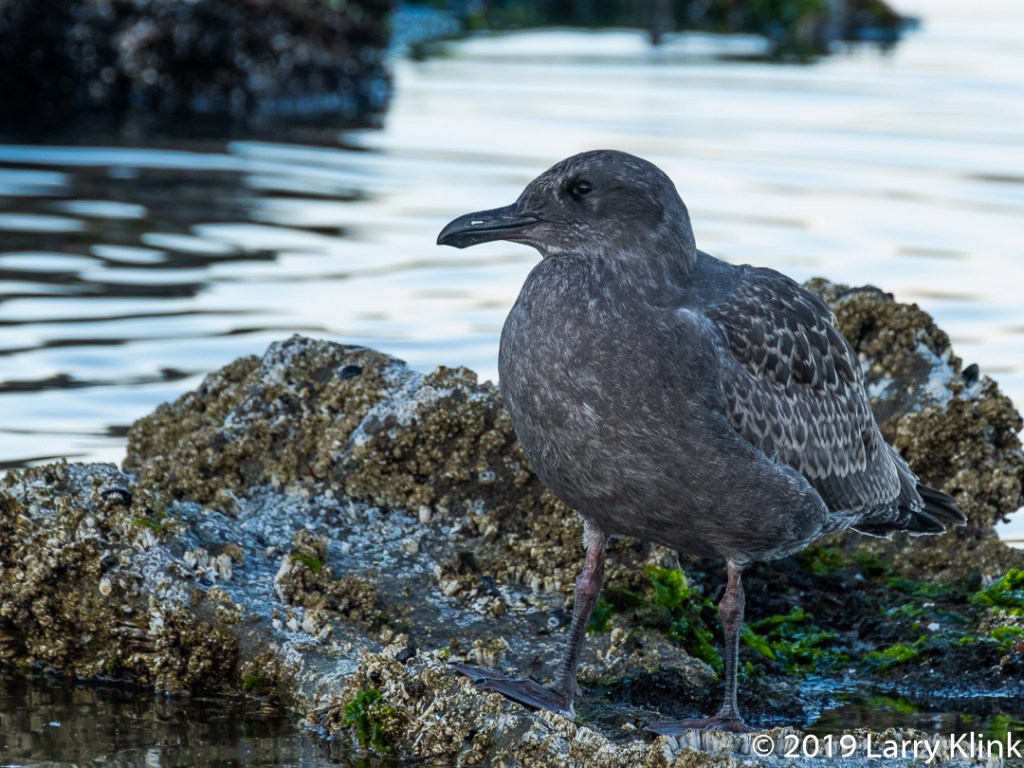
On this visit, the birds really took center stage. We saw some seals, but they were offshore and all I could see were heads bobbing. So, they weren’t photo worthy. But we found some Pelagic Cormorants (Phalacrocorax pelagicus); one with a chick on the nest. We found Western Gulls (Larus occidentalis), many of which were recently fledged juveniles.

The Pelagic Cormorant is found along coastal waters and eats fish and marine invertebrates. It roosts and nests on steep, inaccessible rocky cliffs. It swims and dives for food.

The Western Gull is the common gull that you find on US West Coast beaches. They like fish, marine invertebrates, bird eggs and jelly fish. They will also scavenge on carrion and human refuse.

Our experience with the Western Gull brought some amusement. The juveniles were in the water and along the shore. When they wandered too far inland, an adult would chase after and send it back to the shoreline with the others. In the early morning, we even saw adults force the young into the tidal pools to splash and bathe. It was great fun.

Note: Please click on caption to see image at higher resolution

Pelagic Cormorant (Phalacrocorax pelagicus)
Seal Rock, Waldport, OR; AUG 2019
Juvenile Western Gull (Larus occidentalis)
Seal Rock, Waldport, OR; AUG 2019
Starfish in Tide Pool
Seal Rock, Waldport, OR; AUG 2019
Western Gull (Larus occidentalis)
Seal Rock, Waldport, OR; AUG 2019

These and other images are available to purchase on my website: www.earthwatcher.us or by contacting larry.klink@earthwatcher.us.
Grand Canyon Monsoon – Part 2

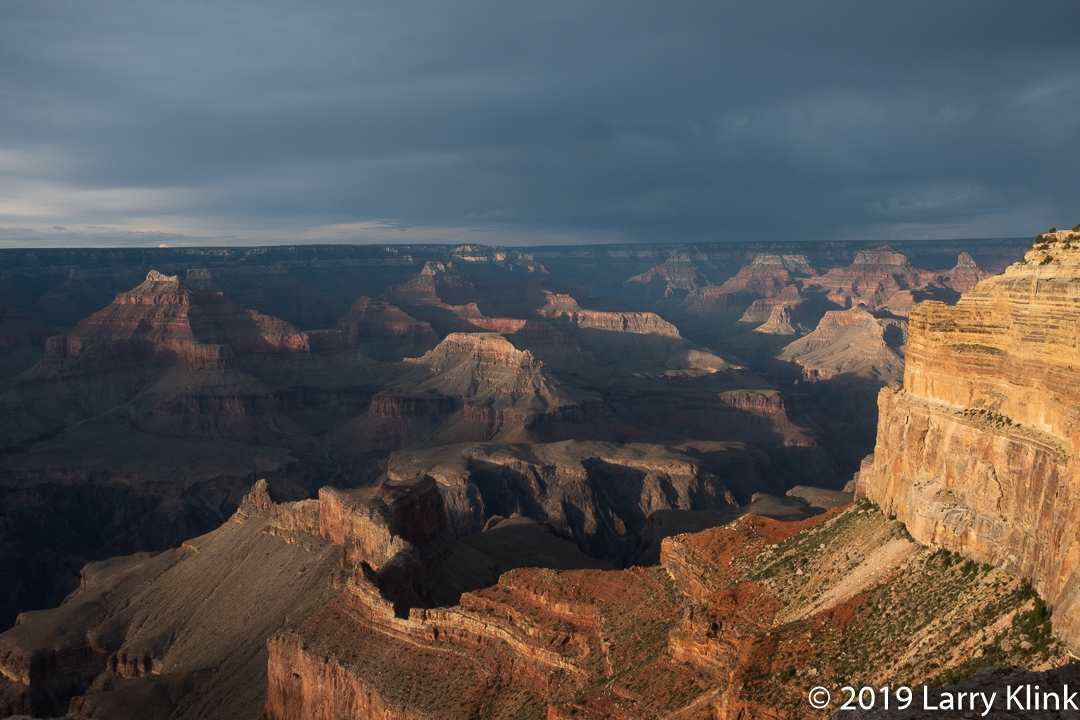
Sunset Over Grand Canyon – P2;
Rim Trail Between Mojave and Hopi Points,
South Rim, Grand Canyon National; Park; AUG 2019

This is the remaining images from the Grand Canyon that I plan to share at this time. Again, I hope you enjoy these images from this amazing place.

Note: Please click on caption to images at higher resolution.

Lightning Over Grand Canyon – P1A;
South Rim, Grand Canyon National Park, AZ; AUG 2019
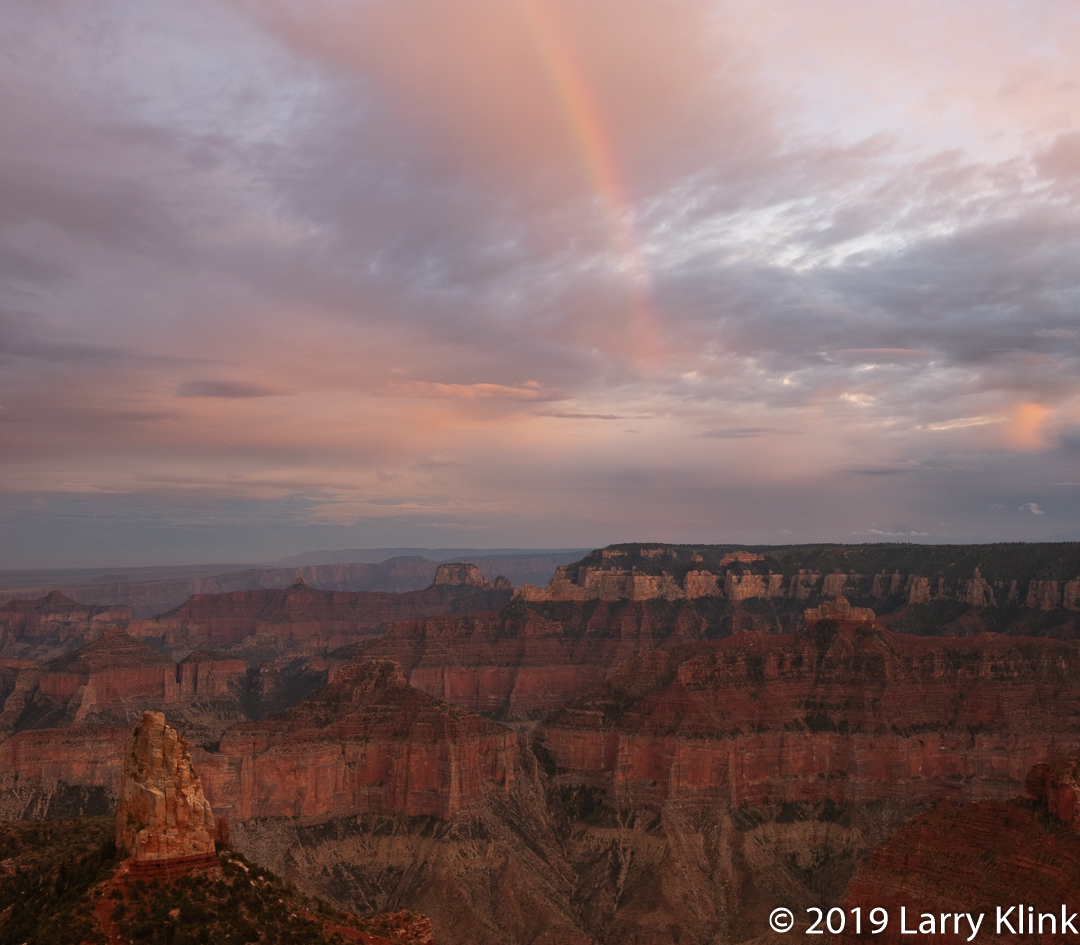
Rainbow Over Grand Canyon;
Imperial Point, Grand Canyon National Park, AZ; JUL 2019
Sunset Over Grand Canyon;
Rim Trail Between Mojave and Hopi Points, South Rim,
Grand Canyon National; Park; AUG 2019
Sunset From Imperial Point – P1;
Imperial Point, Grand Canyon National Park, AZ; JUL 2019
Lightning Over Grand Canyon – P3A;
Mojave Point, South Rim,
Grand Canyon National; Park; AUG 2019

These and other images are available to purchase on my website: www.earthwatcher.us or by contacting larry.klink@earthwatcher.us.
Grand Canyon Monsoon – Part 1

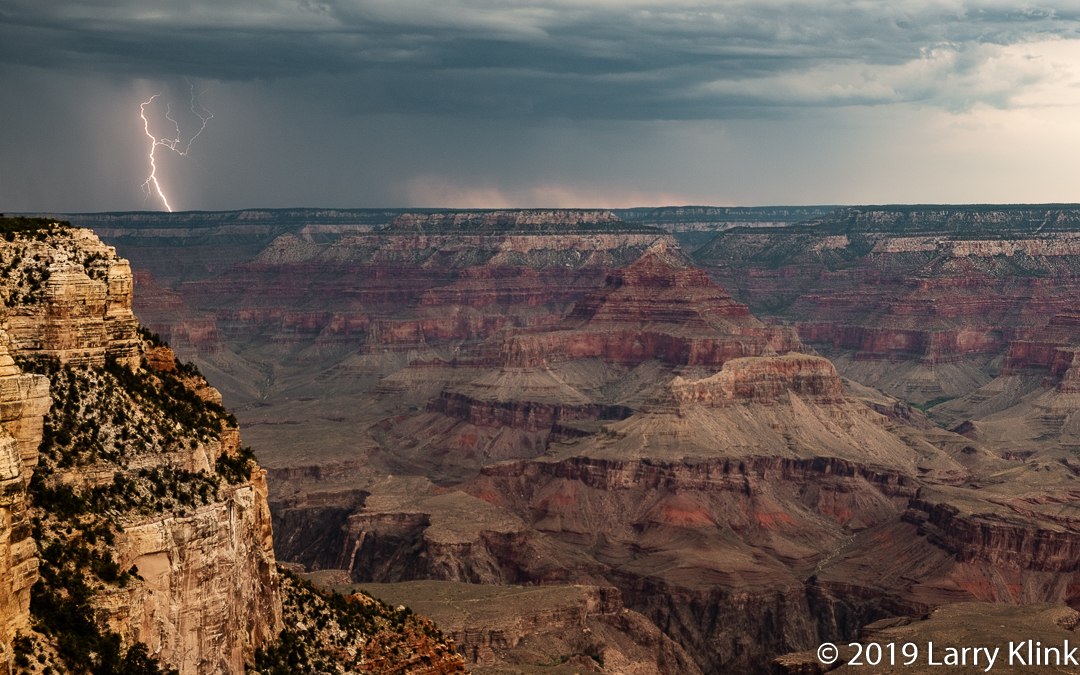
Lightning Over Grand Canyon;
South Rim, Grand Canyon National Park, AZ; AUG 2019

I recently had the privilege to photograph the Grand Canyon during the monsoon season of Southwestern North America. It was a marvelous time to visit this national wonder. We were treated to dark and stormy skies, lightning, rainbows and vivid sunrises and sunsets.

I generally don’t think of the southwestern US as having a monsoon season, after all, it is largely desert. I think of torrential rains in places like India and the eastern coast of Africa. But, the monsoon season in southwestern North America is very real. The term monsoon refers to the seasonal wind shift that brings in warm, humid air. Those winds cause most of the rainfall received by the desert southwest each year – all 1” to 8” of it; sometimes more and sometimes less. It can be responsible for torrential downbursts that cause flash flooding and lightning induced wildfires.

The southwestern North American monsoon season generally starts in early July and runs through September.

In this post, I am sharing a few of the images I took while at the Grand Canyon. I’ll share a few more later this week.


Note: Please click on caption to see image at higher resolution.

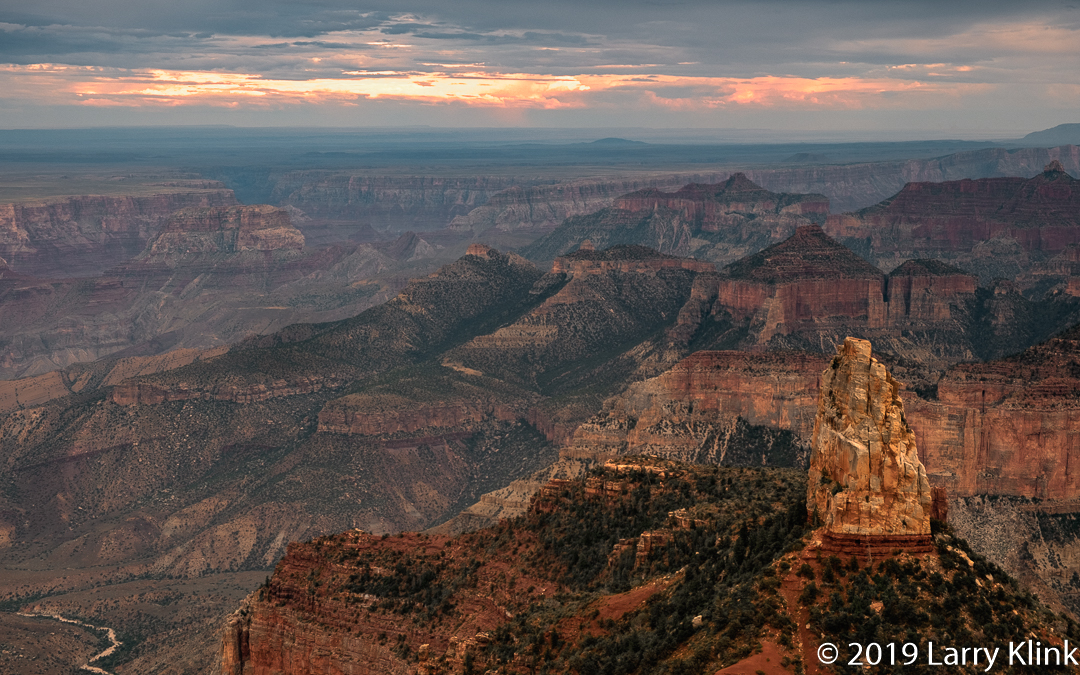
Sunrise From Imperial Point;
Point Imperial, Grand Canyon National Park, AZ; AUG 2019
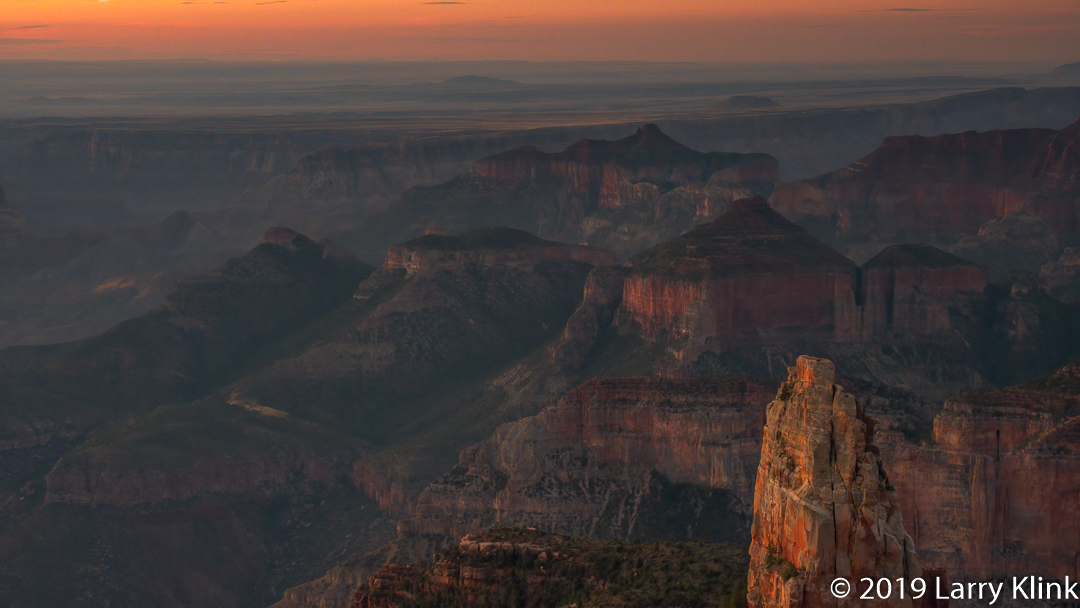
Milky Way From Cape Royal; Cape Royal
North Rim, Grand Canyon National Park, AZ; AUG 2019
Sunset Over Grand Canyon – P1
Mojave Point, South Rim, Grand Canyon National; Park; AUG 2019

Sunrise From Imperial Point – P1
Point Imperial, Grand Canyon National Park, AZ; AUG 2019

These and other images are available to purchase on my website: www.earthwatcher.us or by contacting larry.klink@earthwatcher.us.
Banff: Glaciers, Lakes and Glacial Streams

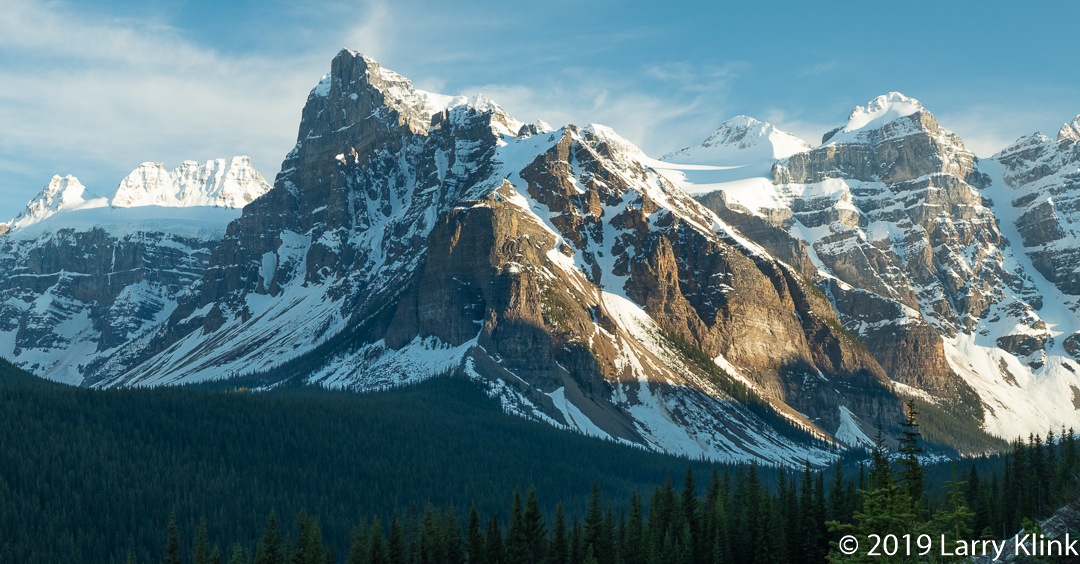
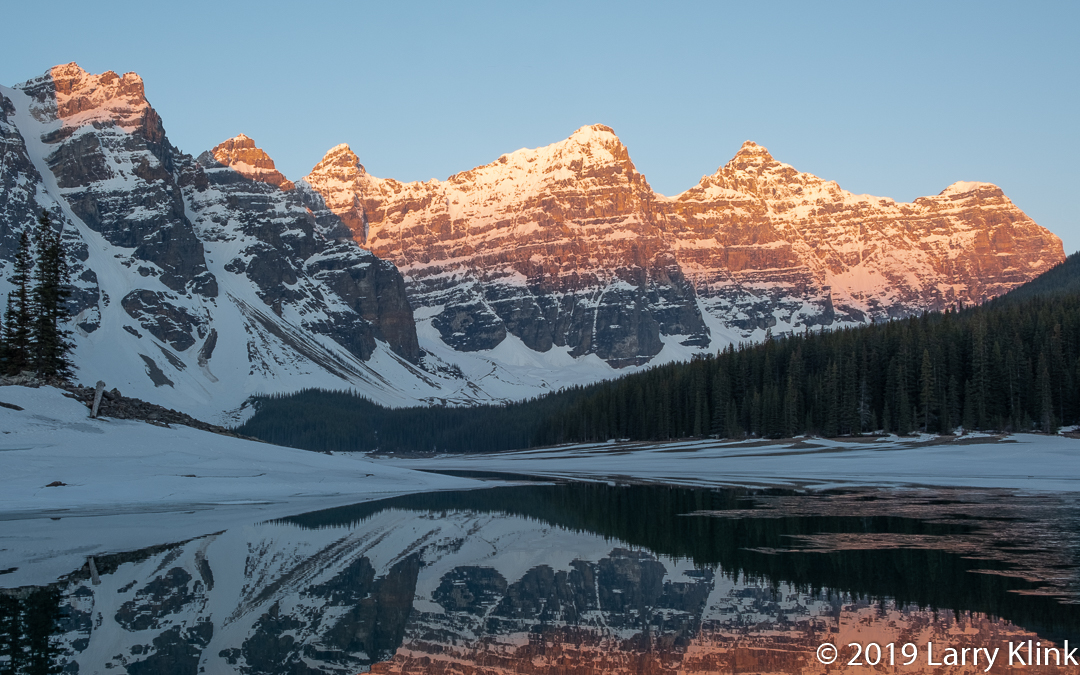
Ten Peaks from the Road to Moraine Lake;
Moraine Lake; Banff National Park, Alberta, Canada; MAY 2019

Canada’s Banff National Park is filled with stunning mountain peaks capped with glaciers and snow. The steep, rugged mountains are the source of beautiful, turquoise streams that feed alpine lakes.

The turquoise water is interesting. As glaciers move, they polish the underlying rock, producing very fine particles of dust called rock flour. The rock flour mixes with the water traveling downstream. The color is a result of light reflecting around the densely packed dust in the water.  On bright days, with the sun in the right position, the river displays the brilliant turquoise. If the sky is more cloudy, the water will be a milky off-white. When it reaches the lakes, the rock flour eventually settles out. But, if the river is filling the lake quickly, the lakes can be turquoise also.
The mountainside on this image from Kootenay National Park is beautifully colored. But the coloring is deceptive. The rust color is dead conifers. The black is foliage that was consumed by fire. Many of the conifers died due to pine beetle infestation.

Please click on caption to see image at higher resolution!

Kootenay RIver and Mount Harkin;
Kootneay National Park, British Columbia, Canada,; MAY 2019

Color born of tragedy: The rusty red color are evergreens damaged by the mountain pine beetle; the black is fire damage.
Bow Lake and Crowfoot, Bow Crow and Bow Peaks;
Banff National Park, Alberta, Canada; MAY 2019
Moraine Lake;
Banff National Park, Alberta, Canada; MAY 2019
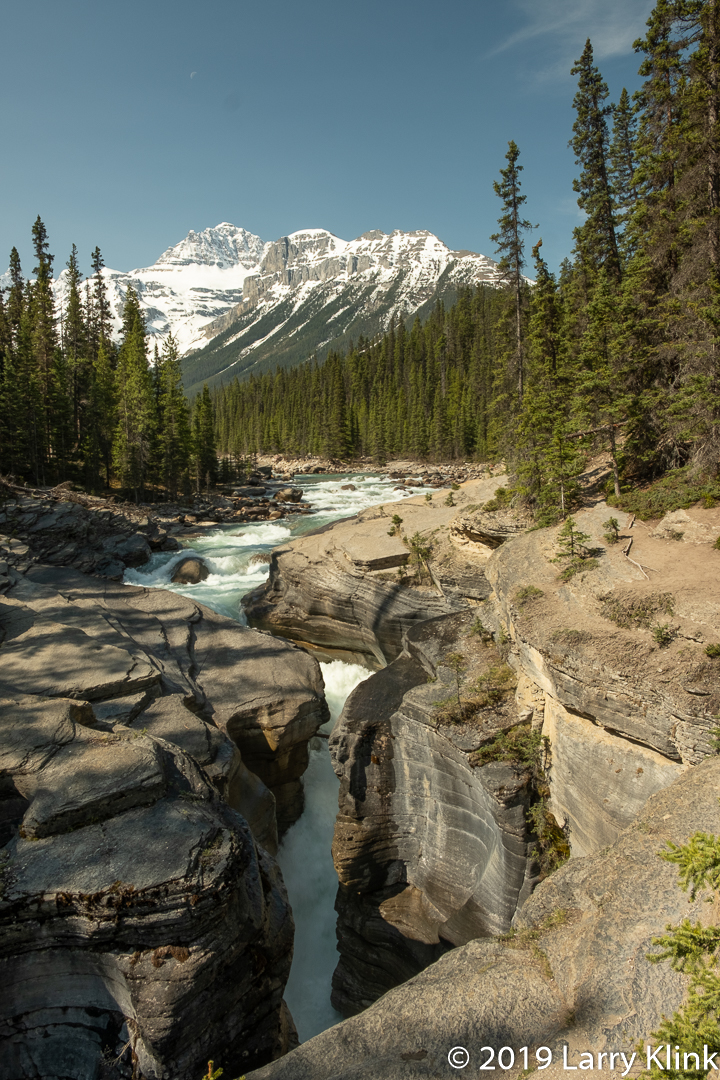
Mistaya Canyon;
Banff National Park, Alberta, Canada; MAY 2019
Bow Lake and Crowfoot Peak;
Banff National Park, Alberta, Canada; MAY 2019
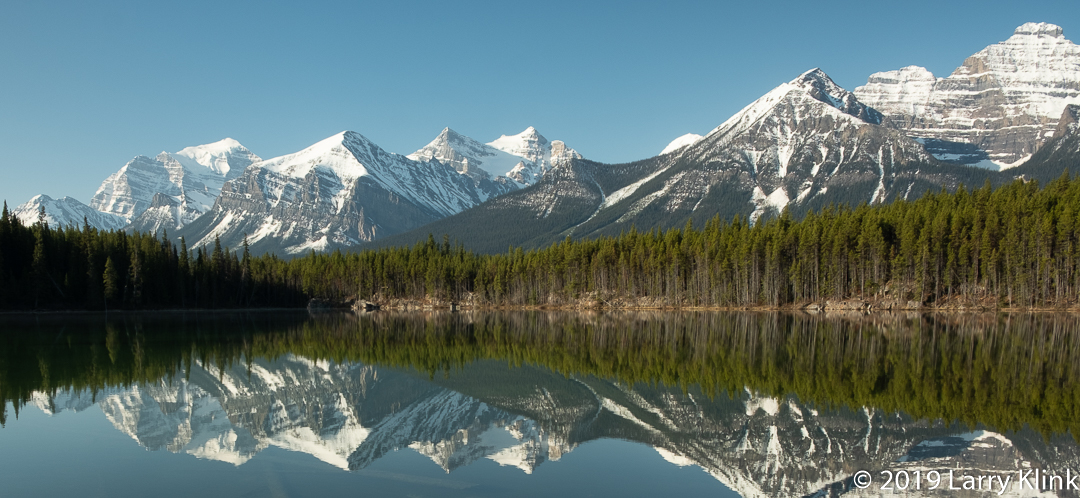
Herbert Lake; Banff National Park,
Alberta, Canada; MAY 2019

These and other images are available to purchase on my website: www.earthwatcher.us or by contacting larry.klink@earthwatcher.us

Some Recent Shorebird Sightings

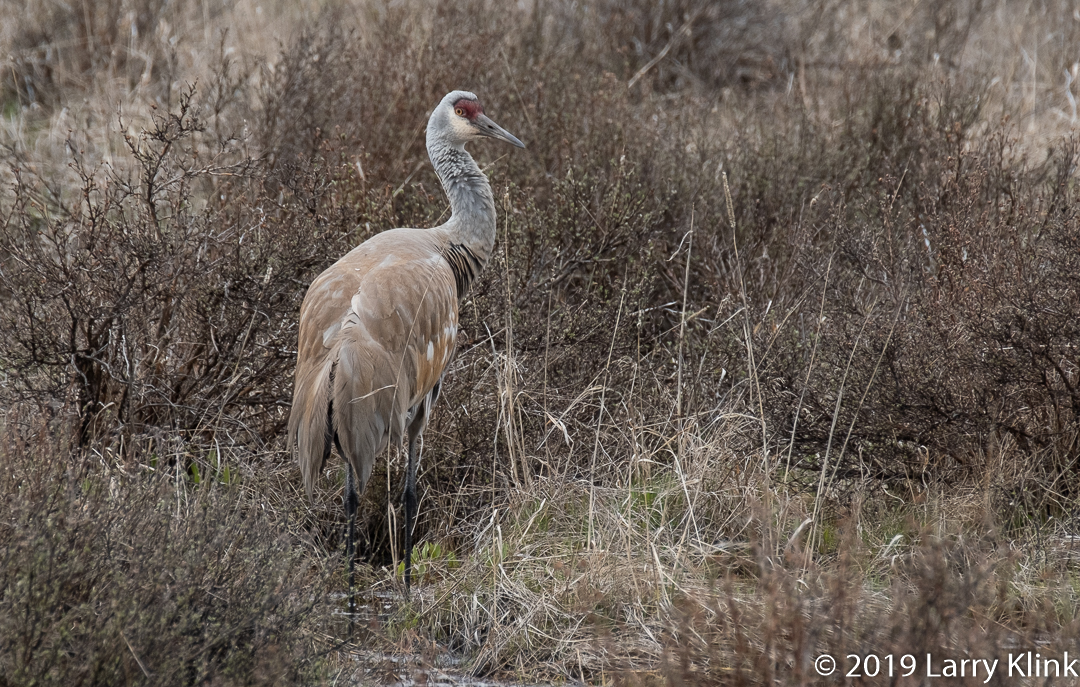
Sandhill Crane (Grus canadensis);
Hayden Valley, Yellowstone National Park, WY; MAY 2019

I’ve been busy and have gotten behind in posting some bird images I took this past spring. So, here are a few. I hope you enjoy them.

Note: Please click on caption to see image at higher resolution.

Green Heron (Butorides virescens);
Sailor Bar, American River Parkway, Fair Oaks, CA; APR 2019
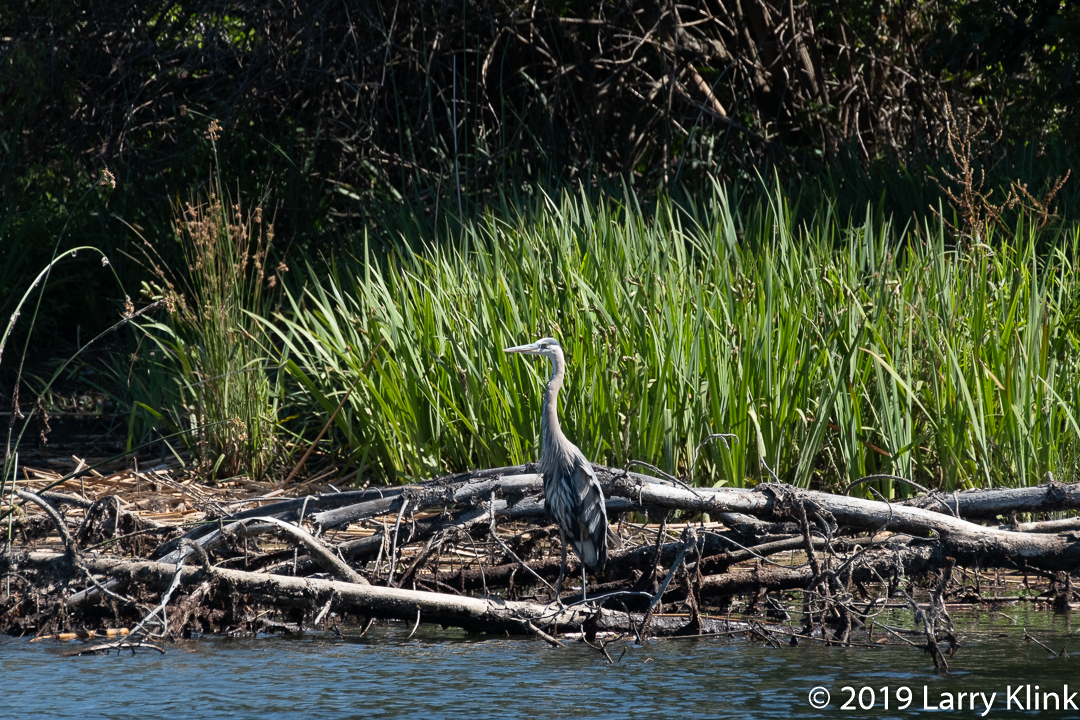
Great Blue Heron (Ardea Herodias);
Willow Creek Recreation Area, American River Parkway, Folsom, CA
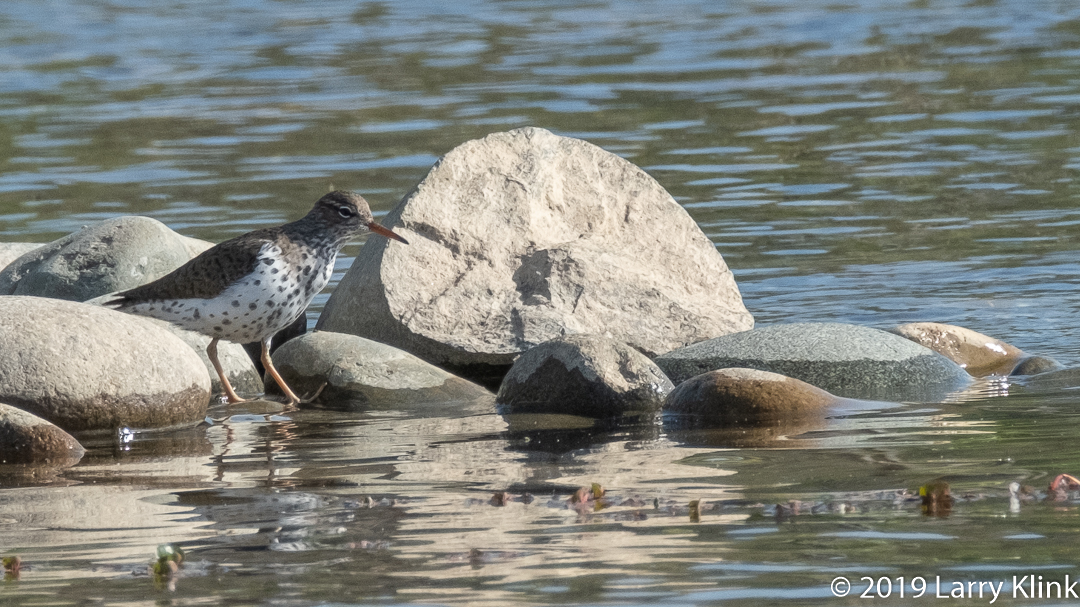
Spotted Sandpiper (Actitis macularius);
Effie Yeaw Nature Center, Sacramento, CA; APR 2019
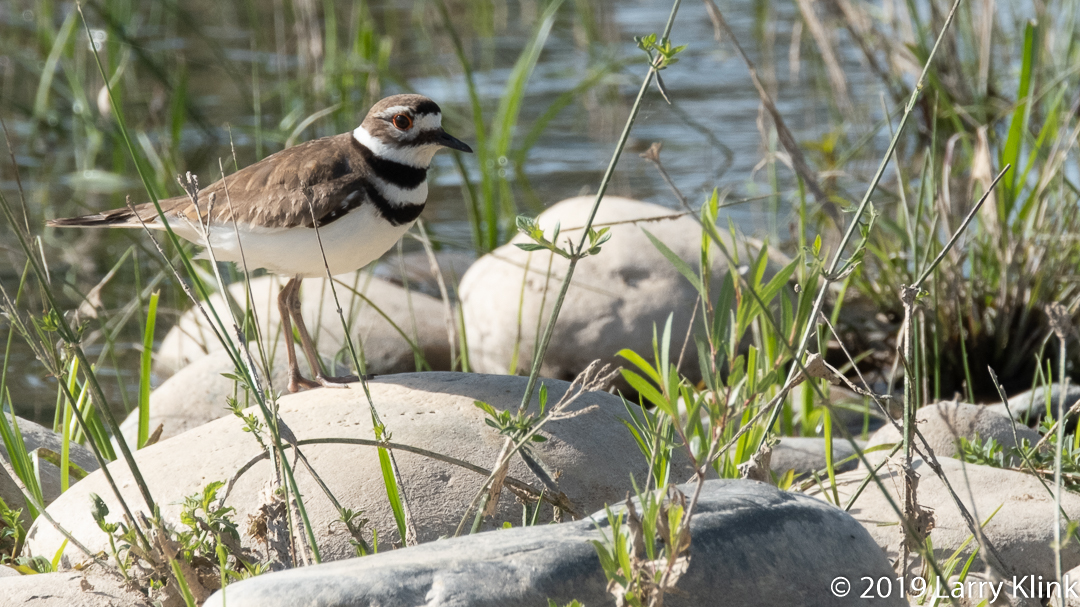
Killdeer (Charadrius vociferus);
Effie Yeaw Nature Center, Sacramento, CA; APR 2019
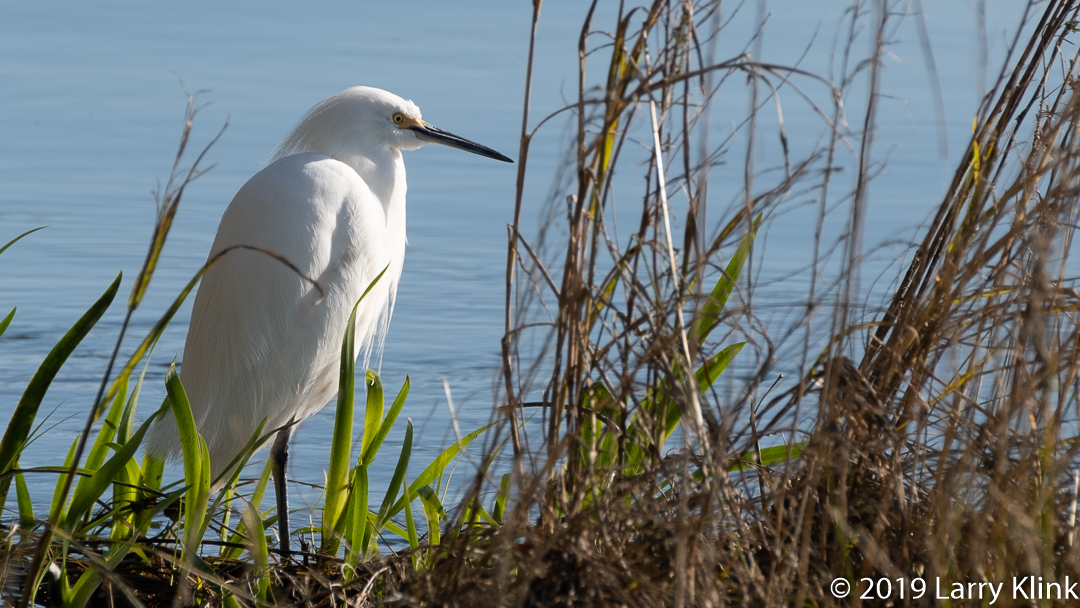
Snowy Egret (Egretta thula);
Effie Yeaw Nature Center, Carmichael, CA; MAR 2019

These and other images are available to purchase on my website: www.earthwatcher.us or by contacting larry.klink@earthwatcher.us

It Was a Dark and Stormy Day

To all of my followers, I just made a new post, It Was a Dark and Stormy Day, on my new page. Please follow the link to my new page and begin following me there.

New page link: www.earthwatcher.photo.blog

I will discontinue this page at the end of July.

Regards,

Earthwatcher (Larry)

New Images Posted

To all of my followers, I just made a new post, Bison at Yellowstone, on my new page: www.earthwatcher.photo.blog. Please follow the link to my new page and begin following me there.

I will discontinue this page at the end of July.

Regards,

Earthwatcher (Larry)

Bison At Yellowstone

Herd of Bison along the Lamar River;
Lamar Valley, Yellowstone National Park, WY; MAY 2019

Bison (Bison bison) are an iconic species at Yellowstone National Park. As many as there are and as often as I see them, I am still in awe of them. This trip was especially fun because of the large number of babies. They were standing, sleeping, scampering about; all the things babies do.

For the first few months of their life, the baby bison have a reddish colored coat; many people refer to them as red dogs. The adults were losing their winter coat, so patches of fur were missing or dangling on many of them. Others had a beautiful coat that appeared gold in the sun.

Please click on caption to see images at higher resolution.

Momma and Baby Bison (Bison bison);
Hayden Valley, Yellowstone National Park, WY; MAY 2019
Bison and Babies;
Lamar Valley, Yellowstone National Park, WY; MAY 2019 #Photography
Morning Discussion;
Lamar Valley, Yellowstone National Park, WY; MAY 2019
Momma and Baby Bison (Bison bison);
Hayden Valley, Yellowstone National Park, WY; MAY 2019

These and other images are available to purchase on my website: www.earthwatcher.us or by contacting larry.klink@earthwatcher.us.