I am a very analytical person. My creativity flows from my need to understand and explain. I made a career of distilling processes to their essence and reconstructing them to be more efficient and productive. My approach to photography is an extension of my life’s work. I distill a scene to identify its processes and actors. I try to understand how the processes, generally the forces of nature and the forces of humans, have and are interacting with the actors to create the scene. I focus on one or more of the actors and compose a scene that shares a moment with them in an aesthetically pleasing way.
Actors may be humans or wildlife. They also may be the sun, the moon, a tree, a river, mountain or other object. Each image shares a unique moment showing how its actors and processes have, are, and sometimes even will impact each other. But I also want to entice the audience to linger and to find their own story. I want them to imagine themselves experiencing the sights, the sounds and the feeling as if they were there.
Water-colored Aspen Great Basin National Park, NV, OCT 2015 .
While at Great Basin National Park, in early October, we were treated to a cold, windy day accompanied by sleet and thunder. The drive up to Wheeler Peak affords spectacular views of the surrounding valleys and mountain ranges. As we drove higher up the mountain, we hit the cloud layer. Aspens, in their gold fall foliage, stood as beacons in the misty fog.
Brightening the Gloom Great Basin National Park, NV, OCT 2015
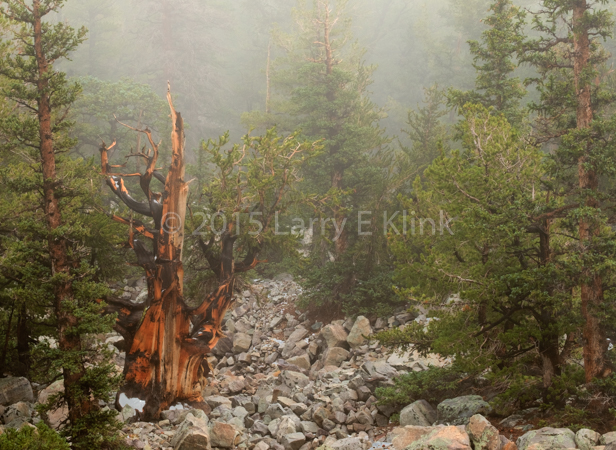
Our destination was the trailhead where we could hike to the bristlecone pine grove. We arrived at the trailhead, bundled up, and began our trek. The grove was about 1 ¾ miles away with a 1,200 foot elevation gain. The trail was rocky, interspersed with mud, snow and water puddles. We hiked past aspens and conifers. When there was a break in the clouds, we could see distant mountain slopes and sometimes Wheeler Peak itself. We made it to the bristlecone grove; it was absolutely worth the effort. I am in awe when I am in the presence of these trees that are thousands of years old.
Steadfast Bristlecone Pine Great Basin National Park, NV, OCT 2015
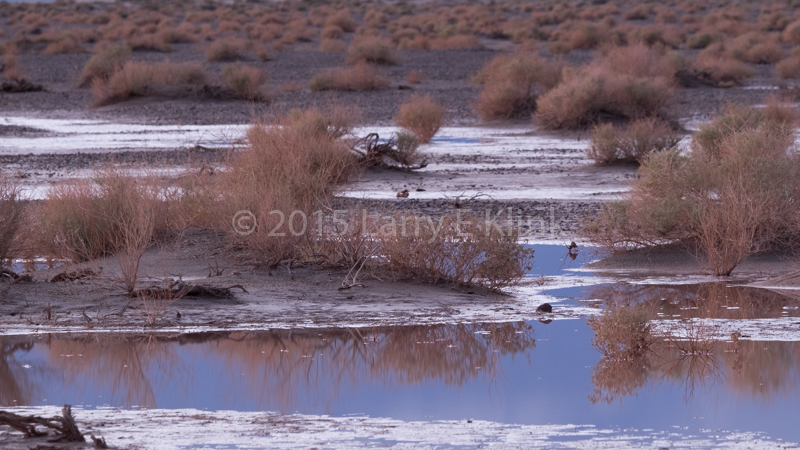
A playa with water was standing from the previous day’s storm. Death Valley, CA OCT 2015.
Death Valley is an amazing place. Especially for those of us who love the desert. In fact, the only thing missing is the sandworms. Donna and I visited Death Valley last week. We arrived the evening after a deluge – 0.5” of rain in a short period of time; slightly more than 20% of its annual rainfall. Water flowing from the box canyons washed debris over many of the roads closing most of the tourist spots.
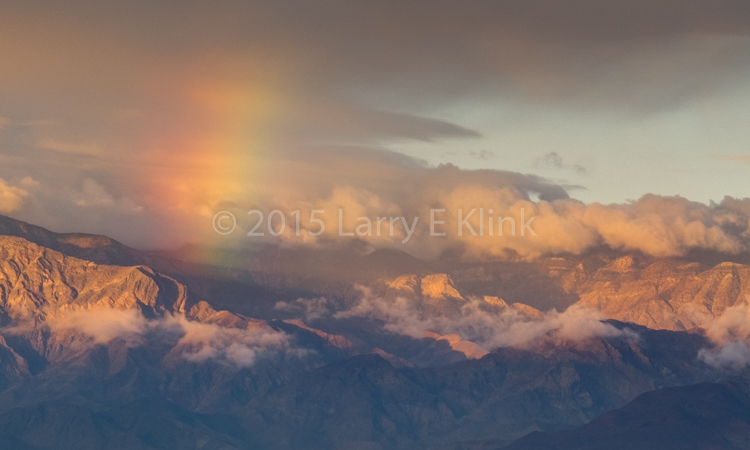
Sunrise over Zabriske Point complete with a marvelous rainbow. Death Valley, Zabriske Point, OCT 2015.
Water was left standing in some of the playas, lake beds where water flows in but not out; an unusual site for most visits. Fortunately, 2 of our favorite spots, Zabriske Point and Mesquite Dunes were accessible.
Zabriske Point is the go to place for a sunrise. The sun rises behind you and over your shoulder, casting an alpenglow onto the mountains on the far side of the valley. If you are lucky, there will be a few clouds over the far mountains and you can watch the sky turn from orange and magenta to gold and then white. It was Donna’s birthday. God was smiling upon her that day. The thick cloud cover from the previous day’s storm was breaking up. We got the beautiful color we had hoped for. But, in addition, we got a marvelous rainbow. It was an unforgettable moment.
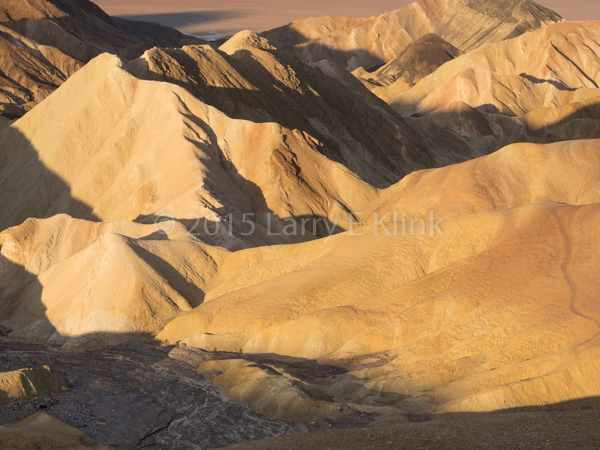
A sculptural landscape of muted earth tones with water standing in both the erosion channels and in the valley below. Zabriske Point, Death Valley, CA OCT 2015.
TV and movies give us a picture of the desert as hot, dry, sandy, flat; sometimes with sand dunes. But, much of the desert, in the Great Basin of the western US, is gravely, gray-brown, clay sediment deposited when run off from glaciers made the basins inland lakes and earlier when it was part of an inland sea. It was supplemented by run-off from the surrounding mountains. It is sparsely populated by vegetation, some fragrant and colorful. Zabriske Point is composed of sediments from Furnace Creek Lake, which dried up 5 million years ago. The sediment is painted by minerals and is heavily eroded by water washing down from the Black Mountains over untold millennia. This activity left behind a sculptural landscape, badlands, of muted earth tones. On this morning, after the storm, there was water was standing in both the erosion channels and in the normally dry playas in the valley below.
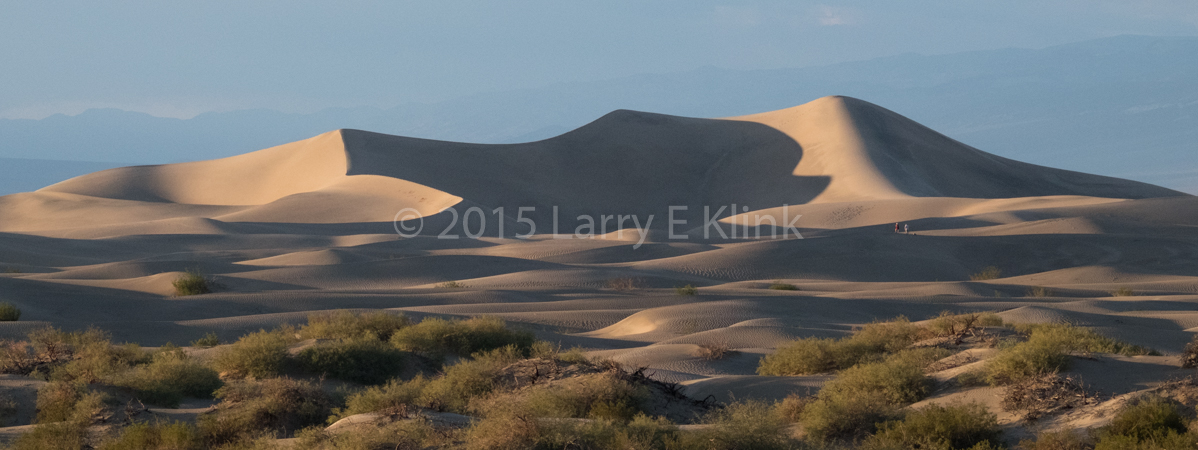
Mesquite Dunes, Death Valley, CA OCT 2015
I’ve photographed Mesquite Dunes at sunrise and sunset. Sunset seems to be the better time; especially later in the sunset when the wind carved dunes cast shadows that are deep and long. To me, the shapes created by the light and dark areas provide a texture reminiscent of a cubist painting by Picasso. It’s fun to watch the light play on the dunes as the sun sets. Shapes and textures change; color changes; all in ways that stimulate the imagination.
Shapes created by the light and dark areas provide a texture reminiscent of a cubist painting by Picasso. Mesquite Dunes, Death Valley, CA OCT 2015.
I hope you enjoy these images from our day in Death Valley. Please share them with your friends.
Mesquite Dunes, Death Valley, CA OCT 2015
Regards,
Larry
These and other images are available for sale by contacting me at larry@earthwatcehr.us or on my web site: www.earthwatcher.us.
Sometimes the light presents itself in such a way that it transforms a mundane setting into one that is stunning. That is what happened this evening. The setting sun cast a narrow beam of light that caught the fireplace in our family room, highlighting St. Francis looking upon the freesias. As I walked into the family room, I was stopped in my tracks by the beauty of the scene. I knew at once that I needed to capture and share it. I wish you could have been there with me to share the moment.
Last week, I was in Washington visiting my son and his family. It was a great week capped off with a camping trip on the Puget Sound. We camped at Sequim Bay, on the Olympic Peninsula, near the point where Puget Sound meets the Strait of Juan de Fuqua. It was a beautiful weekend and lots of fun. I took a few images and want to share 2 with you.
A Sunrise on Sequim Bay, Sequim Bay, WA (Click Image to View Larger Copy)
The first is A Sunrise on Sequim Bay. The sky was overcast on this early morning. Fog shrouded the mountains to the north and west. The water was smooth as glass except where gentle currents caused small ripples. The only sign of life were the few gulls beginning their hunt for breakfast. The sun found a few small breaks in the clouds which allowed it to highlight the sleeping vessels and parts of the shore. A confluence of events that provided a moment of peace and tranquility. Look at the image, close your eyes and imagine yourself there for a few minutes. I hope it will brighten your busy day.
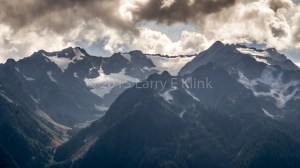
West Peak, Mt Olympus and Glacial Valleys, Hurricane Ridge National Park, WA (Click Image to View Larger Copy)
The second is West Peak, Mt Olympus and Glacial Valleys. This image was shot near the visitor center at Hurricane Ridge National Park in the Cascade National Forest. In this case, dramatic clouds obscured most of the sky. Breaks in the clouds allowed bright sunlight to dapple sections of Mount Olympus and the surrounding peaks, highlighting the glaciers and valleys below. I felt a longing while viewing this scene. My spirit wanted to hike up to that mountain valley and camp by the stream. I wanted to be near the base of the glacier; to see and touch the glacier before our changing climate devours it and drives it to extinction.
Aging & Rain: Rain falling on the decaying remains of the McDonald House, Bodie, CA. (Click to see larger image))Aging Door: Aging Door Highlighted by Rain. Cain residence, Bodie, CA. (Click to see larger image)
The California drought has garnered a lot of attention and it is bad. But, over the past few weeks, storms have driven some rain along the White-Inyo Mountains and the valleys east of the Sierra. So, Donna and I wanted to get a rare glimpse of a green desert landscape in July. Bodie did not disappoint. The desert vegetation was a beautiful spring green. The skies were overcast, covered with rain clouds. We were treated to light hail, cold, light rain and a few claps of thunder. I had hoped for some golden light to peer through breaks in the clouds, highlighting the landscape, but that did not materialize. The rain dampened the wood, saturating the colors and highlighting details of the decaying structures. Here are 2 examples. I hope you enjoy them.
On our recent trip back east, we made a stop in Savannah, GA. It was short, an evening and a morning. Savannah is an old city by US standards. Its historic district follows the borders laid out in 1733 by James Oglethorp. It is laid out in a grid with numerous small squares. Each square is like a little park with stately old trees, draped with Spanish Moss, giving shade to the sidewalks and park benches. Many of the buildings date back into the 18th and 19th century. There are so many photo opportunities, I could spend months, if not years trying to document it, if I chose. The buildings and statuary are beautiful in and of themselves. But, when you take the time to study them in detail, there are beautiful intricate features, many weathered to a fine patina. It is a great place. I recommend a visit. Enjoy the images below. Please share.
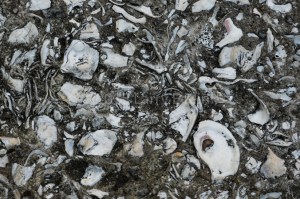
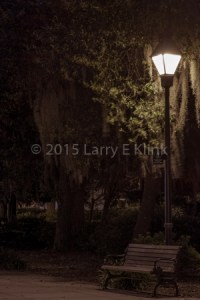
There is beautiful fountain in Lafayette Square. I don’t know its age, but it has the patina of weathered copper. The evening sun was kissing the sea horse, giving a warm glow to ts crusty, weathered body.You build with what you have. When you have sea shells, you don’t need rock in your concrete. The sea shells thrown in an apparently random fashion, worn smooth by years of footsteps, create an abstract scene worthy of a Gothic romance.As evening approached, a column of sunlight highlighted a series of high, steep, weathered stairs.The fountain in Forsythe Square was lit by the streetlights along the pathways in the square making the features glisten.A streetlight casts its light over Spanish moss and a lonely park bench in Forsythe Square.
I am hopelessly left-brained; analytic to the core. I understand that to truly appreciate a piece of art, one must make an emotional connection to it. I understand that art is often collected for its historical value or as an investment, but that doesn’t seem to be enough to allow love for it to grow. I’ve sought to understand how I, personally, create an emotional connection to a scene, how I identify the story I want to tell. I rarely feel the tug on my heart that I feel when I think of my wife, my children or my grandchildren. A mountain sunrise doesn’t bring tears to my eyes. Yet, I love the mountains, the desert, the clouds, how light plays with the texture of a scene. But my reaction is a different reaction; it’s that of an analytic. I look at a scene and marvel at the geologic and/or human forces that formed it. I see clouds and think about the uplift, downdrafts and other meteorological forces that shape them. Some may ask how that can evoke awe; doesn’t analysis ruin the mystery and sense of wonder. Piecing the puzzle together helps me see the processes that shaped the scene and are influencing it now. Understanding the complexity, how processes interact to create systems, how interacting systems create a scene, creates the sense of wonder in me. It provides my emotional link and evokes awe in me. It may not tug at my heart but it tugs at my intellect and helps to create the story I want to tell.
Rainbow Bridge, American River Parkway, Folsom, CA, JUN 2015 (Click to See Image Enlarged)
I regularly walk along various stretches of the American River Parkway trail system. It is a great place to get exercise and enjoy the beauty of an urban forest and riparian habitat. I rarely have my camera because, if I did, I’d never get exercise. But, I always have my phone.
On several of my blogs, I remind readers that it is the composition and lighting that make the image and not the camera. Especially with today’s smartphone cameras and their incredible software. But, I have a problem using my phone. I can’t hold it steady enough to lock in the composition and get the focus right. So, I invested in a walking stick/monopod/tripod by Manfroto and a bracket to hold my phone. Now, I can overcome my shakiness. I also carry a microfiber cloth to clean the lens – it can get grimy being carried around in purse, pocket or holster. Grimy lenses impact the clarity of the image.
I have the Samsung Galaxy S6 with its 16MP rear camera. It does a great job. You can use it as a point and shoot by using auto mode or you can put it in pro mode which allows you to manually control functions just like on a DSLR. I find manual selection of the focus point to be the most useful but wish it wasn’t tied to the auto exposure so I could control them separately.
The attached image was shot with my phone last week. I am very pleased with it. Enjoy and make the best of your photography.
Landscape photographers are taught that you should always try to shoot during the golden hours; roughly the 3 hours after sunrise and the three hours before sunset. Indeed, the warm saturated colors make very dramatic and beautiful vistas. But does that mean you pack away your camera the rest of the day? Not really. You can get great shots any time of day if you work with the compositional elements and lighting you have to craft a great composition. It is the composition that makes the image.
I took the image in Figure 2 on a clear day, at mid-day, when the sun was high. The composition is decent and interesting. You can see some texture in the canyon and the canyon itself leads your eye
Figure 2: Image Taken Under Uninteresting Light
through the image. So, it is a good image to show friends that have never been to Yosemite, what they would see; a travel photograph. But it’s not a great image. Contrast that with the image in Figure 3, taken from a similar perspective but with strong, dramatic lighting. The difference is obvious. Besides making the picture pop with color, the light leads your eye through the image to interesting features. It provides shadows that add texture. It makes the image much more interesting.
Figure 3: Image With Strong , Dramatic Light
So, its obvious: If you have great light, you can make better image. But, what if you can’t just run off and chase the light? You have to work with what you have when you are there.
Look again at figure 3 to see the enhancements the light is providing. It provides color, texture and controls the movement of the eye through the image. When you have light that is diffuse, you need to find other compositional elements to compensate for the missing light.
Figure 4: Image Taken Under Diffuse Light
Look at Figure 4. It was taken under cloudy skies, in the evening. It is, to me, a very interesting image. I like the composition. While the light is not available to provide the interest, look at how the grass and leaves provide texture that contrasts with the granite and the stream. The colors in the leaves add color that subtly pops the image. Even without strong light, there are shadows and highlights. The stream and the line of rocks lead the eye.
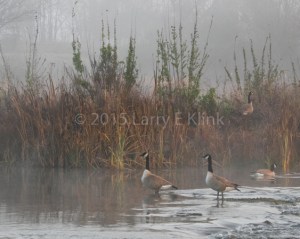
Figure 5 is an image taken under foggy conditions that also diffuse the light. In this case there is some subtle early morning rim light highlighting the edges. The color and texture in the reeds and bushes provide texture to offset the fog shrouded background and the stream.
Figure 5: Image Taken Under Low, Diffuse Light
The key is to look around; to see what is happening; to see what you can use; then craft your image from what you have.










 Earthwatcher