Golden Hued Yosemite

Warm Light Breaking Through Storm Clouds, Trail to Inspiration Point, Yosemite National Park, MAY 2015

This past week, it rained and snowed in the Sierra.  Not nearly enough to have any real impact on our drought.  But, as evening comes and the storm breaks up, golden sunlight streams through the breaks in the clouds, dappling the mountainsides with gold hued color.  I took advantage of the weather conditions this week and visited Yosemite for a quick overnight trip.  My goal was to do some exploring and to study how light can add depth to an image.  I did some research and learned that sun would be setting in a line that would illuminate half dome, clouds rest and the canyons below.  A perfect setting for what I wanted to do.  To satisfy the explorer in my blood, I went off the beaten path to get different perspectives with Half Dome as my anchor.

Early Evening Light Breaking Through Rain Clouds Over Yosemite Valley. Glacier Point, Yosemite National Park, MAY 2015

I hiked the trail toward Inspiration Point looking for a different perspective from the traditional view of Yosemite Valley from Tunnel View. The trail is 2.6 miles, round trip, with a 1,000 foot elevation gain.  Aside from being steep, it is full of rocks, many of which are loose, and many tree roots.  It’s not for the casual walker.  But, for those that are willing to endure, the view of the valley, especially Bridalveil Falls, is spectacular.

I also hiked a small section of the Panorama Trail; the portion from Glacier Point to the top of Illilouette Falls and back.  This piece is 4 miles round trip with a 1,470 foot elevation change.  Fortunately, most of trail is very well groomed.
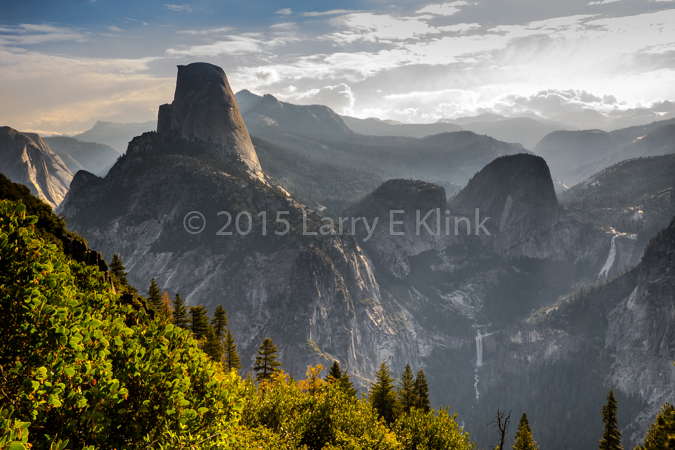
Morning Light Awakening Half Dome and Little Yosemite Valley, the Valley of the Merced River, Panorama Trail near Glacier Point, Yosemite National Park, CA MAY 2015

This portion of the Panorama trail provides a perspective of Half Dome from the back leading down to Little Yosemite Valley and Vernal and Nevada Falls.  Illilouette falls is a 370’ waterfall that is quite beautiful as seen from the Mist Trail.  But, you really cannot see the fall itself from the portion of the trail that I hiked; perhaps crossing the bridge may lead you to a spot where the falls are visible.  There is one spot where you can see the top of falls through the trees and another spot where it may be more visible if you stand right on the cliff edge.  Though you cannot see the fall itself, there is a beautiful cascade where the trail bridge crosses the river.  That, in and of itself, is worth the effort to go there.

Nice weather, nice light, spectacular scenery.  It was a great time.  I hope you enjoy the images.

Regards,

Larry

Sharing Natures Beauty

These and other images are available for purchase from my website, http://www.earthwatcher.us, or by contacting larry@earthwatcher.us.

My Experience with Social Media Marketing

Over the past 6 monLEK-Photo-Logo-20121015-4ths, I have been experimenting with social media marketing.  Some people do phenomenally well.  My experience hasn’t been so good.  I have had my website (www.earthwatcher.us) and my business page on Facebook (Earthwatcher) for several years.  I have 317 followers on Facebook but my posts reach only 100 – 150 viewers.  Over the past month, I’ve had over 400 visits to my website.  But that number is misleading – mostly phishing by web crawlers that drop off after opening the home page.  I have an email mailing list of 60+ recipients.  I’ve opened sites on Twitter (@EarthwatcherPho), Pinterest (Earthwatcher), Instagram (Earthwatcherphoto) and a blog site on WordPress (EarthwatcherPhoto).

Like traditional marketing, social media marketing is a tool to spread information about the product you have to sell and to spread it to as large an audience as possible.  All with the hope that some of them will like and buy your product.  Traditional marketing, TV and Radio Ads, Newspaper Ads, flyers in the mail, etc. pushes your ad to prospective buyers with the hope they will respond by purchasing and also will tell their friends who, in turn will do the same.  I.e. it is a means of networking.  Social media marketing is exactly the same approach but with a different means of delivery.  Unlike traditional delivery methods, the internet gives us the ability to reach unprecedented numbers of potential buyers.

We’ve all heard of YouTube videos  or Twitter Tweets that ”go viral”.  Going viral is the internet version of a fast moving gossip chain.  People share the news with friends who share with other friends and so on.  The key to successful social media marketing is to create that gossip chain; have followers who will share your posts and encourage others to do so.  That is the point where I struggle.  I get views but few shares.  I also find that most of my followers are friends, family and other photographers.  I appreciate them all but they aren’t buyers.

I know that the answer is both deceptively simple and incredibly hard.  You need a product that people want to buy and you have to find the people who want to buy it.  Having good keywords, words that people will use when searching for a product, in your product description, is a very important ingredient.  That helps you with search engines.  But search engines also use the amount of activity, i.e. the number of searches, to position you in the results list.  So, without activity, i.e. shares, you most likely end up hundreds of pages down the list.  Following others, sharing their work, is important also.  Helping others link to potential buyers by sharing encourages them to help you.

I certainly haven’t solved this problem.  But, I keep trying.

Life in the Shadow of a Volcano

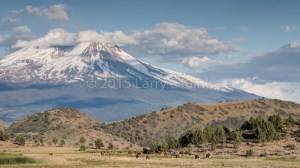
Mt Shasta - Perspective 1, MAY 2015
Mt Shasta, MAY 2015

Mt Shasta, topping off at 14,167 feet, appears as a huge monolith rising out of the countryside as you travel through far North Central California.  It is a stratovolcano; a large cone made of layers of different material ejected during its eruptions.  Should Mt Shasta erupt, it will create severe natural as well as economic impact.  According to Stephen L. Harris, in Fire Mountains of the West, during the last 10,000 years, Mt Shasta has erupted, on average, once every 600-800 years.  But, its pace has accelerated to once every 200-300 years in recent centuries.   Its last significant eruption was 200 years ago.  There are no signs of imminent activity.

Mt Shasta - Perspective 2,  MAY 2015
Mt Shasta, MAY 2015

Volcanoes can be quite disruptive.  When we think of volcanoes, we see images of ash plumes, mudslides, lahars and other natural impacts.  If you happen to be there when in erupts, it will change your life.   But, their periods of activity represent only a very small fraction of their life.  During periods of inactivity, the water from their snow melt brings moisture to the lands below.  Additionally, water and wind erode the mountain side, spreading nourishing minerals to the land below.  If you travel through Eastern Washington, Oregon and California, you see the benefits in places where the rich land has been put to use for agricultural purposes.

I hope you enjoy these images of Mt Shasta.  As you do, pause to think about all we derive from this gentle giant who, only infrequently, explodes and creates havoc.

Regards,

Larry

You can see and purchase these and other images from Larry Klink at http://www.earthwatcher.us or by contacting larry@earthwatcher.us.

Wild Irises

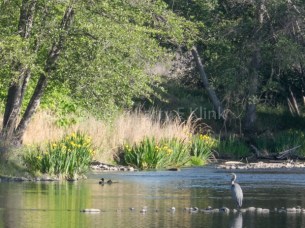
Peaceful Morning on the American RIver
Peaceful Morning on the American River. Wm Pond Park, American River Parkway, Sacramento, CA, APR 2015 (Click on image to enlarge)
Wm Pond Park, American River Parkway, Sacramento, CA, APR 2015
Irises on the Bank. Wm Pond Park, American River Parkway, Sacramento, CA, APR 2015 (Click on image to enlarge)

As often as I have walked along the banks of the American River, at William Pond Park, I never realized that much of the vegetation I saw was wild irises.  But, imagine if you will, clumps of the brilliant yellow blossoms outlining both sides of the shore for perhaps a half mile or so, complimenting the lupine and other wildflowers.    Though there are some wild irises that are native to northern California, I haven’t been able to find if this particular species is or is not and even if it is, whether they are native to the banks of the American River.  Regardless, they provide a real treat.

Regards

Larry

These and other images are available at my website http://www.earthwatcher.us or by contacting me at larry@earthwatcher.us

A Ghostly Memory

Bodie, CA AUG 2014
A Ghostly Memory, Bodie CA, AUG 2014.
Click on image to see larger, higher resolution image.

A column of sunlight illuminates the dim kitchen as evening arrives.  The cooking and baking is done.  The kids have been fed.  The table is set.  All is ready for the master of the house to return from his day’s work.   A typical day in Bodie during the late 1800’s and early 1900’s?  Probably.  But now, the counter cleaned and the table prepared goes unused.  They are covered with a thick layer of dust reminiscent of the flour once mixed in the bowl and baked in the tin.  A ghostly memory of a kitchen filled with voices:  laughter, worry, love, turmoil.   How was your day?  Is one of the kids outgrowing his shoes?  Do we have enough food to put up for the winter?   Long ago abandoned, this kitchen, this house, sits as a snapshot, a moment in time representative of joy and struggles of lives once lived.

Larry

This and other images are available for sale at my website: www.earthwatcher.us of by contacting me directly at larry@earthwatcher.us.

The Fingerling Stream

A Small Tributary from Eagle Falls, Lake Tahoe.

The Fingerling Stream

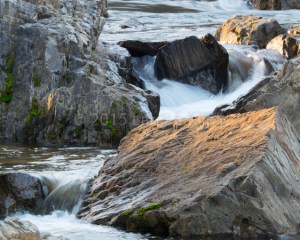
A few weeks ago, Donna and I spent a balmy Saturday exploring the Emerald Bay area of Lake Tahoe.  One of the features of Emerald Bay is Eagle Falls.  Eagle Falls is a big, beautiful waterfall; well worth the hike to see.  But I was more intrigued by a small fingerling stream at its base.  The early rays of sun illuminated the miniature canyon through which it flowed.  Its miniature boulders created whitewater as the stream flowed over a waterfall into a deeper canyon.  All the while, Eagle Falls rumbled in the background adding ambiance to the miniature world it helped create.  I love to see ecosystems that replicate the grandiose in miniature.  I think about how every stream and river started as a trickle and eroded their way into mountainside, plateau and delta, forming the spectacular scenery we see and appreciate.   But, the next time you are at a grand vista, look for the small, hidden, treats also.  They are often as worthy of appreciation.

Regards

Larry

Images displayed on this page, and many others can be viewed and purchased on my website:http://www.earthwatcher.us or by contacting me directly.

A Brief Explanation of Noise

20140816-Bodie-053-Edit-WEB
Night Sky, Bodie CA

Here is a brief explanation about why you get noise on some images, particularly on night shots with long exposures.

Noise is an extraneous electrical signal that is picked up by your camera’s sensor which translates into a pattern of color and graininess on your image.  Look at the image above, you’ll see specs and small streaks of magenta against the dark sky; this is the most common symptom of noise.  Heat is the primary culprit that generates the extraneous electrical signal.

Heat is generated in one of 2 ways: high ISO settings and long exposures.  The pixels on your camera sensor are very tiny.   The longer you hold the shutter open, the more electricity gets fed to your sensor which causes heat to build up in your sensor.   Increasing ISO is like turning up the volume on your radio.  When you turn up the volume on your radio, you are amplifying or increasing the strength of the signal to your speakers by pumping in more electricity.  Likewise, when you increase ISO, you are increasing the strength of the signal to your camera’s sensor.  The more electricity you feed it, the more the heat builds up and the more extraneous electric signals are picked up.

Each camera model has different noise characteristics.  Camera manufacturers are always trying to improve their noise reduction.  But, noise is a reality of digital cameras.  If you are planning to photograph night shots, experiment with your camera ahead of time to find your best noise performance so you can judge how to set up your camera when you are shooting for real.

Software such as Photo Ninja, Photoshop and Adobe Lightroom have ways to reduce noise.  They work well but need to be used in moderation.  As you apply more noise reduction the more you loose sharpness in your finished image.

A Playful Moment in the Life of Water

A Playful Moment in the Life of Water -Perspective 1
A Playful Moment in the Life of Water – Perspective 1
A Playful Moment in the Life of Water – Perspective 2

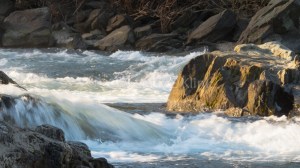
A river; water molecules traveling in unison; herded by rock and dirt; their progress blocked but not deterred.  They flow until captured and stored; until they drift apart, their individual courses changed to serve the purposes of nature, or of human civilization.  But here, in unrestricted freedom, they frolic, they crash, they splash and foam.  Basking in early morning light, they appear to enjoy the moment unperturbed; as if they know they can play now, before they must get to work.  They will do their part then some day will be reunited in the vast ocean, carried into the sky, and begin the journey anew.  Such is the life of water.Regards,

Larry

Images displayed on this page, and many others can be viewed and purchased on my website: http://www.earthwatcher.us or by contacting me directly.

Website Activity and Junk Mail

I’ve often marveled at the fact that I get 6K-10K visits to my website each month (www.earthwatcher.us). I’ve also suspected that much of that traffic is from web crawlers. If you aren’t aware of web crawlers, they are programs that constantly search the internet to glean information they can use for various purposes. Sites like Google and Bing use them to populate their search engines with web sites with which they can link keywords to speed their search results. I’ve recently begun using Google Analytics to analyze the traffic to my site. This week was a slow week because I haven’t posted any new images. So, it was a good week to examine the traffic. Interestingly, about 80% of my traffic originated in Russia. Every one of those visits hit my homepage then dropped off; they didn’t look at images. They hit my site daily looking for something. I get more than 100 junk emails every day, many from hot young Russian women looking for love. I suspect these searches are how they found my email address so they can provide me with so many opportunities. I’ll be analyzing my traffic further. Maybe I can find some other interesting tidbits to share.

Regards

Larry

All images posted on this site, my website, http://www.earthwatcher.us, and other sites are available for sale by contacting me at larry@earthwatcher.us or directly through my website.

Keywords

You are looking for an image of Half Dome at Yosemite.  You use a search engine like Google or Bing or even Pinterest.  You key “Half Dome image” for your search and up pops a search result with hundreds, if not thousands, of images for you to view.   You may not be aware that you just asked your search engine to go through its database to find websites that have the key words Half Dome and image embedded then display them in the search results.  Search engines employ web crawlers, sometimes referred to as bots, which continuously move through the internet hitting web site after web site finding and cataloging key words and linking those keywords to the site so that search results are quickly displayed.  So, as you can see, having some well-crafted keywords in your website is very important.

So, how do you craft keywords to be useful?  You need to make them specific.  This morning, a search on Yosemite yielded 52.6 million results, Half Dome yielded 5.7 million results and half dome images yielded 7.5 million results.    When I narrowed my search to Half Dome images sunset, it whittled the list to 270,000 results.  If you are posting a sunset image of Half Dome, those words should be used as keywords.  If you are posting a watercolor, you need to say that too.   If it is location specific, it also helps to tag your image with a location.  Another important consideration is phrasing,  Here you try to guess what someone might enter as a search request and create keywords that are phrases; something like “Half Dome images”.  So you might use this set of keywords: Half Dome, Half Dome images, Half Dome sunset, Half Dome sunset images, sunset images.  The list needs to be accurate and meaningful.

Are keywords going to bring you to the top of the search results?  No!  What industry experts call Search Engine Optimization or SEO, is a mysterious technology that is closely guarded by each search provider.  Many people claim to be experts at SEO but what I have read is that no one has really cracked the code.  Still, keywords are still important.  They are the method that gets you on the search result list.  After getting your keywords in order, find some big name celebrity like Jennifer Lopez to recommend your site to her followers so you can trend and get to the top of the results.

Good luck with keywords.

Larry